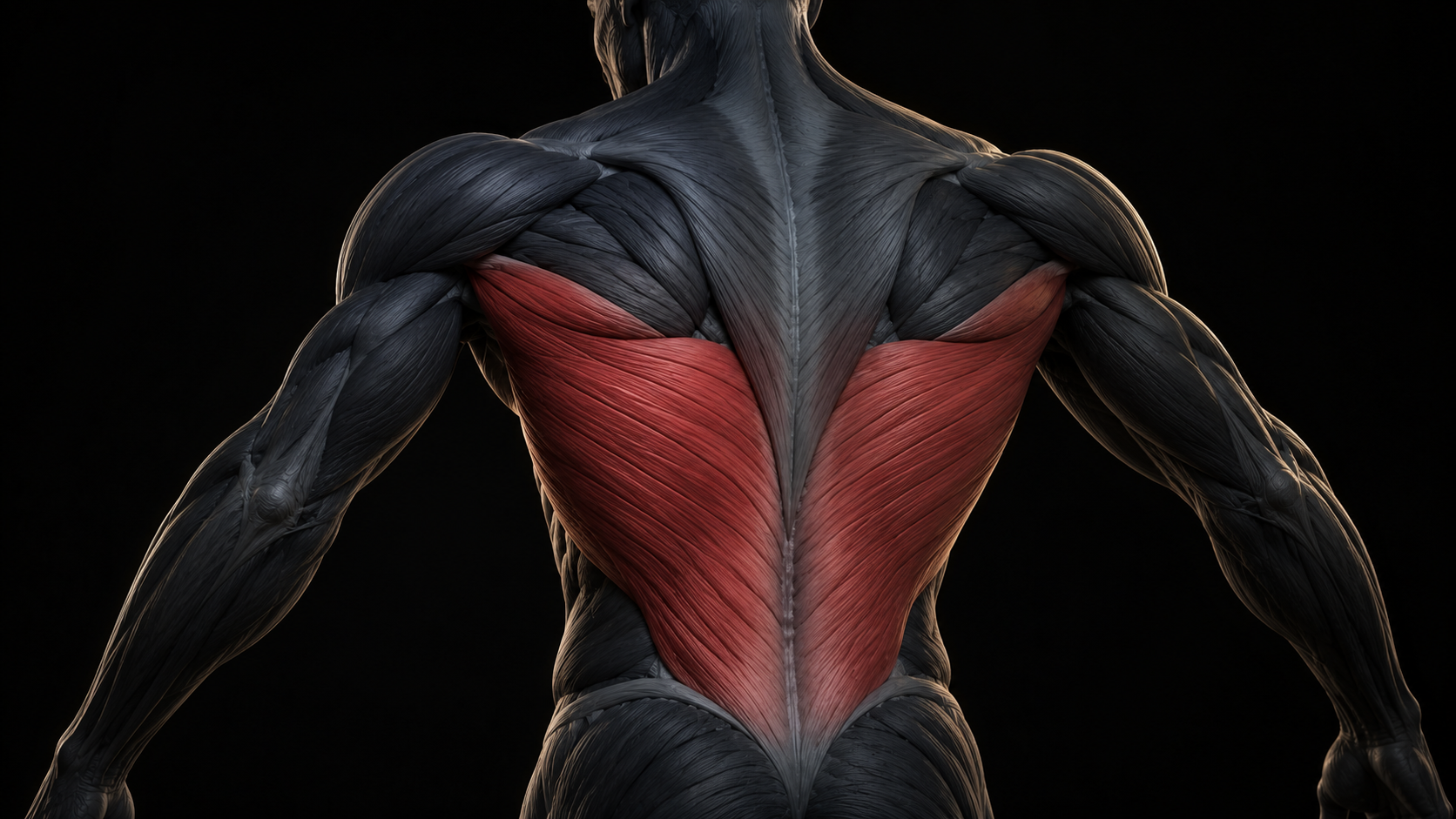
Back training fails in a predictable way. Someone picks two rows and a pull-down, pulls hard, feels their biceps and the tops of their shoulders, and cannot work out why the middle of their back stays flat and overhead pressing still pinches.
The problem is that “back” is not a muscle group in any useful sense. It is one large muscle that moves the arm from the pelvis, three separate sheets of trapezius pulling in three different directions, a pair of retractors that rotate the shoulder blade the wrong way for overhead work, and a column of spinal muscles built for endurance rather than force. They do not share a line of pull, so they cannot share an exercise.
Start with what each one does and exercise selection stops being a matter of taste.
The Muscles and What They Actually Do
Latissimus dorsi — the trunk-to-arm cable
The lat is the broadest muscle in the body and the only one that runs from the pelvis to the upper arm.
| Feature | Detail |
|---|---|
| Origin | Spinous processes of T7–L5, thoracolumbar fascia, iliac crest, inferior 3–4 ribs |
| Insertion | Floor of the intertubercular groove of the humerus (medial lip) |
| Innervation | Thoracodorsal nerve (C6–C8) |
| Actions | Shoulder extension, adduction, medial rotation |
Two features matter for training. It shares its insertion with the teres major and pectoralis major — all three converge on the intertubercular groove, which is why they fire together. And its origin on the thoracolumbar fascia ties it to the pelvis, so it transmits force between the lower body and the arm during anything explosive.
Because it spans two joints in a functional sense, where the arm sits determines how much of the muscle is available.
| Arm position | Lat length | Exercises that live here |
|---|---|---|
| Overhead, fully flexed | Maximally lengthened | Pull-up, lat pull-down, cable pull-over |
| At the side, neutral | Mid-range | Rows of every description |
| Behind the body, extended | Shortened | Stiff-arm pull-down, the finish of a row |
Full-range pulling matters more here than in most muscles, because half the available range sits above the head — and that is exactly the half people abandon first when the weight goes up.
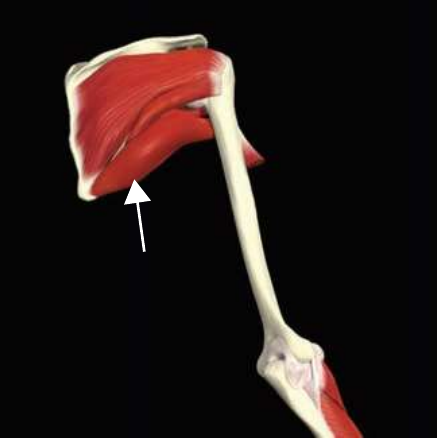
Teres major — the lat’s shadow
Same insertion, same three actions, different origin: the inferior angle of the scapula rather than the spine. It is not part of the rotator cuff — that is the teres minor, a different muscle with the opposite rotational action.
You cannot isolate the teres major, and no exercise claim to the contrary is testable in a gym. Narrow-grip pulling and pull-over movements load it hard alongside the lat, and that is as specific as the anatomy allows.
Trapezius — three muscles wearing one name
| Part | Fibre direction | Primary actions |
|---|---|---|
| Upper (descending) | Superomedial to inferolateral | Scapular elevation, upward rotation, neck extension and lateral flexion |
| Middle (transverse) | Horizontal | Scapular retraction |
| Lower (ascending) | Inferomedial to superolateral | Scapular depression, upward rotation |
The upper trapezius is the part everybody has been told to release. That advice deserves more scepticism than it gets: what feels tight is often a muscle held long and loaded for hours by a forward head and a depressed shoulder girdle — fatigue rather than overactivity. Genuine upper trap dominance shows up as visible shrugging when the arm elevates, and plenty of people show the opposite pattern. This is a defensible reading rather than settled consensus, so treat it as a reason to check before assuming.
The middle trapezius is the pure retractor. It is commonly weak in anyone who sits, and easy to miss in training because the upper fibres will happily do the job by elevating instead.
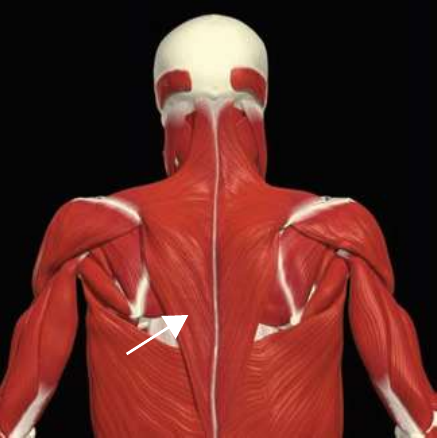
The lower trapezius matters most for shoulder health and gets trained least. It depresses and upwardly rotates the scapula, and without upward rotation the acromion does not clear the humeral head as the arm goes overhead. Someone who cannot press overhead without shrugging usually has a lower trapezius that is not contributing.
The upward rotation triangle
| Muscle | Contribution to upward rotation |
|---|---|
| Upper trapezius | Elevates and rotates the lateral scapula |
| Lower trapezius | Depresses and rotates the medial scapula |
| Serratus anterior | Protracts and rotates, holding the scapula against the ribcage |
Serratus anterior sits on the front of the ribcage but belongs in any back discussion, because it is the only muscle that can protract and upwardly rotate at the same time. Lose it and the medial border of the shoulder blade lifts away from the ribs.
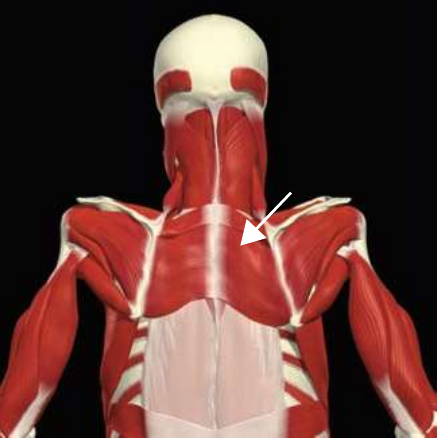
Rhomboids — retraction with a catch
| Feature | Rhomboids | Middle trapezius |
|---|---|---|
| Retraction | Yes | Yes |
| Elevation of medial border | Yes | Minimal |
| Downward rotation | Yes | No |
| Upward rotation | No | Assists |
That downward rotation is the practical point. The rhomboids oppose the scapular position overhead work requires. Someone who rows constantly and never presses or reaches overhead — climbers and rowers are the usual example — can end up with retraction strength that fights their own overhead range. The answer is not less rowing; it is adding overhead and serratus work alongside it.
One honesty note: the rhomboids lie deep to the trapezius and share their main action with it. Any programme claiming to target the rhomboids specifically is describing an intention, not a measurable outcome.
Levator scapulae, erector spinae, multifidus
Levator scapulae runs from the transverse processes of C1–C4 to the superior medial border of the scapula. It elevates and downwardly rotates the scapula, side-bends the neck and assists neck extension. It is one of the more reliably shortened muscles in desk-bound populations, and it responds better to a stretch — head turned 45 degrees away, then flexed towards the opposite armpit — than to anything you can load.
Erector spinae is three columns, not one muscle.
| Column | Position | What it adds |
|---|---|---|
| Spinalis | Most medial | Smallest and least distinct; trained by anything that extends the spine |
| Longissimus | Middle | Thickest and longest; the capitis portion reaches the skull, so it extends the head too |
| Iliocostalis | Most lateral | Primary lateral flexor; most active under one-sided load such as a suitcase carry |
The whole group is Type I dominant — built for hours of postural work rather than peak force. That is why your back holds you upright all day without complaint and still becomes the limiting factor on a heavy pull.
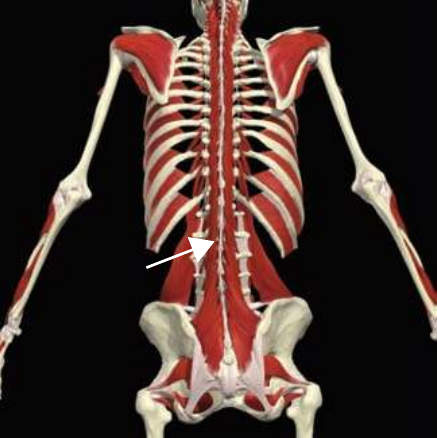
Multifidus fills the groove between the transverse and spinous processes with 23 short fascicles, each spanning two to four segments. Its deep fibres are anticipatory: fine-wire EMG work by Hodges and Richardson found them firing roughly 30–50 milliseconds before limb movement, stiffening the spine ahead of the load rather than reacting to it. That timing is delayed or absent in people with chronic low back pain.
What follows from that is less certain than it is usually made to sound. Motor control exercise — bird dogs, dead bugs, controlled breathing work — reliably beats doing nothing for low back pain, but trials comparing it against other forms of exercise generally find no clear advantage. It is worth including. It is not the missing key, and nobody should sell it as one.
Muscle-Specific Exercises (Anatomy and Form Explained)
The organising principle for the back is elbow path. Where the elbow travels relative to the torso decides which muscle works, far more than which grip is on the bar.
1. Pull-up or lat pull-down — the lat in its longest position
What it targets and why: full overhead reach puts the latissimus dorsi and teres major at maximum length, and the pull is mostly shoulder adduction with some extension. This is the only pattern that loads the top half of the lat’s range.
Setup and execution: grip roughly 1.5 times shoulder width. On a pull-down, set the knee pads so your heels stay planted — on your toes, the hips lift every rep. Lift the chest into thoracic extension, depress the shoulder blades, then drive the elbows down and slightly in, about 10 to 15 degrees forward when viewed from above. Resist the way up and let the arms straighten fully.
The nuance most people miss: grip width is oversold. The claim that a wide grip builds “width” and a close grip builds “thickness” is not well supported — EMG comparisons across grip widths are inconsistent and the differences small. Elbow path is the variable worth controlling.
| Grip and elbow path | What it shifts | How confident |
|---|---|---|
| Medium overhand, elbows 10–15° forward | Adduction — lats plus middle trapezius | Good, mechanically clear |
| Neutral or supinated, elbows driven down | More shoulder extension, more biceps | Good |
| Wide overhand, chasing “width” | Claimed lat width | Weak — not supported by direct comparison |
Common error → fix: using the whole torso. Rocking turns a pull-down into a badly executed inverted row. If you want to cheat the concentric in order to overload the eccentric, do it deliberately and control the way up; otherwise keep the trunk still.
2. Chest-supported row — the mid-range workhorse
What it targets and why: lats through mid-range plus middle trapezius and rhomboids, depending on elbow path. The pad matters more than it appears to: on a free-standing barbell row, a large share of the effort goes to the glutes, erectors and calves keeping you upright, and that tension never reaches the target.
Setup and execution: chest flat on the pad, no arching to steal range. Pull the elbows back towards the hips for a lat bias, or flare them to 45–90 degrees to shift load onto the middle trapezius and rhomboids. Let the shoulder blades protract fully at the bottom of each rep.
The nuance most people miss: those two elbow paths are effectively different exercises, and most programmes only use one. If every row you do pulls elbows to hips, your middle trapezius is under-trained however many sets you accumulate.
Common error → fix: shrugging at the top. Cue “blades together and down” — the upper trapezius takes over the instant the movement runs out of usable range.
3. Cable lat pull-over — extension without the arms
What it targets and why: shoulder extension with the elbows nearly locked, which removes the elbow flexors as the limiting factor. The lat and teres major do the work through a long stretch.
Setup and execution: high pulley, hinge forward as the arms rise to deepen the stretch, then drive the elbows down and towards the hips with the arms staying long.
The nuance most people miss: the long head of the triceps also crosses the shoulder and extends it, so the “pure lat isolation” framing is generous. This movement is usually recommended on the grounds that the lengthened position is the most productive part of the range. That idea has real supporting evidence but remains an active argument, so pick the exercise because it loads a range nothing else does, not because stretch is magic.
Common error → fix: the elbows creep into flexion and it becomes a triceps push-down. Fix the elbow angle before the set starts and treat any change in it as a failed rep.
4. Seated or chest-supported face pull — the middle back
What it targets and why: horizontal abduction plus external rotation, loading the middle trapezius and rhomboids while the infraspinatus and teres minor handle the rotation.
Setup and execution: rope set slightly above chest height, pull towards the face, finish with the thumbs travelling backwards. Let the shoulder blades separate fully on the way out.
The nuance most people miss: standing face pulls lose a meaningful share of their tension to simply not being pulled forward. Performing them seated, or lying prone on a bench, removes the balance demand and lets you actually load the movement.
Common error → fix: the shoulders ride up towards the ears. Drop the weight until the blades can travel together and down without the neck joining in.
5. Prone or cable Y-raise — the lower trapezius
What it targets and why: arms at roughly 30 degrees from overhead in a Y, lifted by depressing and upwardly rotating the scapula. That is precisely the lower trapezius’s job, and almost nothing else in a normal programme asks for it.
Setup and execution: thumbs up, reach long, think “up and away” rather than “lift”. Two to five pounds is the honest working load.
The nuance most people miss: this is motor control work, not strength work. If it feels heavy, it is heavy, and something larger has taken the job over.
Common error → fix: the lower back arches to manufacture range the shoulder blade refused to give. Brace the trunk and reduce the height of the lift.
6. Back extension and Romanian deadlift — the spinal columns
What it targets and why: the erector spinae, in two different modes. A 45-degree back extension takes the spine through active extension against gravity. A Romanian deadlift loads the erectors isometrically — they hold position against a forward-pulling load rather than moving through range.
Setup and execution: on the back extension, pad at the hip crease, lower until you feel a hamstring stretch without rounding, then extend and stop at neutral. On the RDL, soft knees, hips back, bar close to the legs. Cue “keep the back flat”, not “extend the back”.
The nuance most people miss: these two are not interchangeable, and neither is the deadlift. The conventional deadlift is an excellent strength lift and a mediocre back-hypertrophy exercise — it barely stretches the lats or middle back, and the load you add over months usually reflects stronger hips rather than a bigger back.
Common error → fix: hyperextending at the top of the back extension to chase a squeeze. Stop at neutral; the extra range adds compression, not stimulus.
7. Shrug and loaded carry — upper trapezius and levator scapulae
What it targets and why: pure scapular elevation, with the levator scapulae assisting.
Setup and execution: straight arms, elevate towards the ears, hold for a second at the top, lower under control. No rolling.
The nuance most people miss: a shrug trains the upper trapezius in elevation only, and the upper trapezius’s other job is upward rotation. Overhead carries cover that second role, and belong in the programme alongside shrugs rather than instead of them.
Common error → fix: elbows bending, turning the lift into a partial upright row. Straight arms, or a lighter weight.
Progressing it
| Exercise type | Progression | Why |
|---|---|---|
| Pull-ups, rows, RDL | Linear — add load weekly in the 5–10 rep range | Compound, tolerates increments |
| Pull-overs, face pulls, shrugs | Double progression — add reps first, then load | Isolation work runs out of loadability quickly |
| Y-raises, dead bugs, bird dogs | Add control and time under tension, not weight | Motor control, not strength |
Around sixteen working sets a week, split across two sessions, covers all of it. Adding another day beats adding more sets to one day.
Warm-Up for Back
Eight to ten minutes, structured as RAMP — Raise, Activate, Mobilise, Potentiate. Systematic review evidence suggests 5–10 minutes at moderate intensity is sufficient for the performance benefit; longer warm-ups do not perform better, they simply cost time and freshness.
| Phase | Time | What to do | Why |
|---|---|---|---|
| Raise | 2–3 min | Rowing machine, brisk incline walk, easy skipping | Raises muscle temperature and blood flow |
| Activate | 3 min | Band pull-apart 2×15 · prone or standing Y-raise 2×12 · dead bug or bird dog 2×6 per side | Brings the middle and lower trapezius and the deep spinal stabilisers online before load |
| Mobilise | 2 min | Cat-cow, seated thoracic rotation, overhead lat stretch on a rack, two or three unloaded hip hinges | Prepares thoracic extension and overhead reach — the two ranges the session will demand |
| Potentiate | 2–3 min | Ramping sets on the first lift: ~40% × 8, ~60% × 5, ~80% × 3 | Bridges the gap to working weight |
Two points worth being straight about.
The Activate phase is not injury prevention. There is no good evidence that band pull-aparts or bird dogs before a session reduce the odds of hurting your back, and anyone selling them on that basis is over-reading the literature. What the phase does do is rehearse the pattern and the range you are about to load, and get the small scapular muscles contributing before the large ones dictate position. That goal stands on its own without an injury claim propping it up.
Second, keep static stretching short here. Long holds — beyond roughly a minute per muscle — produce a small, temporary drop in force output. Brief holds of 15 to 30 seconds inside a warm-up that also contains movement cost you nothing meaningful. If a stiff lat is genuinely limiting your overhead reach, stretch it, then move through that new range before you load it.
Cool-Down for Back
Three to five minutes, and deliberately shorter than the warm-up.
What it does not do. Static stretching after training does not meaningfully reduce delayed onset muscle soreness, does not restore range of motion faster, and does not speed strength recovery compared with simply stopping and resting. This has been tested repeatedly, and the effects are close to nothing. Stretching sold as a soreness cure is a claim the research does not support.
What it is actually for. It brings heart rate and breathing down in a controlled way rather than abruptly. It gives you a warm window in which mobility work is more comfortable — genuinely useful if the goal is to gain range, as opposed to recover. And it marks the end of the session, which does more for consistency than most people admit.
A workable version:
- 1–2 minutes of easy walking or light rowing
- Overhead lat stretch on a rack or upright, 30 seconds each side
- Levator scapulae stretch — head turned 45 degrees away, then flexed towards the opposite armpit, 30 seconds each side
- Slow cat-cow, 60 seconds
- 60 seconds of unhurried nasal breathing
If you want to do more mobility work than that, do it. Just be clear that you are training range of motion, not accelerating recovery.
Putting It Together
One session covering every major back muscle:
| Order | Exercise | Sets × reps | Purpose |
|---|---|---|---|
| 1 | RAMP warm-up | 8–10 min | Scapular and spinal stabilisers online first |
| 2 | Weighted pull-up or lat pull-down | 3 × 6–10 | Lat and teres major, lengthened |
| 3 | Chest-supported row, elbows to hips | 3 × 8–10 | Lat mid-range, high tension, no balance tax |
| 4 | Seated face pull | 3 × 12–15 | Middle trapezius and rhomboids |
| 5 | Cable Y-raise | 2 × 12–15 | Lower trapezius, light and controlled |
| 6 | 45° back extension | 3 × 12–15 | Erector spinae through range |
| 7 | Dumbbell shrug | 2 × 10–12 | Upper trapezius and levator scapulae |
| 8 | Cool-down | 3–5 min | Downshift |
Repeat two to four days later with the vertical and horizontal pulls swapped for different variations, rather than stacking more sets onto this day.
Key Takeaways
- Elbow path decides the target, not grip width. Elbows to the hips loads the lats; elbows flared loads the middle trapezius and rhomboids.
- The lower trapezius is the most neglected muscle in the group and the one that keeps overhead work comfortable. Two to five pounds, done properly, beats heavy and sloppy.
- The rhomboids downwardly rotate the scapula. Rowing without overhead work builds retraction strength that fights your own overhead range.
- The deadlift is a strength lift, not a back-hypertrophy exercise. Keep it for what it is good at.
- Warm up for 8–10 minutes, cool down for 3–5. The asymmetry is deliberate: warm-ups have measurable performance effects, post-session stretching does not reduce soreness.