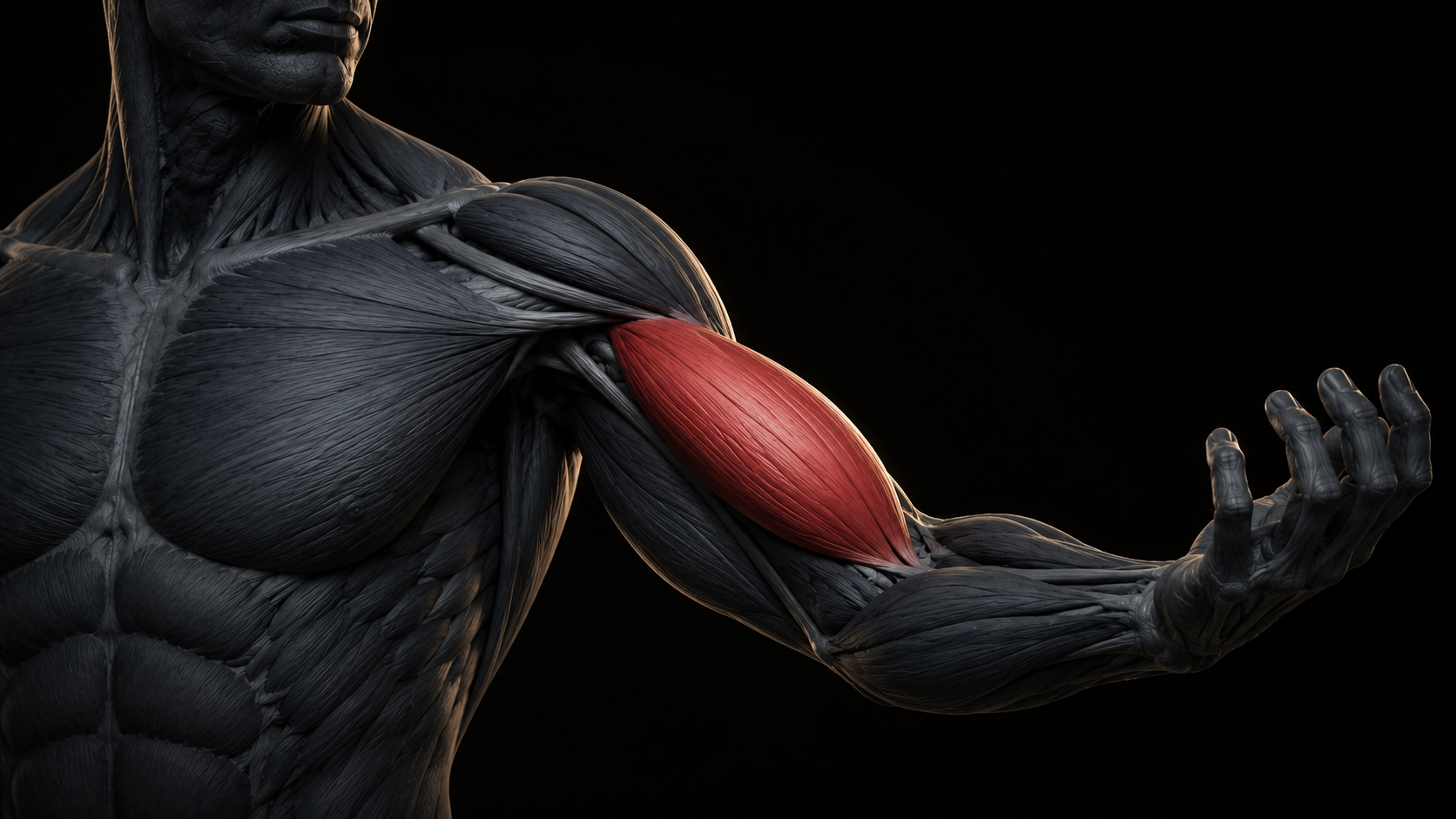
The biceps is the most trained and least understood muscle in the upper body. Almost everyone curls. Very few people can say what the muscle actually does, and that gap is why arm training stalls.
Two facts reorganise everything. The biceps brachii is a powerful supinator and only a secondary elbow flexor — the brachialis underneath it is the primary flexor, and it works regardless of which way your palm faces. And because both biceps heads cross the shoulder as well as the elbow, where your upper arm sits relative to your torso changes which head is loaded before you have moved a single rep.
Get those two right and curl selection stops being a matter of taste. You are no longer picking exercises off a list; you are choosing arm positions and grips that put a specific muscle under tension at a specific length.
The Muscles and What They Actually Do
Biceps brachii — two heads, one belly, two joints
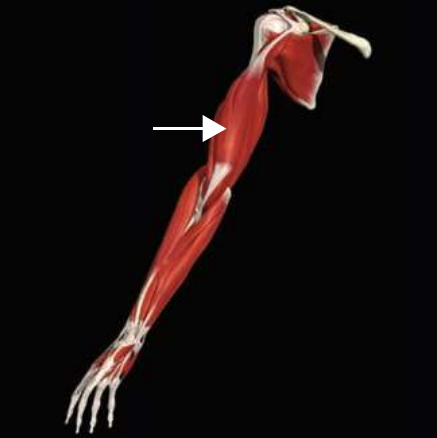
| Head | Origin | Insertion |
|---|---|---|
| Long head | Supraglenoid tubercle of the scapula | Radial tuberosity + bicipital aponeurosis |
| Short head | Coracoid process of the scapula | Radial tuberosity + bicipital aponeurosis |
Both heads originate on the scapula, not the humerus. That single detail is the reason arm position matters so much: the muscle crosses the shoulder joint on its way to the elbow, so moving your upper arm behind or in front of your torso lengthens or shortens the muscle before the curl begins.
The long head is the more interesting of the two. Its tendon runs up over the head of the humerus, through the shoulder joint capsule, and down the intertubercular groove. That intra-articular path is why long head biceps tendon pain so often presents as a shoulder problem rather than an arm problem. The short head takes a simpler route from the coracoid process down the inside of the arm.
Both are supplied by the musculocutaneous nerve (C5–C6).
Three functions, in order of how strong the muscle is at each
| Function | Strength | Practical note |
|---|---|---|
| Supination (turning the palm up) | Strongest | Most powerful with the elbow flexed to roughly 90° |
| Elbow flexion | Secondary | Contributes, but is not the prime mover |
| Shoulder flexion | Weak assist | Enough to matter for positioning, not enough to train deliberately |
This ordering surprises people. The muscle everyone trains for elbow flexion is better at rotating the forearm than bending it. Try it yourself: hold your arm at 90° and slowly rotate the palm from down to up, and you will feel the belly harden without the elbow angle changing at all.
Brachialis — the actual prime mover
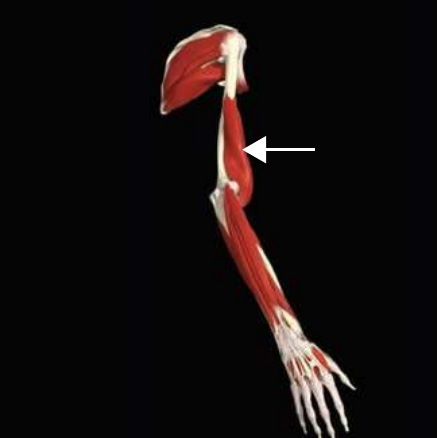
Origin: distal half of the anterior humerus. Insertion: coronoid process and tuberosity of the ulna. Innervation: musculocutaneous nerve, with a small radial nerve contribution.
The brachialis has exactly one job — flex the elbow — and it does it regardless of forearm position, because it inserts on the ulna rather than the radius. The radius rotates during supination and pronation; the ulna does not. So while the biceps loses mechanical advantage as you pronate, the brachialis does not care.
It is also large. Its cross-sectional area is comparable to both biceps heads combined, and it sits directly underneath them. When it grows it pushes the biceps up and out, which changes the shape of the arm from the side more than any amount of curling changes it from the front.
Brachioradialis and supinator — the forearm’s contribution
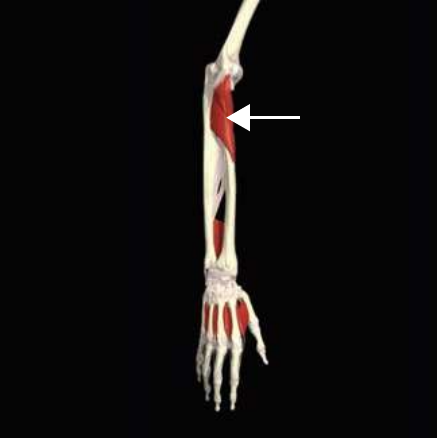
The brachioradialis belongs anatomically to the posterior forearm compartment but functions as an elbow flexor, and it is at its strongest with the forearm in neutral. It does not cross the wrist, which has a blunt training implication: wrist curls will not grow it. Hammer curls and reverse curls will.
The supinator is a deep muscle wrapping the proximal radius. It supinates independently of elbow angle, which is why it does the work when your arm is straight while the biceps takes over as the elbow bends. This is also the reason a reverse curl feels weak — you are asking the brachioradialis and brachialis to lift a load in a position where the biceps has been mechanically sidelined.
Putting the flexors side by side
| Muscle | Strongest grip position | Crosses shoulder? | Crosses wrist? | What it does for arm size |
|---|---|---|---|---|
| Biceps brachii | Supinated (palm up) | Yes | No | Front-on mass and length |
| Brachialis | Any — grip-independent | No | No | Width from the side; lifts the biceps |
| Brachioradialis | Neutral (thumb up) | No | No | Upper forearm thickness |
| Supinator | n/a — rotation only | No | No | Negligible; functional |
Arm position decides the head
| Upper arm position | Long head | Short head | Typical exercise |
|---|---|---|---|
| Behind the torso | Stretched, biased | Less involved | Face-away cable curl, incline curl |
| Beside the torso | Neutral | Neutral | Standing barbell or dumbbell curl |
| In front of the torso | Slackened | Biased | Preacher curl, spider curl |
An honest word about the “peak”
The height of a flexed biceps is mostly a function of muscle belly length and tendon length, and those are not trainable. A short belly with long tendons will never look like a long belly with short tendons, however hard either is trained.
The common claim that hammer curls “build the peak” by growing the brachialis underneath is anatomically plausible — a bigger muscle beneath does have to displace the one above it. But there is no direct evidence that this changes the visible shape of a flexed arm, and the people who make the claim most often are also the ones who admit there is no hard science behind it. Train the brachialis because it is a large muscle that contributes real arm size, not because it will reshape your genetics.
Muscle-Specific Exercises (Anatomy and Form Explained)
The organising principle: grip decides the muscle, arm position decides the head. Everything below follows from that.
1. Preacher curl at 45° — the best all-round biceps builder
What it targets and why. With the upper arm angled forward on the pad, the long head is slackened at the shoulder and the short head takes a larger share. More importantly, the 45° pad produces high tension while the muscle is still at a long length — the resistance is hardest near the bottom of the range rather than at the midpoint.
Setup and execution. Set the pad so your armpits sit against the top edge with no gap. Lower to just short of full elbow extension, then curl to a hard squeeze. The pad removes any possibility of swinging, which is most of its value.
The nuance most people miss. An eight-week trial comparing preacher curls with incline curls found the two grew different regions of the muscle: the preacher curl produced more growth at the distal end of the elbow flexors, the incline curl more at the proximal end. Neither exercise won. The likely mechanism is that the preacher’s peak torque arrives early in the range and drives brachialis growth, while the incline curl lengthens the biceps across the shoulder and biases the upper portion. The practical reading is not “pick the better curl” but run both, which is exactly what this post’s sample session does. That is also why the vertical-armed Scott curl is a downgrade rather than a variation — a vertical upper arm removes tension at the bottom entirely.
Common error → fix. Letting a gap open between the armpit and the top of the pad, which converts it into a standing curl with extra steps. Slide down until the pad is genuinely supporting the upper arm, and drop the weight if that means dropping it.
2. Face-away (Bayesian) cable curl — the long head exercise
What it targets and why. Facing away from the stack puts the upper arm behind the torso, which lengthens the long head across the shoulder joint before the elbow moves. Cable tension is then even through the whole range, with no dead spot at the bottom.
Setup and execution. Pulley at roughly hand height. Step one or two paces forward, let the arms trail behind you, and curl both simultaneously. If you only have a single stack, do one arm at a time.
The nuance most people miss. Cable height is the whole exercise. You want the cable and your forearm to form something near a right angle at the point where the biceps is most stretched, because that is where tension is highest. Too high and the bottom goes slack; too low and you are fighting the stack sideways.
Common error → fix. The elbows creep forward as the set gets hard, which quietly returns the arm to the standing-curl position and removes the entire point. Fix it by reducing load and thinking about keeping the elbows behind the ribcage.
3. Incline dumbbell curl — useful, but not what it is sold as
What it targets and why. Reclining to 45–60° lets the arms hang behind the torso, producing the largest long head stretch of any common curl.
The nuance most people miss. The stretch is real; the tension in that stretched position is close to zero, because a dumbbell hanging straight down produces no moment at the elbow. That is exactly why the preacher curl beat it in the comparison above. Keep it as an accessible, fast-to-set-up long head option — not as your only one.
Common error → fix. Cutting the bottom of the range short, which removes the only advantage the exercise has. Let the arms hang fully before each rep.
4. Hammer curl — the brachialis and brachioradialis lift
What it targets and why. A neutral grip takes the biceps out of supination, so it loses mechanical advantage while the brachialis — which is grip-independent — carries a larger share. The brachioradialis is also near its strongest position here.
Setup and execution. Thumbs up, elbows pinned to the ribs, curl straight up without letting the wrist rotate. Control the lowering deliberately.
The nuance most people miss. Bracing this against a preacher pad substantially improves it, for the same reason it improves the supinated curl: you get tension at a longer muscle length and no cheating. A hammer-grip preacher curl is one of the better arm exercises almost nobody does.
Common error → fix. Two things go wrong. First, the wrist drifts into supination near the top, converting it back into a normal curl. Second — and worth naming — a hammer curl is often described as “not a biceps exercise”. That overstates it. The biceps still flexes the elbow; the neutral grip simply shifts emphasis toward the brachialis and brachioradialis.
5. Reverse curl (EZ-bar) — the brachioradialis and wrist extensors
What it targets and why. A pronated grip removes the biceps’ supination advantage almost entirely and loads the brachioradialis, brachialis and the wrist extensors that have to hold the bar level.
Setup and execution. Pronated grip on the angled part of an EZ-bar, elbows pinned. Let the bar roll toward the fingertips at the bottom for a full forearm stretch, curl to a full contraction.
The nuance most people miss. You will be far weaker here than on a supinated curl, and that is correct rather than a problem. Loading it like a barbell curl produces wrist pain and nothing else. This also happens to be the only common curl variation that trains the extensor side of the forearm, which is worth having if your grip work is otherwise all flexion.
Common error → fix. Wrists collapsing into extension under load. Reduce the weight and keep the knuckles roughly in line with the forearm.
6. Dumbbell curl with supination (or the Zottman)
What it targets and why. The biceps’ strongest function is supination, and a fixed-grip curl never trains it dynamically. Starting neutral and rotating to palm-up as you curl loads flexion and supination together.
Setup and execution. Neutral at the bottom, rotate progressively so the palm faces up at the top. The cue that works is to drive through the little finger, which produces supination without conscious wrist effort. The Zottman variant curls up supinated and lowers pronated, giving the biceps the lifting phase and the brachioradialis the lowering phase.
The nuance most people miss. Be honest about the evidence here: there is no trial showing that adding rotation grows the biceps more than curling with a fixed supinated grip. The rationale is sound — you are training the muscle’s strongest action through its range — but it is a rationale, not a finding.
Common error → fix. Rotating at the wrist rather than the forearm. The rotation should come from the radius turning over the ulna, felt at the elbow, not from twisting the hand.
What to skip, and why
| Exercise | Verdict | Reason |
|---|---|---|
| Drag curl | Redundant | As the elbow shortens the muscle, the shoulder lengthens it — total muscle length barely changes across the range |
| Spider curl | Overrated | Arm fully forward means the biceps never reaches a long length under load |
| Waiter curl | Skip | Awkward plate position, wrist strain, and a hard ceiling on loading |
| Scott (vertical) curl | Downgrade | A preacher curl with the bottom-range tension removed |
| Chin-ups for biceps | Keep, but not as your biceps work | Real elbow flexion range, but the back is usually the limiting factor |
Progressing arm work
| Exercise type | Progression method | Why |
|---|---|---|
| Heavy EZ-bar or preacher curl | Linear — small increments at 6–8 reps | Tolerates load increases for a while |
| Cable and dumbbell isolation | Double progression — fix a rep range, add reps first, then load | The smallest available increment is often a 10% jump on a curl |
Double progression matters more on arms than anywhere else, because a 2.5 kg increase on a 15 kg curl is a 17% jump. Fix a range — say 10 to 12 — add a rep per week until you hit the top, then add the smallest increment available and restart at ten.
Warm-Up for Biceps
Eight to ten minutes, structured as RAMP — Raise, Activate, Mobilise, Potentiate. The evidence here is consistent and slightly deflating: roughly 5–10 minutes at moderate intensity is sufficient to get the performance benefit, and longer warm-ups do not perform better. Past that point you are just accumulating fatigue.
| Phase | Time | What to do | Why |
|---|---|---|---|
| Raise | 2 min | Rowing machine, arm swings, or band pull-aparts | Raises muscle and tendon temperature; general, not arm-specific |
| Activate | 2 min | Band curls 2 × 20 · band pronation/supination 2 × 15 each way | Wakes the flexors and the supinator through their rotational range |
| Mobilise | 2 min | Controlled elbow flexion/extension through full range · wrist circles · gentle shoulder extension reach | Prepares the end ranges the session will actually demand |
| Potentiate | 3–4 min | Ramping sets on your first curl: empty bar × 12, ~50% × 8, ~75% × 4 | Bridges the gap to working load and rehearses the movement path |
The Potentiate phase carries most of the weight here, and there is a specific mechanical reason. Video analysis of distal biceps tendon ruptures found they occur overwhelmingly with the elbow near full extension and the forearm supinated under an eccentric load. That is a precise description of the bottom of a heavy supinated curl. Ramping sets let the tendon see that position under progressively increasing load rather than meeting a working weight cold.
Two honest caveats. First, none of this has been tested specifically for biceps training — the warm-up literature is dominated by lower-limb and whole-body protocols, and the elbow-specific recommendations are extrapolation from mechanism rather than trial evidence. Second, if the biceps session follows a back or chest session, most of the Raise phase is already done and you can go almost straight to ramping sets.
Cool-Down for Biceps
Three to five minutes. Shorter than the warm-up, deliberately.
What it does not do. Static stretching after training does not meaningfully reduce delayed onset muscle soreness, does not restore range of motion faster, and does not accelerate strength recovery compared with simply stopping. This is one of the better-settled questions in the field, and arm training is where the myth is most persistent, because biceps soreness after a heavy eccentric session is so noticeable. Stretching will not shorten it.
What it is actually for. Bringing heart rate and breathing down gradually. Giving you a warm window in which mobility work is more comfortable, if gaining range is a goal in its own right. And marking a clear end to the session, which does more for consistency than most people will admit.
A reasonable biceps cool-down:
- 1–2 minutes of easy walking or light cycling
- Gentle wrist flexor and extensor stretch, 20 seconds each — mostly for comfort after heavy grip work
- Doorway biceps stretch, arm extended behind you, 20–30 seconds each side, taken nowhere near end range
- 60 seconds of slow nasal breathing
Keep the biceps stretch conservative. Extended elbow plus supination plus load is the exact position associated with distal tendon injury, and there is no upside to aggressively stretching a tendon you have just fatigued.
Putting It Together
One arm-focused session using everything above:
| Order | Exercise | Sets × reps | Purpose |
|---|---|---|---|
| 1 | RAMP warm-up | 8–10 min | Temperature, then ramping sets into the first curl |
| 2 | Preacher curl (45°, EZ-bar) | 3 × 8–10 | High tension at a long length; short head bias |
| 3 | Face-away cable curl | 3 × 10–12 | Long head stretched, even tension |
| 4 | Hammer curl (preacher-braced if available) | 3 × 10–12 | Brachialis and brachioradialis |
| 5 | Reverse EZ-bar curl | 2 × 12–15 | Brachioradialis and wrist extensors |
| 6 | Cool-down | 3–5 min | Downshift |
Eleven working sets. If you want more weekly volume, add a second lighter session two or three days later rather than adding sets here — the biceps recovers quickly and responds well to a second exposure.
Key Takeaways
- The biceps is a strong supinator and a secondary elbow flexor. The brachialis is the prime mover, and it works with any grip.
- Both biceps heads cross the shoulder, so upper arm position selects the head: behind the torso for the long head, in front for the short head.
- High tension at a long length beats a big stretch with no tension — this is why the preacher curl outperformed the incline curl on distal growth.
- Hammer and reverse curls train the brachialis and brachioradialis, which add real arm size from the side. The “peak” claim attached to them is plausible but unevidenced.
- Warm up 8–10 minutes with RAMP and use ramping sets — the bottom of a heavy supinated curl is the position where distal tendons fail.
- Cool down 3–5 minutes. It will not reduce your soreness, and nothing else will either.