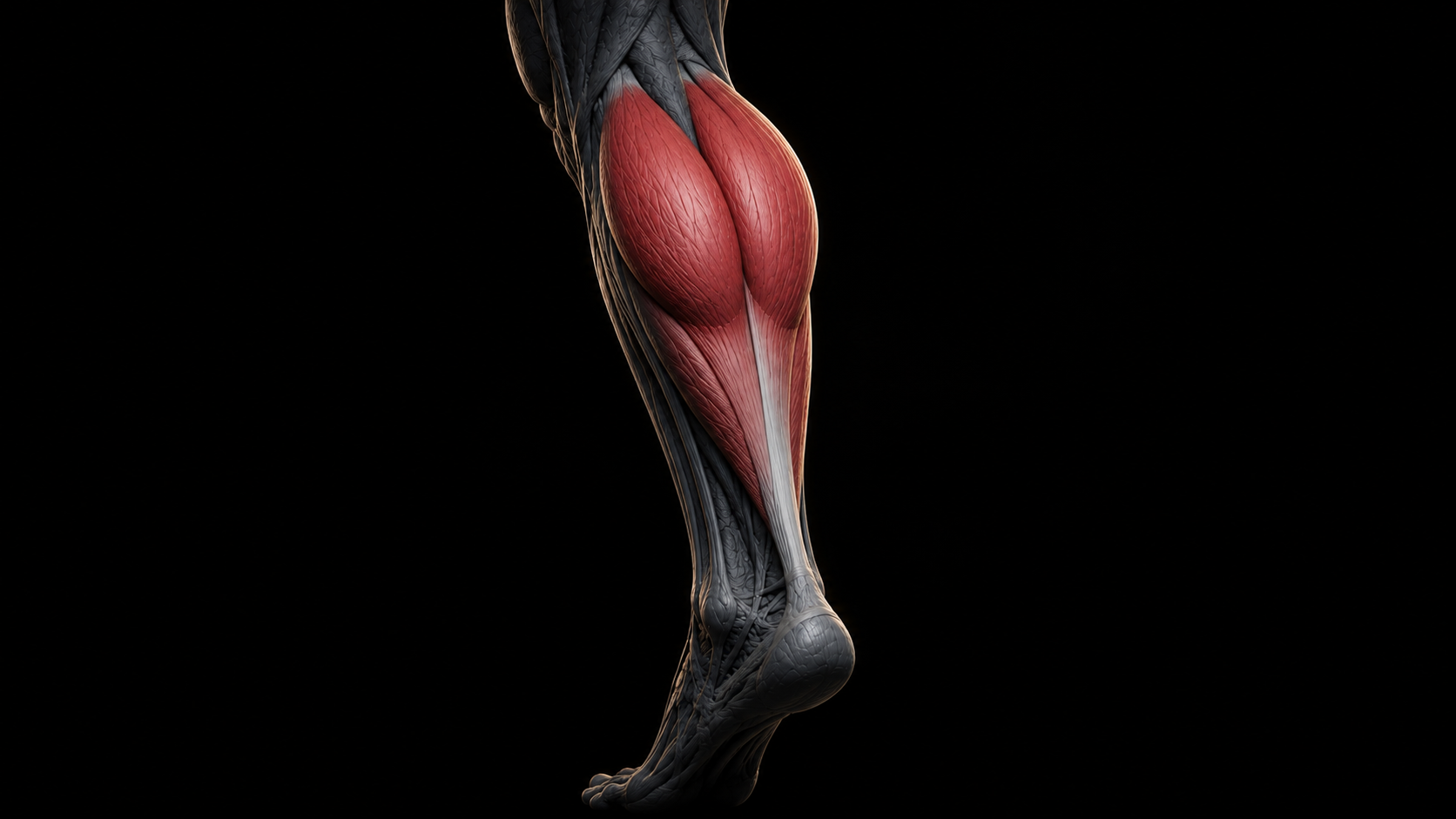
Calves have a reputation for being untrainable. Some of that is genuine — tendon length and muscle-belly insertion height are largely inherited, and no programme changes where your Achilles ends. Most of it, though, is a training problem dressed up as a genetics problem.
The lower leg is not one muscle. It is two plantarflexors with different origins, different fibre compositions and different optimal knee angles, sitting alongside a group of smaller muscles that control the foot in every plane and get trained by almost nobody. The single decision that determines which of the two big ones you are loading is where your knee is, and most people make that decision by accident.
Get the anatomy straight and calf training stops being mysterious. It becomes a short list of exercises, done through a full range, often enough to matter.
The Muscles and What They Actually Do
The triceps surae
The bulge you can see is the triceps surae — three muscle heads sharing one tendon. The gastrocnemius contributes two of them, the soleus the third. All three converge into the calcaneal (Achilles) tendon and insert on the calcaneus.
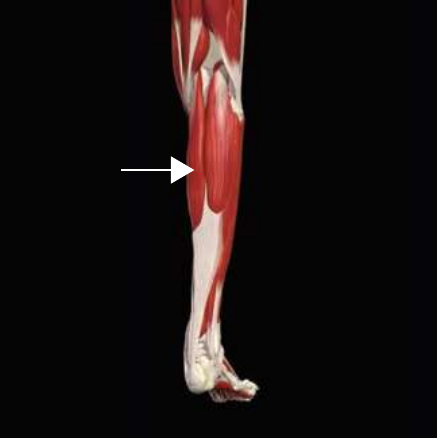
| Muscle | Heads | Origin | Insertion | Crosses knee? | Primary function |
|---|---|---|---|---|---|
| Gastrocnemius | Medial, lateral | Medial and lateral condyles of the femur | Calcaneus via the Achilles tendon | Yes | Plantarflexion + knee flexion |
| Soleus | — | Posterior tibia and fibula (soleal line) | Calcaneus via the Achilles tendon | No | Plantarflexion |
| Plantaris | — | Lateral supracondylar line of the femur | Calcaneus, medial to the Achilles | Yes | Negligible; largely vestigial |
Plantaris is worth one sentence and no more. It is a thin muscle with a long thin tendon, absent in a meaningful minority of people, and it contributes almost nothing to force. The calf injury commonly blamed on it — so-called tennis leg — is usually a tear at the medial gastrocnemius muscle–tendon junction rather than a plantaris rupture.
The knee angle rule
This is the whole of calf training in one idea.
| Knee position | Gastrocnemius | Soleus | Consequence |
|---|---|---|---|
| Extended (standing) | Lengthened across the knee, able to produce high force at the ankle | Working normally | Gastrocnemius is the primary plantarflexor |
| Flexed ~90° (seated) | Shortened across the knee, force capacity drops sharply | Working normally | Soleus becomes the primary plantarflexor |
Because the gastrocnemius crosses two joints, bending the knee brings its origin and insertion closer together and puts it into active insufficiency — it simply cannot generate much tension from there. The soleus, crossing only the ankle, does not care what the knee is doing. This is why standing and seated calf raises are not variations of the same exercise. They are two different exercises for two different muscles.
The soleus is the bigger muscle
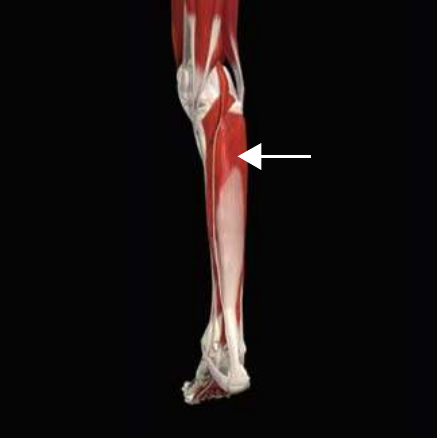
Most people train the visible one and neglect the large one underneath it.
| Parameter | Gastrocnemius | Soleus |
|---|---|---|
| Volume | ~180 cm³ (medial head) | ~425 cm³ |
| Physiological cross-sectional area | Moderate | Largest in the lower limb |
| Type I (slow-twitch) fibres | ~57% | ~80% mean, with a reported range of roughly 64–100% |
| Fatigue resistance | Moderate | High — higher capillary density |
| Responds best to | Heavier load, moderate reps | Moderate load, higher reps, longer sets |
Two honest caveats. First, fibre-type percentages vary enormously between individuals, which is why the soleus range above is so wide — treat “high reps for soleus” as a sensible default rather than a rule derived from your own biopsy. Second, the popular claim that a slow-twitch muscle must be trained with high reps is weaker than it sounds; fibre composition shifts the optimum, it does not create a hard boundary. If a heavy set of eight on the seated calf raise takes you to genuine failure, it is still productive work.
You may also have seen the “soleus push-up” — a seated heel-raise protocol reported to raise fat oxidation and improve blood glucose handling for hours. That work comes from a small laboratory study and has not been independently replicated at the time of writing. Plausible mechanism, thin evidence base.
The two gastrocnemius heads
The medial head is larger and more prominent than the lateral. A long-standing gym claim is that turning the toes in biases the medial head and turning them out biases the lateral. The EMG evidence for this is genuinely mixed, and the effect, where it appears, is small. Treat foot rotation as speculative. Straight-ahead feet through a full range will build both heads; nothing is being left on the table.
Everything below the ankle
Plantarflexion is only one of the things the lower leg does. Three smaller muscles control the foot in the other planes, and they are the ones implicated in most ankle problems.
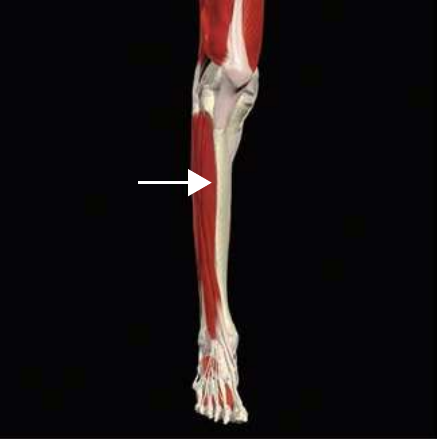
| Muscle | Compartment | Origin | Insertion | Actions | Why it matters |
|---|---|---|---|---|---|
| Tibialis anterior | Anterior | Lateral condyle and upper two-thirds of the lateral tibia | Medial cuneiform, base of the first metatarsal | Dorsiflexion, inversion | Clears the foot in the swing phase of running; weakness is associated with shin splints and, in the extreme, foot drop |
| Tibialis posterior | Deep posterior | Posterior tibia, fibula, interosseous membrane | Navicular tuberosity, spreading to the cuneiforms and metatarsal bases | Plantarflexion, inversion | The main dynamic support of the medial longitudinal arch; dysfunction is the usual cause of adult acquired flatfoot |
| Fibularis (peroneus) longus | Lateral | Head and upper lateral fibula | Crosses the sole to the medial cuneiform and first metatarsal base | Eversion, plantarflexion | Presses the first ray into the ground and resists the inversion sprain mechanism |
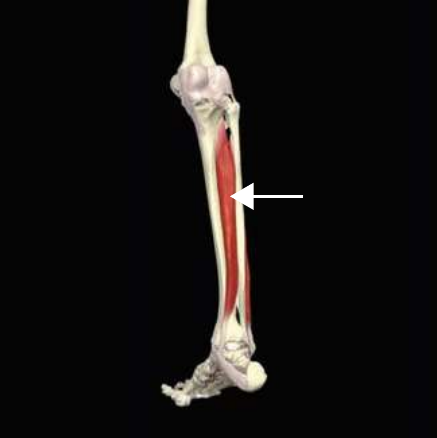
Note what tibialis posterior and fibularis longus have in common: both cross under the foot and insert near the first metatarsal, pulling from opposite sides. Together they form a stirrup that holds the arch and controls the subtalar joint. That is why single-leg work on an unrestricted foot trains them for free, and why every ankle exercise done seated on a machine trains them not at all.
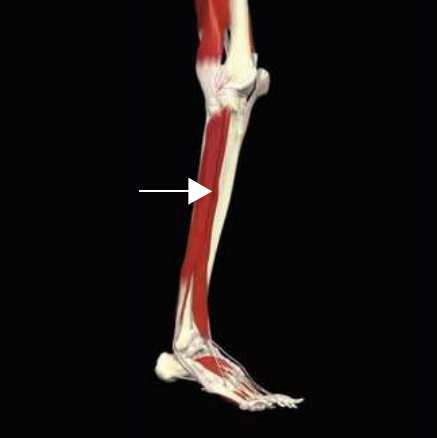
The tendon, not just the muscle
The Achilles is the strongest tendon in the body and routinely handles forces in the region of six times body weight during hopping and running. It also stores and returns elastic energy — the calf complex is as much a spring as an engine. Two implications: heavy, slow calf work builds tendon stiffness and cross-sectional area alongside muscle, and tendon tissue adapts more slowly than muscle does. If you add jumping or sprinting to a programme, add it gradually. The muscle will be ready before the tendon is.
Muscle-Specific Exercises (Anatomy and Form Explained)
The organising principle: knee angle selects the muscle, and range of motion determines whether the set was worth doing.
Standing calf raise — the gastrocnemius builder
What it targets and why. Knee extended means the gastrocnemius is at length across the knee and can produce force at the ankle. It is the only common exercise that loads the gastrocnemius properly.
Setup and execution. Balls of the feet on a raised block or the machine platform, heels unsupported. Knees straight but not locked hard. Lower under control until you feel a deep stretch through the calf, pause for a beat at the bottom, then drive up to the balls of the feet and hold the top for a count.
The nuance most people miss. A 12-week study using magnetic resonance imaging compared standing and seated calf-raise training in the same participants, one leg each. The standing leg gained substantially more in both gastrocnemius heads (roughly 9–12% versus 1–2%), while soleus growth was similar between legs. If you only have time for one calf exercise, this is the one — and it partially trains the soleus regardless.
Common error → fix. Bouncing out of the bottom using the Achilles’ elastic recoil. The tendon does the work and the muscle is spared. Fix: a deliberate one-second pause at full stretch on every rep, which kills the stretch reflex and forces the muscle to start the concentric.
Seated calf raise — the soleus exercise
What it targets and why. Knee flexed to roughly 90° puts the gastrocnemius into active insufficiency. Whatever moves the load is the soleus.
Setup and execution. Pad low across the thighs just above the knee, balls of the feet on the platform. Full drop, full rise, controlled throughout. Higher reps suit this muscle — 12 to 20 is a reasonable working range, and the burn is severe.
The nuance most people miss. The soleus is fatigue-resistant, which means sets that stop when it starts to hurt stop far short of anything meaningful. This is the one calf exercise where you should expect the last few reps to be genuinely unpleasant.
Common error → fix. Loading the pad so heavily that the range collapses to a few centimetres. Fix: halve the weight and demand the full range. Depth is the point.
Leg press calf raise — loadable, and gentler on the spine
What it targets and why. Knee angle sits between the two extremes, so both muscles contribute. The real advantage is that the load is not compressing your spine, so you can use a lot of it.
Setup and execution. Feet low on the platform with the balls of the feet on the edge, legs nearly straight, safeties engaged. Press through the balls of the feet and lower to a full stretch.
The nuance most people miss. A common coaching point is that you needn’t rise all the way onto the toes at the top. The reasoning is that the last portion of the range adds little tension. There is no direct evidence for this, and it sits awkwardly with the finding that the stretched end of the range does the most for growth — so if you shorten anything, shorten the top, never the bottom.
Common error → fix. Bending the knees to help the weight up. Fix: keep the knee angle fixed and let only the ankle move.
Single-leg calf raise on a step — range and stability
What it targets and why. One leg at a time doubles the effective load, and standing on a step allows a deeper stretch than a flat floor permits. Balancing on an unrestricted foot also recruits tibialis posterior and fibularis longus to control the subtalar joint.
Setup and execution. One foot on the edge of a step, fingertips on a wall for balance only, dumbbell in the free hand. Full drop below the step, full rise, pause at both ends.
The nuance most people miss. Calf strength asymmetries after an ankle sprain are common and persistent. Single-leg work exposes them; bilateral machine work hides them.
Common error → fix. Pulling on the wall to assist. Fix: fingertips only, and if you cannot complete the set without pulling, drop the dumbbell.
Loaded eccentric heel drop — the tendon exercise
What it targets and why. Slow, heavy eccentric and slow concentric loading through the plantarflexors is the best-supported approach for building Achilles tendon stiffness and cross-sectional area, and progressive loading is the mainstay of Achilles tendinopathy rehabilitation.
Setup and execution. From the top of a single-leg calf raise, lower over three to four seconds to a full stretch. Rise using both legs, or the machine, and repeat.
Honest scope. This is tendon work, not a hypertrophy tool, and it is not medical advice. If you have symptomatic tendinopathy, the loading needs to be programmed by someone who has assessed you.
Common error → fix. Treating it as a stretch and hanging at the bottom. Fix: it is a controlled lowering under load, not a hold.
Tibialis raise — the anterior compartment
What it targets and why. Dorsiflexion against resistance, which nothing else in a normal programme provides. The anterior compartment works eccentrically every time your heel strikes the ground, and it is chronically underprepared for running volume.
Setup and execution. Heels on a block or against a wall with the back of the head, shoulders and hips supported, toes free. Pull the toes towards the shins through full range, lower slowly. Add load with a plate over the toes or a tib bar.
The nuance most people miss. Bodyweight is enough for far longer than people expect, because the lever is short. Progress reps before load.
Common error → fix. Compensating with hip flexion so the whole leg lifts. Fix: keep the heel pinned and move only the ankle.
What to skip, and what to fix
| Habit | Verdict |
|---|---|
| Donkey calf raise | Fine, not superior. Same knee-extended position as a standing raise; use whichever your gym has |
| Calf raises on a flat floor | Cuts off the stretched half of the range — the half that matters most |
| Toe-in / toe-out for head emphasis | Speculative. Not harmful, just unlikely to do much |
| Calves “at the end, if there’s time” | The main reason calves do not grow. Put them where they will actually be trained |
Programming
| Muscle | Exercise | Reps | Progression |
|---|---|---|---|
| Gastrocnemius | Standing calf raise | 8–12 | Linear while it lasts, then double progression |
| Soleus | Seated calf raise | 12–20 | Double progression — add reps first, then load |
| Both | Leg press calf raise | 10–15 | Double progression |
| Tibialis anterior | Tibialis raise | 15–25 | Reps first; load rarely needed early |
Frequency matters more than sets per session. The calves recover quickly and rarely stay sore, so three exposures a week of two or three hard sets each beats one session of eight sets. On range of motion, the evidence is unusually clear for this muscle group: training that emphasises the lengthened portion of the range produces at least as much gastrocnemius growth as full-range training, and in one trial more. The stretch is not optional.
Warm-Up for Calves
Eight to ten minutes, structured as RAMP — Raise, Activate, Mobilise, Potentiate. Systematic review evidence supports 5–10 minutes at moderate intensity as sufficient; longer warm-ups do not perform better and eat into the session.
| Phase | Time | What to do | Why |
|---|---|---|---|
| Raise | 2–3 min | Easy cycling, incline walking, or a gentle skipping rope | Raises muscle and tendon temperature; the Achilles behaves differently warm than cold |
| Activate | 2–3 min | Tibialis raises 2×15 · banded ankle eversion 2×15 each side · short-foot / arch press 2×10 | Wakes tibialis anterior, fibularis longus and tibialis posterior before the big plantarflexors dominate |
| Mobilise | 2 min | Half-kneeling knee-to-wall dorsiflexion drill, 10 slow reps each side | Restores the dorsiflexion range the bottom of a calf raise demands |
| Potentiate | 2–3 min | Bodyweight calf raises ×15, then ~50% load ×8, ~75% ×5. Add 2×10 low pogo hops only if the session includes jumping | Bridges to working weight and primes the stretch-shortening cycle |
The Activate phase is where the value is, and it is the phase everyone skips. The reason is the stirrup: tibialis posterior and fibularis longus control the subtalar joint from opposite sides, and if they are not contributing, the ankle rolls under load rather than staying stacked. A few minutes of low-intensity eversion and inversion work costs nothing and makes the ankle position honest for the sets that follow.
Two things the warm-up will not do. It will not measurably change Achilles tendon stiffness or strain — one study testing stretching and warm-up, alone and combined, found no significant differences in tendon material properties. And it will not prevent injury on its own. Prepare, then load progressively; the loading is what protects you.
Keep the potentiation sets genuinely submaximal. If your ramping sets are hard, you have spent the session’s first hard set on the warm-up.
Cool-Down for Calves
Three to five minutes. Deliberately shorter than the warm-up.
What it does not do. Post-exercise static stretching does not meaningfully reduce delayed onset muscle soreness, does not restore range of motion faster, and does not speed strength recovery compared with simply resting. This has been tested repeatedly and the answer keeps coming back the same. Stretching your calves after a session because you believe it will stop them aching tomorrow is a belief the evidence does not support.
What it is actually for. Bringing heart rate and breathing down gradually. Providing a warm window in which mobility work is more comfortable — genuinely useful if you are trying to gain dorsiflexion range, which is a training goal in its own right and not the same thing as recovering. And marking the end of the session, which matters for adherence more than most people admit.
A reasonable calf cool-down:
- 1–2 minutes easy walking or cycling
- Straight-knee wall calf stretch, 30 seconds each side — targets the gastrocnemius
- Bent-knee version of the same stretch, 30 seconds each side — shifts the stretch to the soleus
- 30 seconds each side rolling the plantar fascia and calf, if you find it comfortable
If you want to stretch more than that, do it. Just be clear you are training range of motion, not accelerating recovery.
Putting It Together
One calf session, built on everything above:
| Order | Exercise | Sets × reps | Purpose |
|---|---|---|---|
| 1 | RAMP warm-up | 8–10 min | Foot and ankle stabilisers online first |
| 2 | Standing calf raise | 3 × 8–12 | Gastrocnemius, paused at full stretch |
| 3 | Seated calf raise | 3 × 12–20 | Soleus, high reps, full range |
| 4 | Single-leg calf raise on a step | 2 × 10–12 each | Range, symmetry, subtalar control |
| 5 | Tibialis raise | 2 × 15–25 | Anterior compartment |
| 6 | Cool-down | 3–5 min | Downshift |
Roughly eight working sets across the plantarflexors. Rather than adding sets here, run a shorter version — one standing and one seated exercise, two sets each — twice more across the week. The calves handle frequency well.
Key Takeaways
- Knee angle selects the muscle. Straight knee loads the gastrocnemius; bent knee loads the soleus. They are different exercises, not variations.
- The soleus is the larger muscle by volume and the more neglected. Train it seated, with higher reps, past the point where it starts to burn.
- Standing calf raises produced far greater gastrocnemius growth than seated in a direct 12-week comparison. If you do one, do that one.
- The stretched half of the range is the productive half. Pause at the bottom, never bounce, and never train calves on a flat floor.
- Train the tibialis anterior, tibialis posterior and fibularis longus too. They control the ankle in the planes plantarflexion ignores.
- Warm up 8–10 minutes; cool down 3–5. Warm-ups have measurable performance effects, post-session stretching does not reduce soreness.