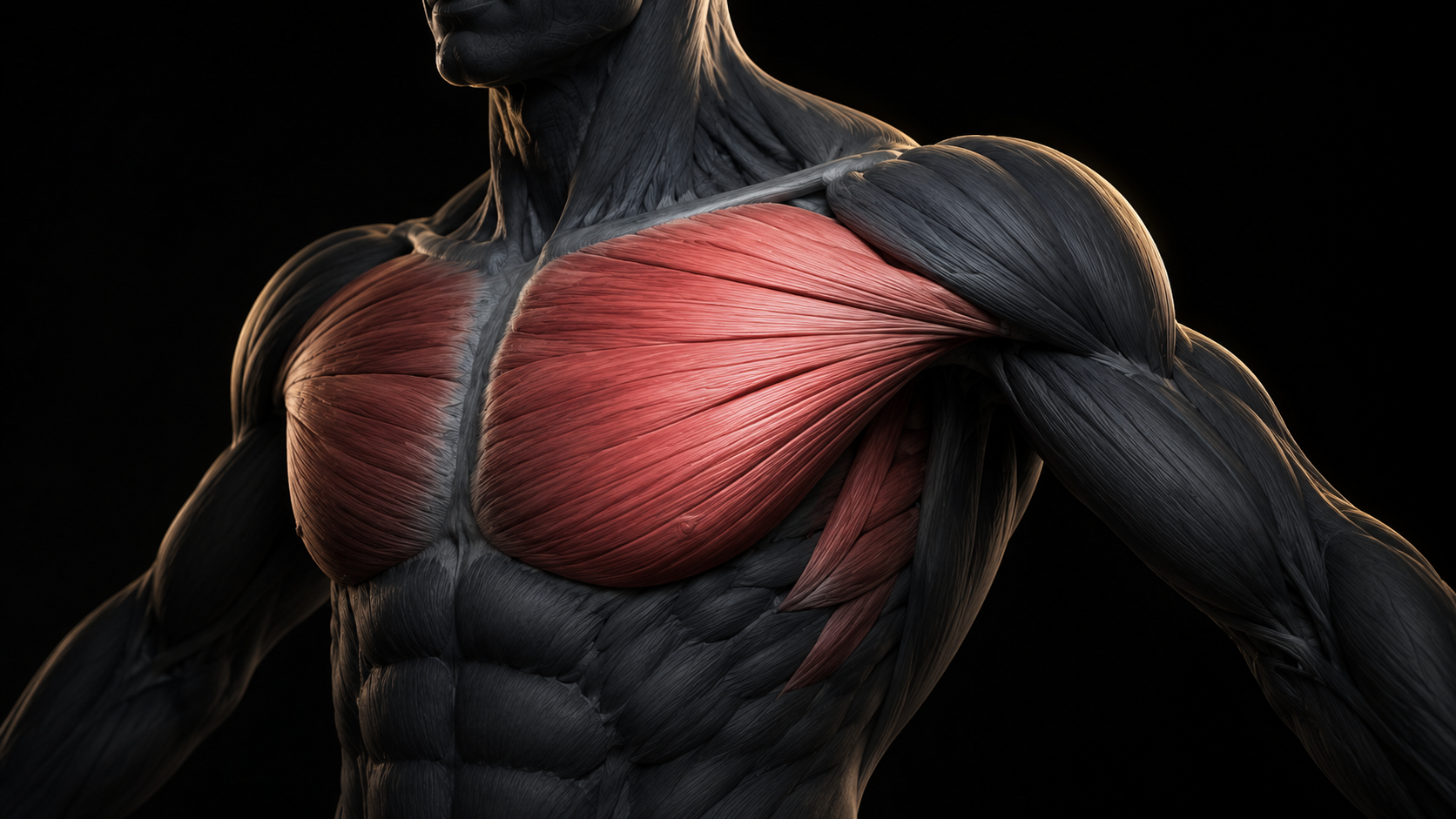
The chest is the most trained muscle group in most gyms and one of the least understood. Nearly every recurring complaint — the upper chest that never fills out, the shoulders that grumble the day after benching, the flat pecs on someone with a respectable bench number — comes back to the same error: treating the pectoralis major as one muscle with one job, and ignoring the two smaller muscles beneath and beside it that decide whether the shoulder blade is in a position to let you press well at all.
The pectoralis major has three parts with genuinely different actions, not simply an upper and a lower half. The pectoralis minor sits underneath it and never moves the arm. The serratus anterior sits on the ribcage and does the job the pec minor gets blamed for failing at. Get those three relationships straight and exercise selection stops being a matter of taste.
The Muscles and What They Actually Do
Pectoralis major — one muscle, three parts
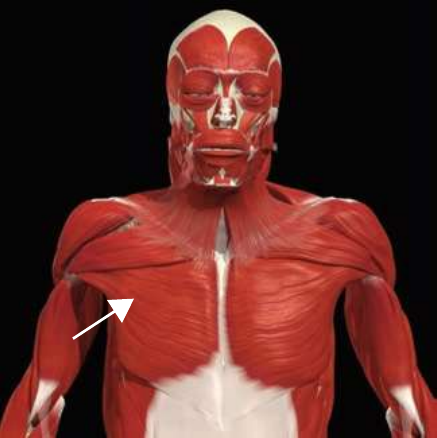
The pectoralis major is a large, fan-shaped, superficial muscle covering the front of the chest wall. Its fibres converge from a very wide origin onto a very small insertion, which is what lets one muscle do several different things depending on where the arm starts.
| Feature | Detail |
|---|---|
| Origin | Clavicular head: anterior surface of the medial half of the clavicle. Sternocostal head: anterior sternum and costal cartilages of ribs 1–6. Abdominal part: aponeurosis of the external oblique and the anterior layer of the rectus sheath |
| Insertion | Lateral lip of the intertubercular sulcus of the humerus |
| Innervation | Lateral pectoral nerve (C5–C7) to the clavicular head; medial pectoral nerve (C8–T1) to the sternocostal head |
| Blood supply | Pectoral branches of the thoracoacromial artery |
The three parts are not “upper, middle and lower” in any useful sense. They differ by what the arm is doing.
| Part | Origin | Primary actions |
|---|---|---|
| Clavicular head | Medial half of the clavicle | Shoulder flexion to roughly 90°, horizontal adduction, internal rotation |
| Sternocostal head | Sternum, costal cartilages 1–6 | Horizontal adduction, internal rotation, shoulder extension from a flexed position |
| Abdominal part | Rectus sheath | Assists the sternocostal head in adduction and internal rotation |
That middle column is the whole story. The clavicular head raises the arm forward and up; the sternocostal head pulls a raised arm down and back. In that one action they are direct opponents, which is why an incline press and a dip feel like completely different exercises despite both being filed under “chest”. The two heads also have separate nerve supplies, so the nervous system genuinely can recruit them to different degrees. It cannot switch either off. Every press works both.
Horizontal adduction is the actual job
Whatever the angle, the pectoralis major’s primary function is horizontal adduction — bringing the upper arm across the front of the body. Bench press, push-up, fly, crossover, a punch: all the same pattern. Leverage is best when the upper arm sits near 90° of abduction, and elbow position is how you trade that leverage against shoulder comfort.
| Elbow flare from torso | What happens |
|---|---|
| ~30° (tucked) | Load shifts toward the triceps and anterior deltoid; least pec stretch |
| 45–60° | The usual compromise — strong pec involvement, tolerable shoulder position |
| ~90° (fully flared) | Greatest pec stretch, greatest demand on the anterior shoulder |
The 45–60° default is sensible, not a law. There is no strong direct evidence that flaring injures healthy shoulders, and plenty of experienced lifters bench comfortably with more flare and a higher bar path. If flaring hurts, don’t do it. If it doesn’t, the extra stretch is worth having.
Can you actually train “upper” and “lower” chest separately?
Partly. Here is where the evidence sits.
| Claim | What the evidence shows | Verdict |
|---|---|---|
| Incline pressing biases the clavicular head | Higher clavicular activation at 30–45°, and one longitudinal trial found greater upper-pec growth | Supported |
| Incline pressing costs you mid and lower chest | That same trial found incline matched flat for mid and lower growth | Not supported |
| Decline pressing biases the sternocostal head | Biomechanically reasonable, but no long-term growth comparison exists | Plausible, untested |
| Reverse-grip pressing raises clavicular activation | Consistent EMG finding, no growth data | Supported, weakly |
| You can isolate one head | Both heads contract in every press | False |
Bias is real but small, so spread your angles rather than hunting for an upper-chest secret — and if you are going to bias anything, bias the clavicular head, because far more people struggle to develop the upper chest than the lower.
Fibre type, and how much it should change your training
The pectoralis major is unusual in being fast-twitch dominant — roughly 60% Type II fibres, against something nearer a 50/50 split in many limb muscles. The inference usually drawn is that it must be trained heavy with long rest.
Fibre composition is a weaker programming guide than that suggests: growth is broadly similar across rep ranges from about five to thirty when sets are taken close enough to failure. What the fast-twitch bias justifies is including some genuinely heavy work in the 5–8 range with two to three minutes of rest. It does not justify avoiding higher reps.
Pectoralis minor — the one that doesn’t move your arm
| Feature | Detail |
|---|---|
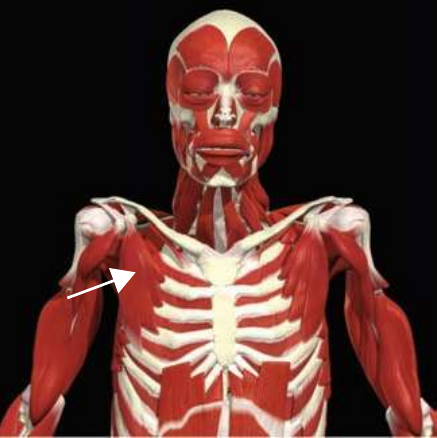
| Origin | Anterior surfaces of ribs 3–5, near the sternocostal junctions |
| Insertion | Medial border and superior surface of the coracoid process of the scapula |
| Innervation | Medial pectoral nerve (C8–T1) |
| Actions | Scapular protraction, depression, downward rotation, anterior tilt |
The pectoralis minor attaches to the scapula, not the humerus. It is a postural muscle rather than a prime mover, and when it is short it pulls the scapula forward, down and into anterior tilt — the opposite of the upward rotation and posterior tilt the shoulder blade needs to clear the acromion as the arm goes overhead.
That mechanism is sound. The prescription usually attached to it is not. A systematic review with network meta-analysis found that static stretching alone produced no measurable change in pectoralis minor resting length, at doses of 20–60 seconds held over periods up to six weeks. A randomised trial in people with subacromial pain found that adding pec minor stretching to an existing exercise programme gave no additional benefit for pain, function or muscle length.
So “release your pec minor before you press” is a reasonable comfort ritual and a poor structural claim. Keep the doorway stretch if it makes the first set feel better — just don’t expect it to lengthen a muscle, and don’t let it stand in for the thing that does have evidence behind it: strengthening the muscle that opposes it.
Serratus anterior — the one that does the work
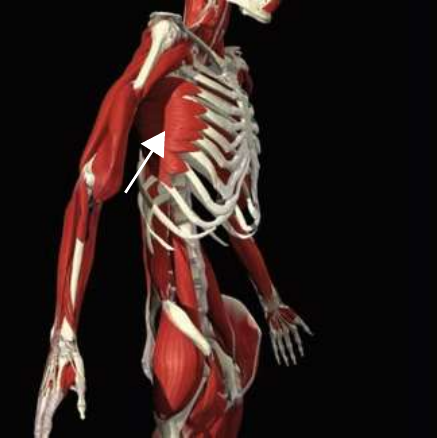
The serratus anterior is the only muscle that can protract and upwardly rotate the scapula at the same time. The trapezius upwardly rotates but cannot protract; the rhomboids retract and downwardly rotate. Nothing else does both.
| Pairing | Relationship |
|---|---|
| Pectoralis major + serratus anterior | Synergists in pushing — the pec moves the arm, the serratus moves the scapula underneath to support it |
| Pectoralis minor + serratus anterior | Synergists for protraction, antagonists for rotation — pec minor downwardly rotates, serratus upwardly rotates |
That second row explains much of the anterior shoulder trouble seen in people who bench often. A short pec minor and a weak serratus pull the same way for protraction and opposite ways for rotation, so the scapula settles into protraction and downward rotation — the position that narrows the space the humeral head needs. The serratus is the lever you actually control, because it responds to training.
The push-up plus is the standard tool. One EMG protocol recorded serratus activity rising from around 49% of maximum voluntary contraction during the push-up itself to about 76% during the “plus”. Other protocols report gaps nearer 20 percentage points. The direction is consistent; the magnitude is not settled.
Muscle-Specific Exercises (Anatomy and Form Explained)
The organising principle: where the arm starts determines which part of the pec does the work, and the tension the muscle sees in its lengthened position determines how much the exercise is worth.
Incline press at 30° — the clavicular head builder
What it targets and why. The clavicular head’s unique action is shoulder flexion. An incline adds a flexion component to horizontal adduction, which is why clavicular activation climbs as bench angle rises. Thirty degrees is the useful setting: steeper angles keep adding anterior deltoid involvement without much more clavicular recruitment.
Setup and execution. Bench at 30°. Lower the bar to just below the collarbones, elbows at roughly 45–60° from the torso. Press up and slightly back over the shoulders, not straight up over the face.
The nuance most people miss. The dumbbell version buys range at the bottom, because nothing runs into the ribcage. The barbell version buys clean loading and easy progression. Alternate them across training blocks rather than arguing about which is better.
Common error → fix. Setting the bench at 45° on the assumption that steeper must mean more upper chest. It mostly recruits more front delt. Drop it to 30° and the chest does more of the work.
Flat barbell bench press — the loadable one
What it targets and why. Pure horizontal adduction with the arm at mid-height — the sternocostal head’s home range. It is also the most straightforwardly progressible chest exercise there is, and progression is the variable that drives growth.
Setup and execution. Grip slightly wider than shoulder width. Modest upper-back arch, feet driving into the floor, glutes tight. Lower to mid-chest, touch lightly, press up and slightly back toward the rack.
The nuance most people miss. The barbell limits range at the bottom because the bar meets the ribcage before the pec is fully stretched. Real drawback, routinely overstated — it only matters if the bench is your sole chest exercise.
Common error → fix. Bouncing the bar off the chest to disguise a weight that is too heavy. Pause for a beat on the chest and reduce the load until you can. Shoulder complaints on the bench press are far more often a loading problem than a technique problem.
Machine chest press — the one you can take to failure
What it targets and why. The same horizontal adduction pattern with the stabilisation demand removed. That matters more than it sounds: proximity to failure is among the strongest determinants of growth, and a machine lets you get there without technique collapsing or needing a spotter.
Setup and execution. Back flat against the pad, handles at roughly mid-chest height. Press by thinking about bringing the elbows toward each other rather than pushing the handles away. Hold the end position for a count.
The nuance most people miss. Machine quality varies enormously, and one built around someone else’s proportions may not fit yours. If a chest press leaves you feeling it entirely in the front of the shoulder, that is information about that machine, not about machines.
Common error → fix. Using it as a warm-up for the barbell work. Put it after the heavy pressing, where its stability lets you add volume cheaply.
Weighted dip — the sternocostal specialist
What it targets and why. The dip matches the sternocostal head’s actual action: the arm starts above and behind the body and drives down and back — extension from a flexed position. It also produces one of the deepest pec stretches available in any compound movement.
Setup and execution. Lean the torso forward; dipping upright turns it into a triceps exercise. Lower until the upper arms reach parallel or a little below, then press up by driving the elbows toward each other.
The nuance most people miss. Dips offer more progression options than most exercises: reduce assistance, add reps, slow the eccentric, then add load with a belt. Work down that ladder rather than reaching for the belt first.
Common error → fix. Descending until the shoulders sit deep behind the body chasing more stretch. Stop where the stretch is strong and the shoulder still feels stable. This is the one chest exercise where a meaningful minority do develop anterior shoulder pain, and depth is usually the reason.
Seated cable fly — the best isolation option
What it targets and why. Flies strip out the triceps and most of the front delt and leave the pec performing horizontal adduction against even tension. Sitting removes the balance demand, so more of that tension lands on the muscle rather than your stabilisers.
Setup and execution. Pulleys at roughly chest height. Slight elbow bend, around 30°, held fixed throughout — not a pressing motion in disguise. Open into a wide arc until the stretch is strong, then bring the hands together in front of the chest.
The nuance most people miss. Dumbbell flies have zero tension at the top, where the pec is shortest, and maximum tension at the bottom, where it is longest. That was once treated as a fatal flaw. Given how strongly the evidence now favours training at long muscle lengths, it looks closer to a feature. Cables are smoother, but dumbbell flies are not the mistake they were once called.
Common error → fix. Bending and straightening the elbows to move more weight. If the elbow angle changes during the set, it is a press. Halve the load.
Low-to-high cable crossover — clavicular head isolation
What it targets and why. The low-to-high path combines shoulder flexion with horizontal adduction — precisely the clavicular head’s job description — without the anterior deltoid dominance that steeper pressing brings.
Setup and execution. Pulleys at the lowest setting. Step forward to load the start position. Sweep the hands up and together, finishing above chest height with the palms facing each other. Control the return; that is where the useful tension is.
The nuance most people miss. Lying on a 30° incline bench between low pulleys beats doing it standing — you get the incline’s stretch at the bottom and constant cable tension, without spending effort staying upright.
Common error → fix. Loading it heavily enough that the torso swings. This is an accessory. Light weight, full arc, deliberate return.
What to skip
| Exercise | Why |
|---|---|
| Hex press / squeeze press | Arms stay tucked, so the pec never reaches a stretched position and the triceps take over |
| Standing plate press | Resistance acts vertically while you press horizontally — mostly a front delt exercise |
| Dumbbell pullover | Genuine pec involvement on paper, but lats and triceps dominate. A good back exercise, a poor chest one |
| Standing cross-body dumbbell fly | No tension where the pec is stretched, and it doubles as a front raise |
| Barbell guillotine press | Excellent stretch, but lowering a loaded barbell toward your throat is not a risk worth taking. Use dumbbells |
Progressing it
| Exercise type | Progression method | Why |
|---|---|---|
| Barbell and machine presses | Linear — add the smallest increment once the top of the rep range is hit | Compounds tolerate load increases for a long time |
| Dips | Reps, then eccentric tempo, then added load | Three levers before a belt is needed |
| Flies and crossovers | Double progression — fix a rep range, add reps first, then load | Isolation lifts run out of loadable range quickly |
Twelve to eighteen hard sets per week across two sessions suits most people, roughly two-thirds aimed at the sternocostal head and a third at the clavicular head. Returns drop off beyond about eight sets for one muscle in a single session, so the way to add chest volume is another day, not another three sets.
Warm-Up for Chest
Eight to ten minutes, structured as RAMP — Raise, Activate, Mobilise, Potentiate. Systematic review evidence indicates 5–10 minutes at moderate intensity is sufficient; longer warm-ups do not perform better, and long static holds immediately before heavy pressing can blunt force production.
| Phase | Time | What to do | Why |
|---|---|---|---|
| Raise | 2 min | Rowing machine, easy skipping, or brisk arm swings | Raises muscle temperature and blood flow |
| Activate | 3 min | Push-up plus 2 × 12 · scapular push-up 2 × 12 · band pull-apart 1 × 15 | Serratus online before the pecs are loaded; pull-aparts balance the pressing pattern |
| Mobilise | 2 min | Doorway pec stretch 30s each side · thoracic rotations · wall overhead reach | Prepares the ranges the session demands |
| Potentiate | 2–3 min | Ramping sets: empty bar × 10, then ~50% × 5, ~70% × 3, ~85% × 1 | Bridges warm-up to working weight |
The Activate phase is the part that earns its place. The serratus has to upwardly rotate and protract the scapula for the humeral head to have room during pressing, and unlike the pec minor it responds reliably to training — so a few minutes teaching it to fire before the chest gets loaded is time well spent.
Keep Mobilise short and hold the doorway stretch to about thirty seconds. As covered above, it will not change pectoralis minor length. It makes the first working set feel more comfortable, which is a fair reason to do it and the only one honestly on offer.
Potentiate matters more on chest day than most people allow. Ramping sets are not merely rehearsal — a single set of three bench press repetitions at around 90% of one-rep max has been shown to raise mean barbell velocity in the following sets by roughly 7–9%. For a fast-twitch dominant muscle, arriving switched on is worth a couple of extra light singles.
Cool-Down for Chest
Three to five minutes. Deliberately shorter than the warm-up, because that asymmetry is what the evidence supports.
What it does not do. Static stretching after training does not meaningfully reduce delayed onset muscle soreness, does not restore range of motion faster, and does not speed strength recovery compared with simply stopping and resting. This is one of the better-settled findings in the field, and recent expert consensus agrees on it completely. Anyone selling post-workout stretching as a soreness cure is selling something the research does not support.
What it does do. It brings heart rate and breathing down gradually. It gives you a warm window in which mobility work is more comfortable — useful if gaining range is an actual goal rather than a recovery hope. And it marks the end of the session, which helps adherence more than most people admit.
A reasonable chest cool-down:
- 1–2 minutes of easy walking or light rowing
- Doorway pec stretch, 30 seconds each side
- Open-book thoracic rotation, 6 slow reps each side
- 60 seconds of slow nasal breathing
That is the whole thing. Do more mobility work if you want it — just be clear that you are training range of motion, not accelerating recovery.
Putting It Together
One chest session built on everything above:
| Order | Exercise | Sets × reps | Purpose |
|---|---|---|---|
| 1 | RAMP warm-up | 8–10 min | Serratus online, pressing pattern rehearsed |
| 2 | Incline barbell press (30°) | 3 × 6–8 | Clavicular head, trained heavy while fresh |
| 3 | Flat barbell bench press | 3 × 5–7 | Sternocostal head, linear progression, 2–3 min rest |
| 4 | Weighted dip | 3 × 8–10 | Sternocostal and abdominal parts, deep stretch |
| 5 | Seated cable fly | 3 × 10–12 | Isolation, even tension, double progression |
| 6 | Low-to-high cable crossover | 2 × 12–15 | Clavicular head finisher |
| 7 | Cool-down | 3–5 min | Downshift |
Fourteen working sets is a full session. Run a second, lighter chest day later in the week — dumbbells and cables in place of barbells — rather than adding sets to this one.
Key Takeaways
- The clavicular head flexes the arm; the sternocostal head extends it from flexion. That is why incline presses and dips feel like different exercises.
- You can bias one head, never isolate it. Bias the clavicular head, since it is more often the one lagging.
- “Release your pec minor” is a comfort ritual, not a structural fix — static stretching does not change its resting length. Strengthen the serratus instead.
- The pec is fast-twitch dominant, so include heavy sets with real rest. That does not make higher reps wasted.
- Warm up for 8–10 minutes with RAMP; cool down for 3–5. Warm-ups improve performance; post-session stretching does not reduce soreness.