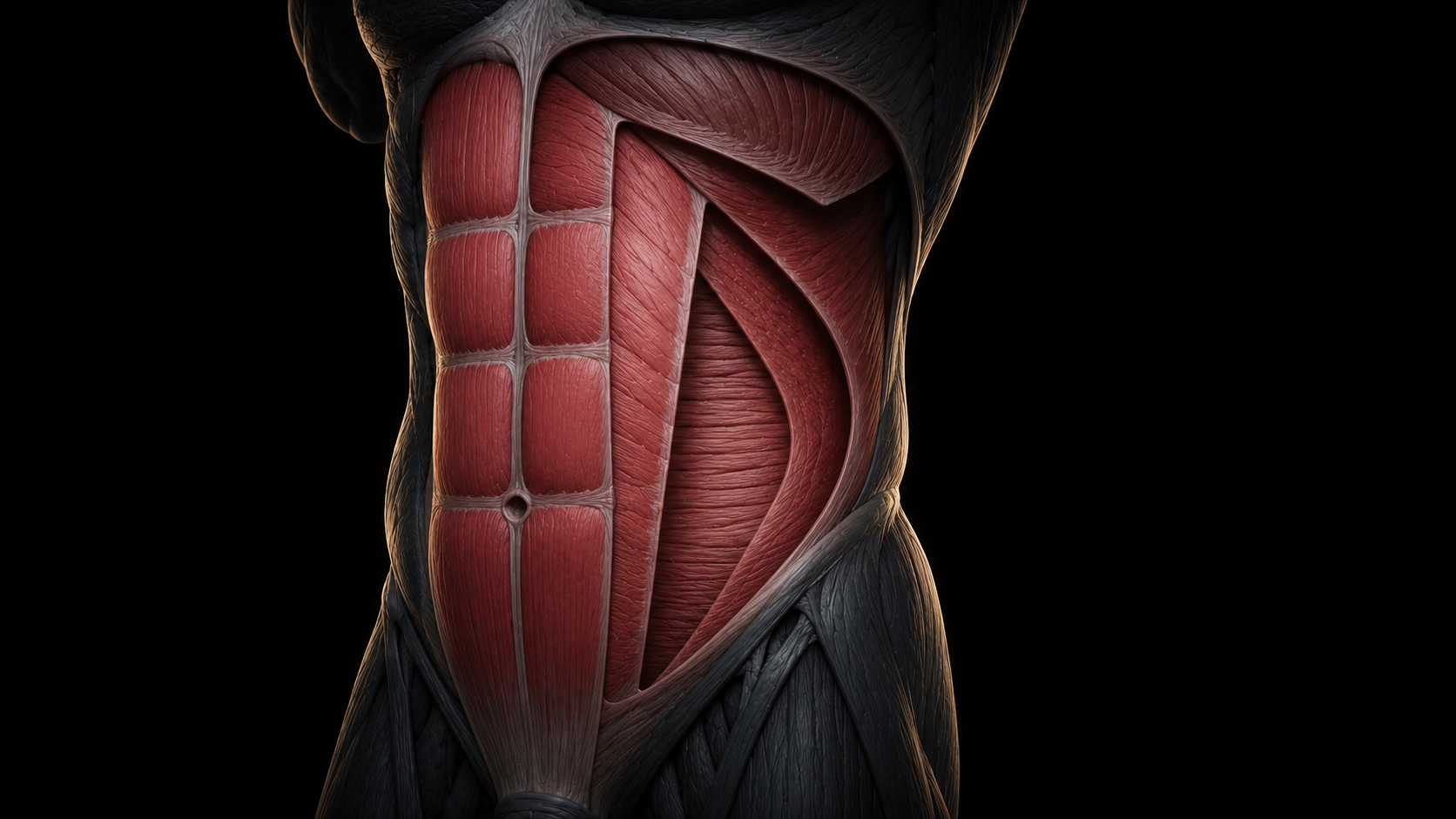
Core training has a definition problem. Ask most people what the core is and they point at the rectus abdominis. Ask what it does and they say it flexes the trunk. Both answers are technically correct and both are close to useless, because the rectus abdominis is one of roughly nine muscles in the group, and trunk flexion is the least important thing the group does.
The core is better understood as a pressurised cylinder: a roof, a floor, and four walls. Under load its defining job is not to produce movement but to refuse it — to stop the spine flexing, extending, twisting or bending sideways while the hips and shoulders do the work. That is why a visible six-pack tells you nothing about whether someone can hold a neutral spine under a heavy bar, and why the exercise that looks least impressive in a gym is often the one doing the most.
Get the anatomy right and exercise selection stops being a matter of taste.
The Muscles and What They Actually Do
The canister
| Position | Muscles | Job |
|---|---|---|
| Roof | Diaphragm | Breathing, and regulating intra-abdominal pressure |
| Floor | Pelvic floor (levator ani, coccygeus, perineal muscles) | Organ support, continence, pressure management |
| Front wall | Rectus abdominis, pyramidalis | Trunk flexion, compression |
| Side walls | External oblique, internal oblique, transversus abdominis | Rotation, lateral flexion, compression |
| Back wall | Multifidus, erector spinae, quadratus lumborum, thoracolumbar fascia | Extension, segmental control, lateral stability |
Two things follow from this picture. First, the walls are useless without a roof and a floor — you cannot pressurise an open can. Second, individual muscles inside the cylinder are genuine prime movers (the rectus abdominis really does flex the trunk), but the cylinder as a system exists to resist motion. Both statements are true at once, and confusing them is the source of most bad core advice.
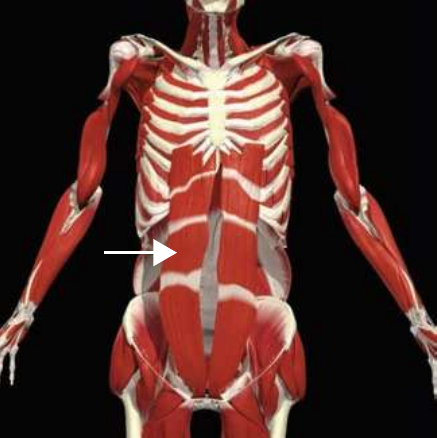
Rectus abdominis
| Feature | Detail |
|---|---|
| Origin | Pubic symphysis, pubic crest |
| Insertion | Xiphoid process, costal cartilages of ribs 5–7 |
| Innervation | Thoracoabdominal nerves (T7–T12) |
| Actions | Trunk flexion, posterior pelvic tilt, abdominal compression, forced expiration |
The “six-pack” look comes from three (occasionally four) tendinous intersections that fuse with the anterior rectus sheath — one at the xiphoid, one at the umbilicus, one between them. They do not run through the full thickness of the muscle. They segment its appearance and limit how much it can bulge.
There is a real regional difference in how the upper and lower portions behave, and it is not a marketing invention. EMG work consistently shows the pattern below.
| Movement | Upper fibres | Lower fibres | External oblique |
|---|---|---|---|
| Slow curl-up | Highest | Moderate | Moderate |
| Cable crunch (thoracic flexion) | Highest | Moderate | Low |
| Reverse crunch (hips lifted) | High | Moderate | Low |
| Straight-leg raise (isometric hold) | Moderate | Highest | Low |
| Full sit-up, quick start | Moderate | Moderate | Highest |
The mechanism is simple. Curling the ribcage down loads the upper fibres, because that is the end doing the shortening. Moving the legs from a supine position loads the lower fibres, because they have to hold the pelvis against roughly a third of your body weight hanging off the far end of a long lever. This is regional emphasis within one muscle, not two separate muscles — you cannot train “lower abs” independently, only bias them.
The sit-up-versus-crunch argument resolves along the same lines.
| Partial-range curl-up | Full sit-up | |
|---|---|---|
| Rectus abdominis | Highest early in flexion | Moderate; drops as hip flexors take over |
| Hip flexor involvement | Minimal | High past roughly 30–40° |
| Lumbar loading | Low, spine stays near neutral | Higher, spine flexes under load |
| Best used for | Hypertrophy, endurance | Practising getting off the floor |
An honest caveat on the numbers: the exact angle at which hip flexors take over is protocol-dependent and varies between studies. The direction of the finding is solid — the rectus abdominis does its best work in the early part of trunk flexion — but treat “35 to 40 degrees” as a rule of thumb rather than a measured threshold.
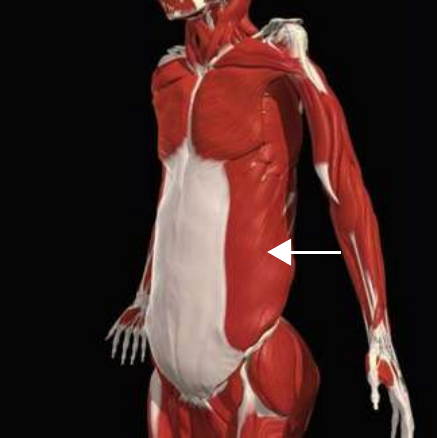
The obliques, and the sling that drives rotation
| External oblique | Internal oblique | |
|---|---|---|
| Fibre direction | Inferomedial — “hands into pockets” | Superomedial — perpendicular to the external |
| Rotation | Contralateral (opposite side) | Ipsilateral (same side) |
| Lateral flexion | Ipsilateral | Ipsilateral |
| Also does | Trunk flexion, compression, posterior pelvic tilt | Trunk flexion, compression, tensions thoracolumbar fascia |
The pairing matters more than either muscle alone. Rotating to the right requires the right internal oblique and the left external oblique working together — the oblique sling. Every genuine rotational athlete, from a batter to a thrower, is driving that diagonal. It also means you can bias, but never isolate, either muscle: they share the rectus sheath and the linea alba with the transversus abdominis and behave as a continuous sheet.
The internal oblique’s attachment to the thoracolumbar fascia gives it a plausible role in lumbar support — when it contracts it tensions the same fascia that sheathes the erector spinae. You will see it claimed that the internal obliques matter more for back health than the rectus abdominis. That is an anatomically reasonable inference, not a demonstrated comparative finding. Worth knowing; not worth stating as fact.
Transversus abdominis
Fibres run horizontally, wrapping the abdomen. It cannot flex, extend, rotate or side-bend the trunk. All it does is compress — which is exactly the point.
Its interesting property is timing. In healthy people the transversus abdominis contracts roughly 30–50 milliseconds before the limb it is about to stabilise for, a feedforward pattern rather than a reaction. In people with chronic low back pain that anticipatory onset is delayed or missing: the spine moves before it is braced. This is why deep core work is treated as motor control rather than strength training. You are not trying to make the muscle bigger, you are trying to restore its timing, and heavy loading does not do that.
The popular “navel to spine” cue is a poor description of a 360-degree compression. “Draw your hip bones gently toward each other” or “firm the whole waistband” gets closer.
Diaphragm and pelvic floor
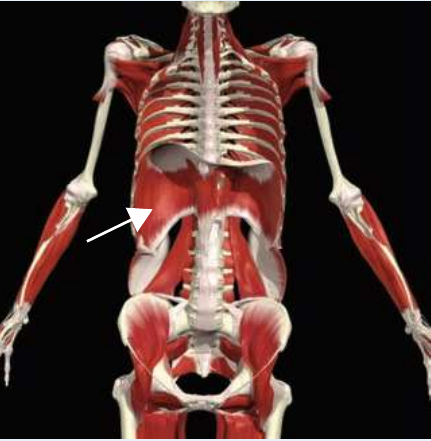
The diaphragm has two jobs that compete. As the primary muscle of inspiration it contracts rhythmically, flattening its dome to draw air in. As a postural muscle it holds position isometrically to raise intra-abdominal pressure and stiffen the spine. It cannot do both maximally at once — which is why breathing gets restricted under a heavy bar, and why someone who holds their breath through every single set is leaning entirely on one function.
The pelvic floor is the matching surface at the bottom. On inhalation the diaphragm descends and the pelvic floor lengthens eccentrically to accommodate the pressure; on exhalation it lifts. The two are mechanically coupled, and the transversus abdominis shares an attachment with the costal part of the diaphragm on the inner surfaces of the lower costal cartilages. This is the real reason breathing drills open a core session — not relaxation, but the motor pattern underneath everything else.
One clinical point that gets missed: a pelvic floor can be too tight as easily as too weak. An overactive floor cannot lengthen on inhalation, which breaks the coupling and pushes people into shallow chest breathing. Hard clenching is not the goal at either end of the cylinder.
Quadratus lumborum
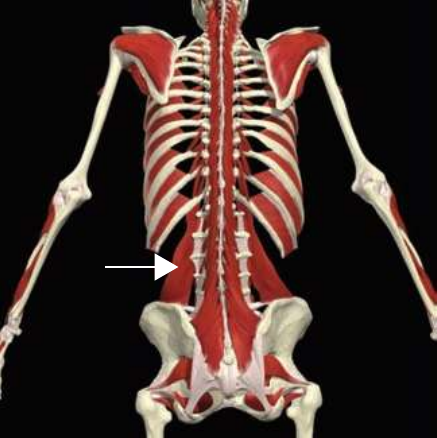
A quadrilateral sheet running from the iliac crest and iliolumbar ligament to the 12th rib and the transverse processes of L1–L4. It laterally flexes the trunk to the same side, assists lumbar extension, and fixes the 12th rib during breathing.
It is routinely overrated. Cadaveric analysis of its fascicular anatomy found the quadratus lumborum contributes no more than about 10% of the compression, extension or lateral-bending moment produced by the erector spinae and multifidus. It is a stabiliser and a force distributor across the thoracolumbar fascia, not an engine.
It is also more often overactive than weak. The classic pattern is a quadratus lumborum gripping on one side to hoist a pelvis that a weak gluteus medius on that side cannot hold level. Stretching it alone leaves the cause untouched.
| Inner core | Outer core | |
|---|---|---|
| Muscles | Transversus abdominis, multifidus, diaphragm, pelvic floor | Rectus abdominis, obliques, erector spinae, quadratus lumborum |
| Activation | Feedforward, low threshold | Reactive, high threshold |
| Trained with | Motor control, breath, low load | Strength, hypertrophy, loaded resistance |
Muscle-Specific Exercises (Anatomy and Form Explained)
The organising principle: choose exercises by the direction of force you are resisting, not by the muscle you want to feel. Anti-extension, anti-rotation, anti-lateral-flexion and loaded flexion between them cover every wall of the cylinder.
Dead bug — the timing drill
What it targets and why: transversus abdominis and multifidus. The limbs move, the spine must not. That is precisely the feedforward demand the deep core exists to meet, delivered at a load low enough that motor control is the limiting factor rather than strength.
Setup and execution: supine, lower back gently flattened into the floor, arms vertical, hips and knees at 90°. Extend one arm and the opposite leg slowly, stopping short of where the back lifts. Return, then swap sides. Exhale as you extend.
The nuance most people miss: the exhale is not incidental. The transversus abdominis fires hardest during expiration, so a set performed on held breath removes the muscle you came for. Six controlled reps per side beats twenty rushed ones.
Common error → fix: the lower back arching as the leg extends. That is the moment the drill ended. Shorten the range until you can keep contact, and slide a hand under the lumbar spine as feedback.
Long-lever plank — anti-extension done properly
What it targets and why: rectus abdominis, obliques and transversus abdominis contracting isometrically to stop the lumbar spine dropping into extension. Left to gravity, the pelvis tips forward and the low back sags; the abdominal wall is what prevents it.
Setup and execution: elbows forward of the shoulders — roughly under the eyes — rather than beneath them. Squeeze the glutes hard to pull the pelvis into posterior tilt. Hold 20–40 seconds for three sets.
The nuance most people miss: a standard plank is not a hard exercise. The Guinness record hold runs to over eight hours, and EMG data has it as merely average among common abdominal movements. Moving the elbows forward lengthens the lever, and squeezing the glutes creates a force couple between the hip extensors and the abdominal wall; research has found both modifications meaningfully raise activation. Adding minutes is the worst way to progress a plank. Add lever, add tilt, then narrow the elbows.
Common error → fix: hips too high, which parks the load on the shoulders and skeleton. Fix by squeezing the glutes to level the pelvis. The opposite error, hips sagging, is fixed with the cue to drag your elbows toward your toes and your toes toward your elbows without either actually moving.
Ab wheel rollout — a plank with a range of motion
What it targets and why: the same anti-extension demand, but travelling. In one comparison of four abdominal exercises the ab wheel came out top for rectus abdominis activation, which makes sense — it is a long-lever plank where the lever gets progressively longer.
Setup and execution: start from knees. Roll out only as far as you can hold a neutral lumbar spine, then pull back. Range increases across weeks as control improves.
The nuance most people miss: range of motion is the progression variable here, not load. Stopping early with a neutral spine is a completed rep; going further with a sagging back is a different, worse exercise.
Common error → fix: hauling the wheel back with the arms and lats. Initiate the return by crunching the abdominal wall and let the wheel follow.
Cable crunch — loaded thoracic flexion
What it targets and why: upper rectus abdominis, through its strongest range. The cable maintains tension across the whole movement, which a floor crunch does not, and it loads a muscle that responds to progressive overload like any other.
Setup and execution: kneel facing the stack, rope behind the head. Flex the thoracic spine — ribcage travelling toward pelvis — and pause a beat at the bottom. Return under control without hyperextending at the top.
The nuance most people miss: this is spinal flexion against load, which is the whole point, but it means keeping the movement in the thoracic spine and out of the lumbar. Chin tucked lightly, not dragged to the chest by the arms.
Common error → fix: pulling with the arms so the elbows travel and the spine barely moves. Fix by holding the rope loosely against the head and thinking of the elbows as fixed to the skull.
Reverse crunch — the pelvic tilt, not the leg lift
What it targets and why: lower rectus abdominis, which has to posteriorly tilt the pelvis against the mass of the legs. This is the most lower-biased of the common abdominal exercises for that reason.
Setup and execution: supine, knees bent to 90°, lower back flat. Curl the tailbone toward the ribcage so the hips lift off the floor. The legs move because the pelvis moved, not the reverse. Lower slowly.
The nuance most people miss: almost everybody does this as a hip flexor exercise. If the pelvis stays neutral and the legs simply swing, the iliopsoas and rectus femoris are doing the work and the lumbar spine is being pulled into extension for nothing. The tell is the low back lifting off the floor.
Common error → fix: momentum. Fix with “tuck the tailbone first, then lift” and a two-second lowering phase. The hanging knee raise is the same movement with more range and a stricter requirement for pelvic tilt — progress to it only once the floor version is genuinely controlled.
Pallof press — anti-rotation
What it targets and why: the obliques, particularly the internal oblique on the side nearer the cable, plus the transversus abdominis. The cable tries to rotate you; you refuse. Because the load is applied at the hands and resisted at the trunk, the further you press, the harder the demand.
Setup and execution: stand side-on to a cable or band at chest height, feet about hip width. Hold the handle at the sternum, press straight out, pause, return. Hips and shoulders stay square throughout.
The nuance most people miss: the working part is the pause at full extension, not the press itself. Two seconds out there is worth more than four fast reps. Adding an overhead reach at the end turns it into an anti-rotation and anti-extension drill at once.
Common error → fix: the torso quietly rotating toward the stack so the arms end up pointing at the cable rather than straight ahead. Fix by standing further away for less leverage and watching your sternum in a mirror.
Suitcase carry — anti-lateral-flexion
What it targets and why: quadratus lumborum and obliques on the side opposite the weight, preventing you from folding toward the load. This is the closest thing to a purpose-built exercise for the lateral wall of the cylinder, and it is also the most transferable — carrying an unbalanced load is a thing life asks of you constantly.
Setup and execution: one heavy dumbbell or kettlebell at your side. Walk slowly for 40–60 seconds, torso vertical, shoulders level, then switch sides. Breathe normally.
The nuance most people miss: people either hike the loaded shoulder or let it drop. Neither is the exercise. The instruction that works is to stay exactly as tall on the loaded side as the free side, and to walk slowly enough that this is a stability task rather than a conditioning one.
Common error → fix: going too light. Unlike deep core work, this one wants genuine load — it fails when the trunk gives way, not when the legs tire. If your posture is unaffected, add weight.
A note on what to skip
Weighted side bends are the usual candidate. They load lateral flexion through a small range in a muscle group whose main job is to prevent lateral flexion, and the loaded-carry alternative trains the same tissue with better carryover. Not dangerous — just a poor use of a set.
Warm-Up for Core
Eight to ten minutes, structured as RAMP — Raise, Activate, Mobilise, Potentiate. Systematic review evidence supports 5–10 minutes at moderate intensity as sufficient; longer warm-ups do not perform better, and past a point they simply cost you working sets.
| Phase | Time | What to do | Why |
|---|---|---|---|
| Raise | 2–3 min | Easy bike, rower, or brisk incline walk | Raises muscle and tissue temperature |
| Activate | 3–4 min | 90/90 breathing × 6 breaths · dead bug 2 × 6 per side · bird dog 2 × 6 per side · glute bridge 2 × 10 | Restores the diaphragm–transversus–pelvic floor sequence and gets the glutes contributing before they are needed |
| Mobilise | 2 min | Cat-cow × 8 · open-book thoracic rotation × 6 per side · half-kneeling hip flexor rock × 8 per side | Prepares rotation and extension ranges the session will use |
| Potentiate | 2–3 min | One submaximal set of the first working exercise · 15-second plank at working technique | Bridges warm-up to load |
The Activate phase carries the reasoning. If the diaphragm is not descending properly and the deep stabilisers are not sequencing, everything above it in the session is built on a soft foundation — and the feedforward pattern is a timing skill, so it responds to rehearsal rather than effort. Keep it light. If your dead bugs feel hard, they are too fast or too long-levered, not too easy.
The glute bridge earns its place for a specific reason: the glutes and the abdominal wall form a force couple across the pelvis, and glutes that are not participating leave the abdominal wall fighting an anterior pelvic tilt on its own.
One honest limitation. There is essentially no trial evidence on core-specific warm-ups. The 5–10 minute figure and the RAMP framework come from general warm-up research, and applying them here is a sensible extrapolation rather than a tested prescription. The mechanistic case for the Activate phase is good; the outcome data specific to core training does not exist.
A second point worth flagging, with the same caveat about certainty: intervertebral discs take on fluid overnight and are at their most hydrated in the first hour or so after waking, which raises the stress that spinal flexion places on them. The practical suggestion — leave heavy loaded flexion work out of a session performed immediately on waking — is cheap to follow, though the size of the real-world effect is not well established.
Cool-Down for Core
Three to five minutes. Deliberately shorter than the warm-up, and it is worth being clear about why.
What it does not do. Post-exercise static stretching does not meaningfully reduce delayed onset muscle soreness, does not restore range of motion faster, and does not speed recovery of strength compared with simply stopping and resting. Recent expert consensus is unusually unanimous on this. If a cool-down is being sold to you as a soreness cure, it is being oversold.
What it does do. It brings heart rate and breathing down gradually. It provides a warm window in which mobility work is more comfortable, which is useful if range of motion is the actual goal. And it marks a clean end to the session, which matters for adherence more than most people will admit.
For core specifically there is one genuinely defensible inclusion: breathing. The diaphragm is a core muscle you have just been asking to hold position and produce pressure, and returning it to a full, quiet, 360-degree breathing pattern is training a skill, not chasing a recovery effect.
- 60–90 seconds of easy walking
- Supine 90/90 breathing, six to eight slow nasal breaths with a long exhale
- Child’s pose with a side reach, 30 seconds each side — lengthens the quadratus lumborum, which usually needs it
- Gentle prone press-up into extension, 5 slow reps — a reasonable counterpoint after a session of loaded flexion
Anything beyond that is mobility training. Do it if you want the range; just do not file it under recovery.
Putting It Together
| Order | Exercise | Sets × reps | Resists |
|---|---|---|---|
| 1 | RAMP warm-up | 8–10 min | — |
| 2 | Dead bug | 3 × 8 per side | Uncontrolled motion (motor control) |
| 3 | Long-lever plank | 3 × 20–40 s | Extension |
| 4 | Cable crunch | 3 × 10–12 | — (loaded flexion) |
| 5 | Reverse crunch | 3 × 12–15 | — (loaded flexion, lower bias) |
| 6 | Pallof press | 3 × 10–12 per side | Rotation |
| 7 | Suitcase carry | 3 × 40–60 s per side | Lateral flexion |
| 8 | Cool-down | 3–5 min | — |
Deep stabiliser work first while the nervous system is fresh, loaded flexion in the middle, carries last because they are self-limiting and make a decent finisher. Roughly eighteen sets, twice weekly, covers every layer of the cylinder. Rotate one exercise per slot every four to six weeks rather than adding sets.
Key Takeaways
- The core is a pressurised cylinder with a roof and a floor. Train it as a system that resists movement, not as a muscle that produces it.
- Upper and lower rectus abdominis emphasis is real but regional. Curling the ribcage biases the top, tilting the pelvis biases the bottom — you cannot separate them.
- The transversus abdominis fires roughly 30–50 ms before limb movement. That is a timing skill, and it is trained with control, not load.
- Progress a plank by lengthening the lever and tilting the pelvis, never by adding minutes.
- The quadratus lumborum contributes under 10% of the moment that the erector spinae and multifidus produce. It is a stabiliser, and usually overactive rather than weak.
- Warm up 8–10 minutes, cool down 3–5. Warm-ups have measurable performance effects; post-session stretching does not reduce soreness.