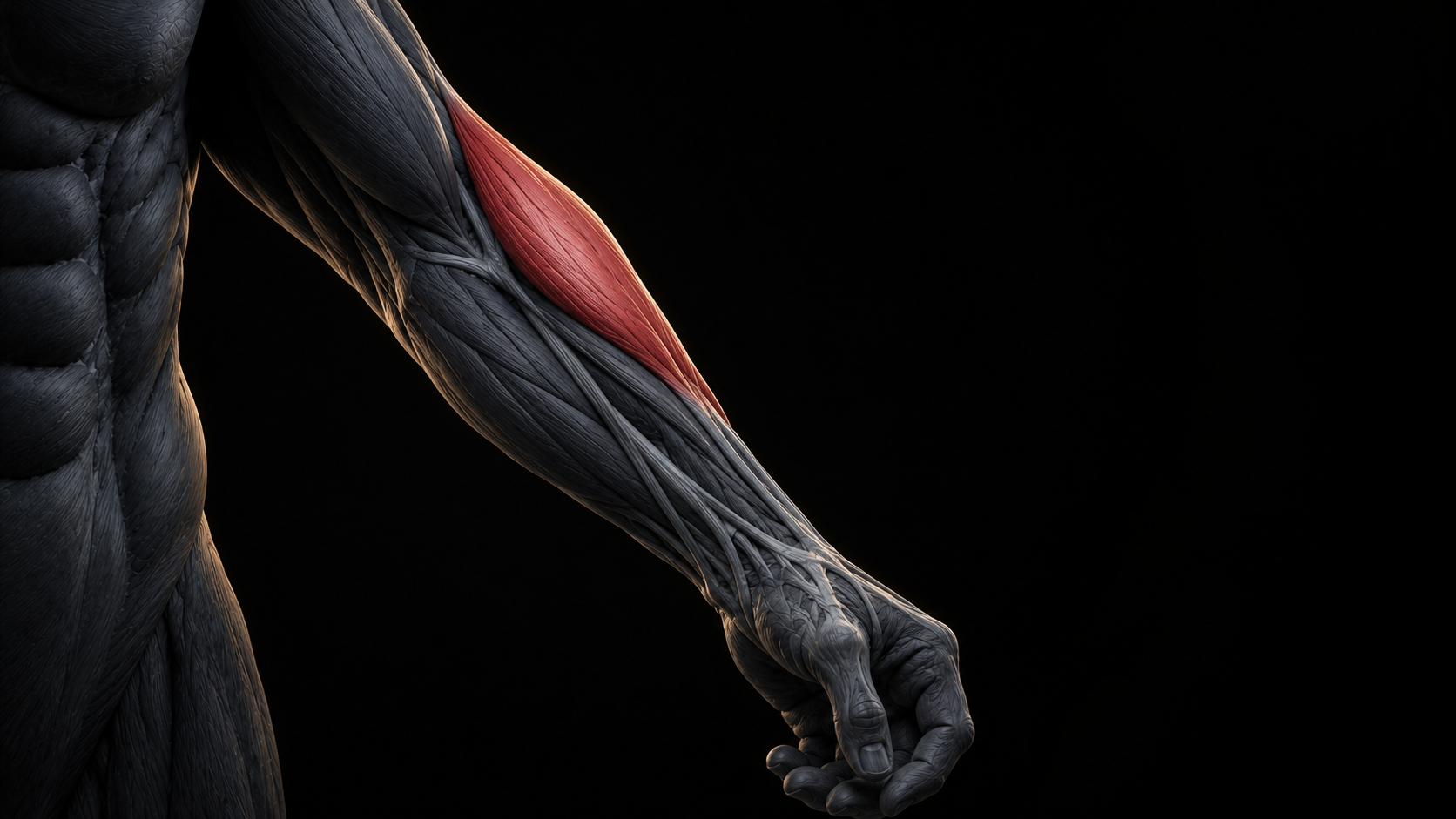
The forearm is the only part of the arm that is on display in a t-shirt, and the only muscle group that decides how much of your back workout you actually get to do. If your hands open before your lats are tired, your rows are being programmed by your fingers.
Most people train forearms badly for one reason: they treat the forearm as a single lump that responds to wrist curls. It isn’t. There are more than twenty muscles between elbow and fingertips, arranged in two compartments and three depths, and they do at least six mechanically distinct jobs — wrist flexion, wrist extension, finger flexion, finger extension, pronation and supination. Worse, the single muscle most responsible for a thick-looking forearm doesn’t cross the wrist at all, so no amount of wrist curling will grow it.
Sort the anatomy out and the exercise selection stops being a guessing game.
The Muscles and What They Actually Do
Everything below the elbow divides into two compartments, separated by the radius, the ulna and the interosseous membrane between them.
| Compartment | Position | Broad job | Common origin | Main nerve |
|---|---|---|---|---|
| Anterior (flexor) | Palm side | Wrist flexion, finger flexion, pronation | Medial epicondyle of the humerus | Median (ulnar for two) |
| Posterior (extensor) | Back of the forearm | Wrist extension, finger extension, supination | Lateral epicondyle of the humerus | Radial |
That shared origin matters. Nearly every flexor tendon converges on one small bony point on the inside of the elbow, and nearly every extensor on one point on the outside. It is why forearm training problems show up at the elbow rather than in the forearm belly.
The anterior compartment
| Layer | Muscle | Primary function |
|---|---|---|
| Superficial | Pronator teres | Forearm pronation |
| Superficial | Flexor carpi radialis | Wrist flexion + radial deviation |
| Superficial | Palmaris longus | Weak wrist flexion; absent in a substantial minority of people |
| Superficial | Flexor carpi ulnaris | Wrist flexion + ulnar deviation |
| Intermediate | Flexor digitorum superficialis | Flexes the middle finger joints + wrist |
| Deep | Flexor digitorum profundus | Flexes the fingertip joints + wrist |
| Deep | Flexor pollicis longus | Thumb flexion |
| Deep | Pronator quadratus | Forearm pronation |
Palmaris longus is the tendon that pops up mid-wrist when you pinch thumb to little finger and flex — and in a meaningful share of people it simply isn’t there. The figure usually quoted is around 15%, but prevalence varies enormously by ancestry, so treat any single number as an average rather than a fact about you. Its absence changes nothing functionally, which is why surgeons harvest it for tendon grafts.
The posterior compartment
| Layer | Muscle | Primary function |
|---|---|---|
| Superficial | Brachioradialis | Elbow flexion (strongest in neutral/pronated grip) |
| Superficial | Extensor carpi radialis longus | Wrist extension + radial deviation |
| Superficial | Extensor carpi radialis brevis | Wrist extension + radial deviation |
| Superficial | Extensor digitorum | Finger extension + wrist extension |
| Superficial | Extensor digiti minimi | Little finger extension |
| Superficial | Extensor carpi ulnaris | Wrist extension + ulnar deviation |
| Superficial | Anconeus | Assists elbow extension |
| Deep | Supinator | Forearm supination |
| Deep | Abductor pollicis longus | Thumb abduction |
| Deep | Extensor pollicis brevis / longus | Thumb extension |
| Deep | Extensor indicis | Index finger extension |
Brachioradialis — the odd one out
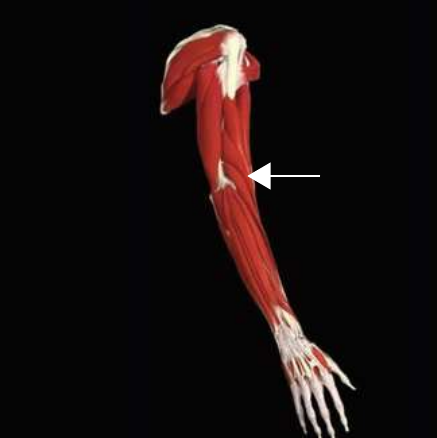
Brachioradialis sits in the extensor compartment, is supplied by the radial nerve like its neighbours, and then does something none of them do: it flexes the elbow. It runs from the lateral supracondylar ridge of the humerus to the styloid process of the radius — crossing the elbow and stopping short of the wrist entirely.
Two consequences follow, and they are the two most useful facts here.
First, wrist curls cannot grow it. A muscle that does not cross a joint cannot be trained by moving that joint. If your forearms look flat from the side despite years of wrist curls, this is why.
Second, grip position decides how hard it works. Brachioradialis flexes the elbow in every position, but it earns its keep when the forearm is neutral or pronated — precisely where the biceps, which needs supination to pull efficiently, is at a mechanical disadvantage. Hammer curls and reverse curls are not “biceps variations”. They are brachioradialis and brachialis exercises that happen to involve the elbow.
A third point, more speculative: at least one biomechanics paper put peak brachioradialis torque around 100–120° of elbow flexion against roughly 80° for the biceps, which would make top-half partials a brachioradialis bias. That is an inference from a single measurement, not an established principle — use it as a set-extension trick, not a programme.
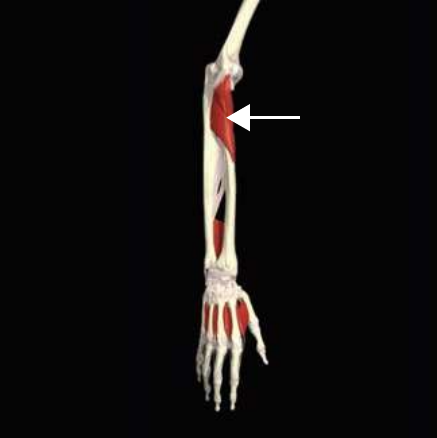
Pronation and supination — the plane everybody forgets
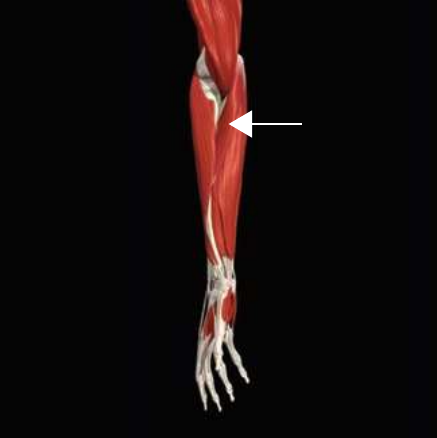
Rotating the forearm is a genuine movement with dedicated muscles, and almost nobody trains it.
| Muscle | Action | When it does most of the work |
|---|---|---|
| Pronator quadratus | Pronation | The workhorse — active across essentially all pronation, including slow unloaded rotation |
| Pronator teres | Pronation | Recruited as speed and resistance rise |
| Supinator | Supination | Carries supination on its own when force is low or the elbow is extended |
| Biceps brachii | Supination | The strongest supinator, but only meaningfully so with the elbow flexed and force high |
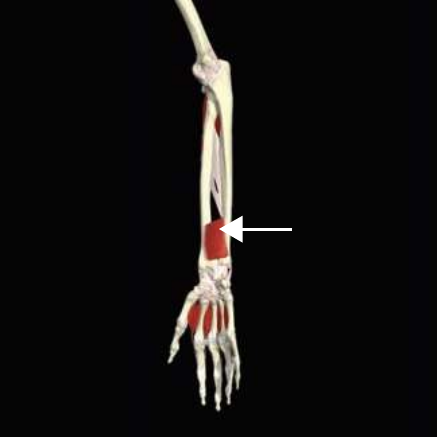
The practical read-out: because biceps dominates supination, the supinator itself is best loaded with the elbow relatively straight. And because the two pronators split their duties by intensity, pronation work needs real resistance to reach pronator teres at all.
Grip is finger flexion, not wrist flexion
Three muscles do the vast majority of gripping: flexor digitorum profundus, flexor digitorum superficialis and flexor pollicis longus. Profundus and pollicis longus are the only muscles in the body capable of flexing the interphalangeal joints — the joints in the fingers and thumb themselves. Nothing in the hand substitutes for them.
You will see a specific size ratio quoted for how far these outweigh the thumb flexor alone. We cut it from our own notes because it could not be traced to a primary source. The defensible version is the direction only: the long finger flexors, not the small intrinsic muscles of the hand, are what limit your deadlift.
Grip also isn’t one quality. It splits into three, and they transfer to each other only partially.
| Grip type | What it is | Trained by |
|---|---|---|
| Support | Holding a load in a closed hand | Deadlift holds, farmer’s walks, pull-up hangs |
| Crush | Squeezing the hand shut against resistance | Hand grippers |
| Pinch | Thumb opposing the fingers, no palm contact | Plate pinches, towel work |
One mechanical point changes how you set up every pulling exercise: grip is strongest with the wrist neutral or slightly extended and weakest with it flexed. Flex the wrist and you shorten the long finger flexors across a second joint before they have done any work at the fingers, dropping them onto a poor part of their length–tension curve. If your grip fails early on rows, check for a collapsing wrist before you buy straps.
A caveat on the popular story. You will read that flexor dominance causes elbow pain and extensor work prevents it. The treatment half is well supported — graded loading of the wrist extensors genuinely helps lateral elbow tendinopathy. The prevention half is an inference, not a finding.
Muscle-Specific Exercises (Anatomy and Form Explained)
The organising principle: decide which joint you are moving before you pick the exercise. Elbow flexion under a pronated grip builds brachioradialis. Wrist movement builds the wrist movers. Nothing moving at all builds grip. Three separate jobs that most people try to cover with one movement.
Reverse curl — the brachioradialis builder
What it targets and why. A pronated grip parks the biceps in a poor pulling position, so brachialis and brachioradialis take over elbow flexion. The wrist extensors work isometrically to stop the bar dropping into flexion, loading the back of the forearm at the same time. This is the best single exercise for forearm thickness seen from the side.
Setup and execution. EZ bar or straight bar, pronated grip, elbows pinned to your ribs. Curl to full elbow flexion, lower under control, 12–15 reps.
The nuance most people miss. Take a thumbless grip and claw your fingers into the base of your palm on every rep. The moment the bar sits passively on the crook of your thumb, the digit flexors switch off and the exercise narrows to elbow flexion alone.
Common error → fix. Swinging the torso to shift a load the forearm can’t handle. Halve the weight and brace your back against an upright. The working weight on a reverse curl is embarrassing next to a supinated curl, and that gap is the point — it is the biceps not helping.
Wrist roller — both compartments in one set
What it targets and why. As one hand rolls into extension the other rolls into flexion, so both compartments are loaded alternately and continuously. Few exercises train the wrist movers through so much cumulative range.
Setup and execution. Stand on a box so the rope hangs clear of the floor, load it light, and roll the plate up by twisting the wrists backwards. Then actively unwind it on the way down rather than letting gravity work — the lowering half is half the set.
The nuance most people miss. Hold the roller close to your body with the elbows bent, not out at arm’s length. Held out in front, your anterior deltoids fail long before your forearms and you have accidentally done a very bad front raise.
Common error → fix. Progressing by load only. The cleaner progression is distance: same weight, extra round trips, then add load and reset the rounds.
Towel bar hold — support grip, without the spinal tax
What it targets and why. Wrapping two towels around a bar removes the palm shelf that a straight bar gives you. The load can only be held by the long finger flexors actively crushing the fabric, which is exactly the quality that fails on heavy deadlifts.
Setup and execution. Set a barbell in a rack just above knee height so you never have to deadlift it. Wrap a small towel around the bar on each side, grip the overlapping ends, lift a few inches to lockout and hold. Start at 30 seconds, progress to 45, then add load and go back to 30.
The nuance most people miss. Towels overload grip at a fraction of the systemic cost of a heavy barbell hold — useful if you are also squatting and deadlifting that week.
Common error → fix. Holding until the bar physically drops, every set. Grip work at absolute failure is unusually taxing for the connective tissue in the hand. Stop when the hand starts to open, not after.
Plate pinch — the thumb, and only the thumb
What it targets and why. Pinch is partly separate from support grip, and it loads flexor pollicis longus and the digit flexors with no palm involvement at all. It also exposes left–right differences that a barbell hides completely.
Setup and execution. Two smooth plates face to face, squeezed between thumb and fingers, lifted clear of the floor and held. Start with two 5s or 10s. Chalk if you slip — slipping here is a skin problem, not a strength problem.
The nuance most people miss. Isolate further by pinching with thumb plus one finger. Thumb-and-index versus thumb-and-little-finger are genuinely different, and the weak one shows up within a set.
Common error → fix. Letting the plates tilt so an edge catches the fingertips. Keep them vertical and level; the moment they angle, geometry is holding them, not you.
Dumbbell wrist curl — the anterior compartment, directly
What it targets and why. The most direct loading available for flexor carpi radialis, flexor carpi ulnaris and the finger flexors through an active wrist range. Little functional transfer, but hard to beat for size on the palm side.
Setup and execution. Forearm on a bench or thigh, wrist just past the edge, palm up. Let the dumbbell roll down to the fingertips at the bottom, then curl it back into the palm and flex the wrist fully. Fifteen to twenty reps.
The nuance most people miss. The roll to the fingertips is not decoration. It adds finger flexion to what would otherwise be wrist flexion alone — the difference between training four muscles and training seven.
Common error → fix. Lifting the forearm off the bench to help. If the elbow moves, the set is over.
Reverse wrist curl — the half everyone skips
What it targets and why. Extensor carpi radialis longus and brevis and extensor carpi ulnaris, which are small, chronically undertrained, and the tissue involved in lateral elbow tendinopathy.
Setup and execution. Same position, palm down, wrist off the edge. Use noticeably less weight than the flexion version — a third is normal, not a failure. Fifteen to twenty reps, with a deliberately slow lowering phase.
The nuance most people miss. Slow eccentric wrist extension with the elbow straight and the forearm pronated is the loading pattern used in the tendinopathy rehabilitation literature, where it has reasonable support as a treatment. Adopting the same tempo in training costs nothing.
Common error → fix. Extending the fingers instead of the wrist. Make a light fist and move only the wrist.
Cable rope pronation and supination — the neglected plane
What it targets and why. Pronator teres, pronator quadratus and supinator — none of which get direct work from anything else on this list.
Setup and execution. Rope or single handle on a low pulley, one end in hand, elbow tucked at your side. Rotate the palm from fully pronated to fully supinated against the cable, then reverse the setup for the opposite direction. Twelve to fifteen slow reps each way.
The nuance most people miss. Do a set with the elbow extended as well as flexed. With the elbow bent, biceps dominates supination and the supinator barely works. Straighten the arm and it has to carry the movement alone.
Common error → fix. Rotating at the shoulder. Pin the upper arm to your side; if the elbow drifts backwards, the shoulder is doing the work.
How much of this do you actually need?
| Situation | Direct forearm work | Reasoning |
|---|---|---|
| You deadlift, row and do pull-ups regularly, forearms grow fine | None required | Pulling already provides substantial indirect load |
| Grip fails before the target muscle on pulls | 2 sessions/week, support and crush focus | Grip is the limiting factor, so it is the trainable bottleneck |
| Forearms are a visual weak point | 2 sessions/week, must include reverse curls | Brachioradialis gets no meaningful load from wrist work |
| History of elbow pain | Start with extensor work only, low load, slow eccentrics | The extensors are almost always the undertrained side |
Progress isolation work by double progression — fix a rep range, add reps to the top of it, then add the smallest load increment and restart. Grip holds progress by time first, then load. And be honest that the forearm-specific hypertrophy literature is thin: there are very few controlled training studies on this group, so most recommendations here, ours included, are anatomy plus reasonable inference rather than direct trial evidence.
Warm-Up for Forearms
Eight to ten minutes, structured as RAMP — Raise, Activate, Mobilise, Potentiate. Systematic review evidence suggests 5–10 minutes at moderate intensity is sufficient; longer warm-ups do not perform better, and past a point they simply add fatigue.
| Phase | Time | What to do | Why |
|---|---|---|---|
| Raise | 2 min | Easy rowing, arm swings, or 60 seconds of opening and closing the hands briskly | Raises tissue temperature in a group with modest blood flow at rest |
| Activate | 2–3 min | Light band wrist extension 2×15 · band wrist flexion 2×15 · finger extension against a rubber band 2×15 | Brings the small wrist movers online, extensors first |
| Mobilise | 2 min | Controlled wrist circles · pronation/supination sweeps · a gentle wrist flexor stretch on all fours, palms down, fingers toward the knees, 20–30 s | Prepares the ranges the session will demand |
| Potentiate | 2–3 min | Ramping sets on the first exercise: very light × 12, then ~50% × 8, ~70% × 5. For grip work, one 15-second sub-maximal hold | Bridges warm-up to working weight |
Two things are specific to this group.
Warm the extensors before the flexors. The extensor origin at the lateral epicondyle is the tissue that gets irritable, and everything else in the session — every bar, every dumbbell, every hold — is going to load the flexors anyway. The extensors are the side that needs the deliberate prep.
Keep the Activate phase genuinely light. Bands or an empty hand. This is circulation and motor readiness, not a training stimulus. If your warm-up wrist extensions feel like a working set, they are too heavy and you have simply moved fatigue earlier in the session.
If forearm work is tacked onto the end of a back or arm day, you do not need this warm-up twice. Two minutes of wrist circles and a light ramping set is enough, because everything above the wrist is already warm.
You may see nerve glides — median and ulnar flossing drills — recommended as forearm prep. They have a role in specific nerve-related symptom management under clinical guidance. There is no good reason to include them in a general training warm-up, and we would not.
Cool-Down for Forearms
Three to five minutes. Deliberately shorter than the warm-up, because that is what the evidence supports.
What it does not do. Post-exercise static stretching does not meaningfully reduce delayed onset muscle soreness, does not restore range of motion faster, and does not speed recovery of strength compared with simply resting. A recent expert consensus reached full agreement on this. Stretching your forearms after a grip session because your hands ache will not make them ache less tomorrow.
What it does do. It brings heart rate and arousal down. It gives you a warm window in which mobility work is more comfortable, which is useful if you are genuinely trying to gain wrist range rather than recover. And it closes the session, which matters for adherence more than most people admit.
A reasonable forearm cool-down:
- 60 seconds of easy shaking-out and gentle hand opening and closing
- Wrist flexor stretch, palms down on a bench or the floor, fingers pointing back, 30 seconds
- Wrist extensor stretch, back of the hand down, 30 seconds
- 30 seconds per side of slow pronation and supination through full range, unloaded
If your hands feel stiff for two days after grip work, the answer is less volume next time, not more stretching.
Putting It Together
A forearm session, run as a standalone block or bolted onto a pulling day:
| Order | Exercise | Sets × reps | Purpose |
|---|---|---|---|
| 1 | RAMP warm-up | 8–10 min | Extensors first, everything light |
| 2 | Reverse curl (EZ bar, thumbless) | 3 × 12–15 | Brachioradialis and brachialis — the size lift |
| 3 | Towel bar hold | 3 × 30–45 s | Support grip and the long finger flexors |
| 4 | Dumbbell wrist curl | 2 × 15–20 | Anterior compartment, full finger roll |
| 5 | Reverse wrist curl | 2 × 15–20 | Posterior compartment, slow eccentric |
| 6 | Plate pinch | 2 × 20–30 s per hand | Pinch grip, left–right balance check |
| 7 | Cool-down | 3–5 min | Downshift |
Run this twice a week. If you are also deadlifting heavy, move the towel holds to the non-deadlift day — grip recovers fast, but not that fast.
Key Takeaways
- Brachioradialis does not cross the wrist. Wrist curls cannot grow it. Reverse curls and hammer curls can.
- Grip is finger flexion, not wrist flexion, and it splits into support, crush and pinch, which transfer to each other only partially.
- Grip is strongest with the wrist neutral or slightly extended. Fix a collapsing wrist before you buy straps.
- Train the extensors deliberately and warm them first — they are the undertrained half and the tissue that gets irritable at the lateral epicondyle.
- Direct forearm work is optional if you pull a lot and it is not a weak point. If it is a weak point, two sessions a week is enough.
- Warm-up 8–10 minutes, cool-down 3–5. The asymmetry is deliberate: warm-ups have measurable performance effects, post-session stretching does not reduce soreness.