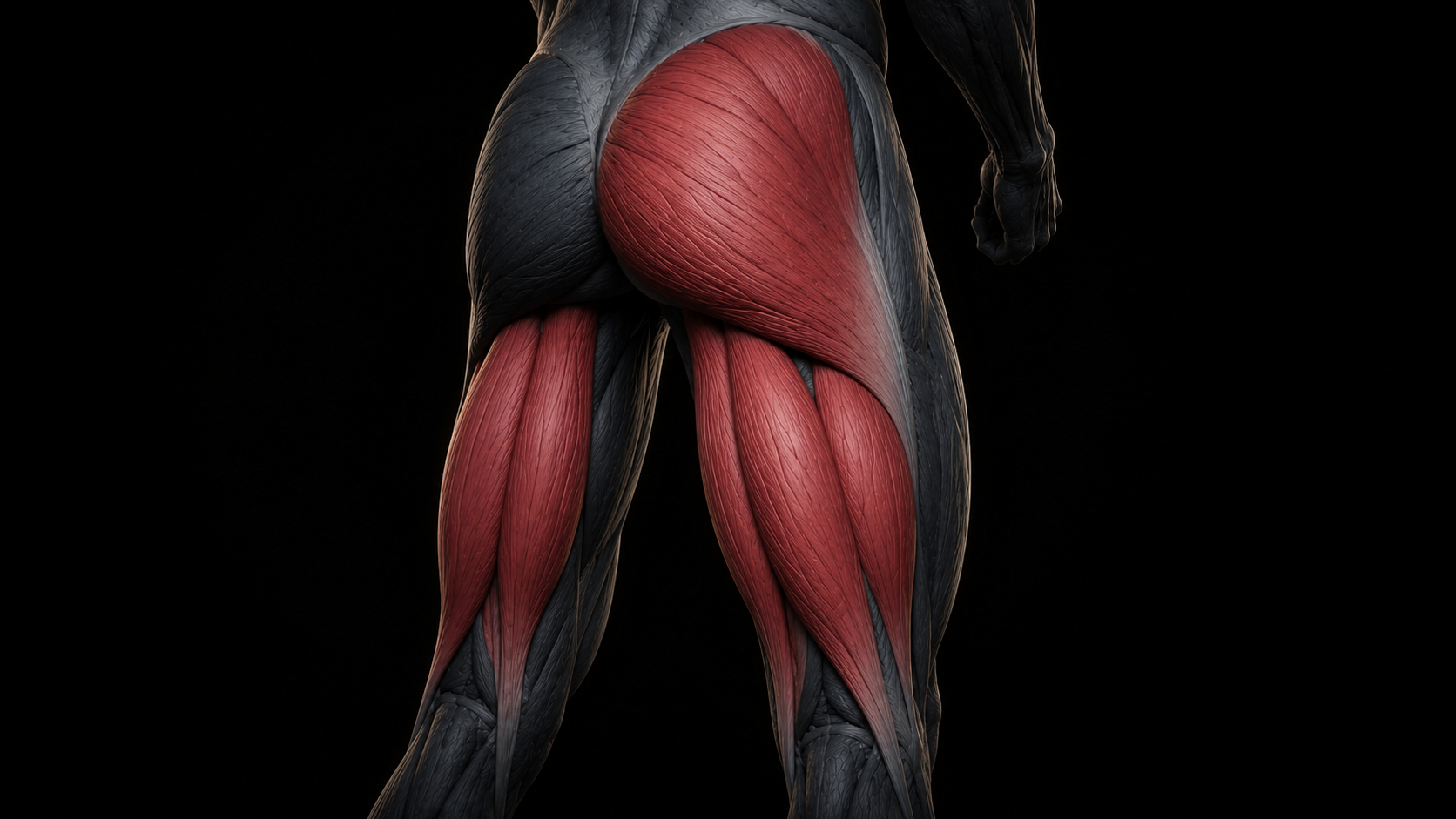
Most people train the back of their legs as one undifferentiated block called the posterior chain, and that is precisely why most people’s hamstrings and glutes are half-built. The hamstrings are three muscles with four heads. Two of them are recruited hardest by hip hinging, two by knee bending, and one of them cannot extend the hip at all. The glutes are three muscles with different fibre directions that answer to hip extension, abduction and rotation respectively.
Run a programme of nothing but Romanian deadlifts and you will grow roughly half of a hamstring. Run nothing but leg curls and you will grow the other half. Do hip thrusts alone and you will train the largest muscle in the body only in the range where it is already short.
The useful organising idea is joint angle. Where the hip and knee sit determines which of these muscles can produce force at all. Get that straight and exercise selection follows almost automatically.
The Muscles and What They Actually Do
The hamstrings — three muscles, four heads
All four heads flex the knee. Only three of them extend the hip.
| Muscle | Origin | Crosses hip? | Actions | Position |
|---|---|---|---|---|
| Biceps femoris, long head | Ischial tuberosity | Yes | Hip extension, knee flexion, external rotation of hip and knee | Lateral (outer) |
| Biceps femoris, short head | Linea aspera of femur | No | Knee flexion, external rotation of the knee only | Lateral, deep |
| Semitendinosus | Ischial tuberosity | Yes | Hip extension, knee flexion, internal rotation | Medial (inner), superficial |
| Semimembranosus | Ischial tuberosity | Yes | Hip extension, knee flexion, internal rotation | Medial, deepest |
The medial two insert on the tibia; the long head of biceps femoris crosses to the fibula. That difference in insertion is why the medial hamstrings internally rotate the lower leg and the lateral hamstring externally rotates it.
The lateral–medial divide
This is the single most useful training distinction for the hamstrings.
| Movement pattern | Preferentially loads | Typical exercises |
|---|---|---|
| Hip extension, knee near-straight | Biceps femoris long head | Romanian deadlift, good morning, 45° back extension |
| Knee flexion, hip fixed | Semitendinosus, semimembranosus, short head | Lying and seated leg curls, Nordic curls |
A 2015 regional-activation study found the lying leg curl beat the stiff-legged deadlift for activating the distal portion of the hamstrings, with no meaningful difference proximally. Hinging alone leaves the lower third of the group under-stimulated.
Honest caveat: most of this literature is surface EMG, which measures electrical activity during a set, not growth over months. The direction of the finding is consistent enough to act on; the precision is not.
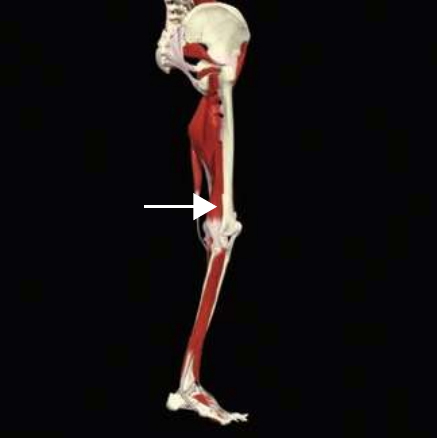
Why the short head matters more than its size suggests
The short head of biceps femoris originates on the femur, not the pelvis, and has no action at the hip whatsoever. If your hamstring training is entirely hinge-based, this head is not being trained — not under-trained, untrained. It earns its keep when the hip is flexed: in a seated leg curl the long head is already shortened at the hip and cannot contribute much at the knee, so the short head and the medial hamstrings take over.
Active insufficiency, or why squats are a poor hamstring exercise
A muscle crossing two joints cannot produce much force when it is short at both ends.
| Hip | Knee | Hamstring length | Consequence |
|---|---|---|---|
| Flexed (hinge bottom) | Extended | Long at both ends | Maximum tension — this is where growth happens |
| Extended | Flexed | Short at both ends | Active insufficiency, very little force available |
| Extending | Extending (squat) | Roughly constant | Lengthening distally, shortening proximally — the two cancel |
That last row is the squat. As you stand up, hip extension shortens the hamstrings while knee extension lengthens them, so net muscle length barely changes across the rep. EMG work has repeatedly ranked the squat at or near the bottom for hamstring involvement. The deadlift is different — the knee starts far less flexed, so hip extension dominates and the hamstrings genuinely work.
One popular belief worth retiring: the hamstrings are not fast-twitch dominant. Better methodology puts them at a fairly even split of type I and type II fibres, so both heavy low-rep and lighter high-rep work belong in the programme.
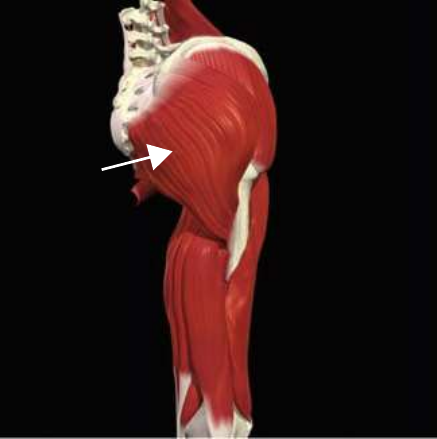
The glutes — three muscles, three jobs
| Muscle | Origin | Insertion | Primary actions |
|---|---|---|---|
| Gluteus maximus | Posterior ilium, sacrum, coccyx, sacrotuberous ligament | Iliotibial band (upper fibres), gluteal tuberosity of femur (lower fibres) | Hip extension, external rotation, posterior pelvic tilt |
| Gluteus medius | Outer ilium between the gluteal lines | Greater trochanter | Hip abduction, pelvic stabilisation, internal rotation (anterior fibres) and external rotation (posterior fibres) |
| Gluteus minimus | Outer ilium below the gluteal lines | Anterior greater trochanter | Hip abduction, internal rotation, pelvic stabilisation |
Gluteus maximus is the largest muscle in the body and it has two functionally distinct regions.
| Region | Insertion | Best loaded by |
|---|---|---|
| Upper fibres | Iliotibial band | Wide stance, abduction and external rotation — sumo pulls, wide-stance squats, abduction work |
| Lower fibres | Gluteal tuberosity of the femur | Pure sagittal hip extension — narrow-stance thrusts, conventional deadlifts, back extensions |
Treat that split as anatomically sound but lightly tested. Fibre direction clearly differs; whether targeting one region produces measurably different growth is not established.
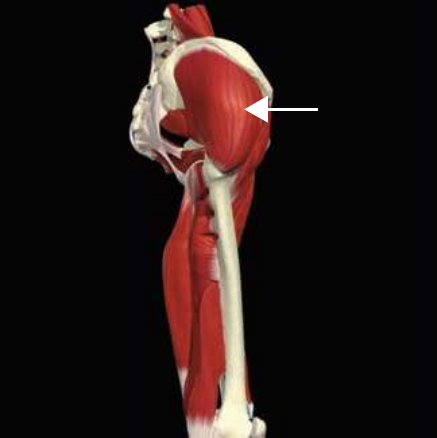
Gluteus medius and minimus — the frontal-plane muscles
Gluteus medius is the primary hip abductor and the main defence against the knee collapsing inward during single-leg loading. Its anterior fibres abduct and internally rotate; its posterior fibres abduct and externally rotate. Gluteus minimus sits underneath with a stronger internal rotation bias, which is why abduction with the hip slightly internally rotated — a side-lying raise, a banded clamshell — is the standard way to bias it.
These two are stabilisers before they are movers, so they need single-leg loading, not only machine abduction.
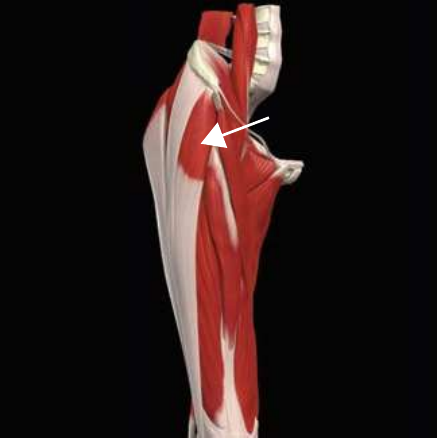
Tensor fasciae latae — the muscle that steals the work
Tensor fasciae latae runs from the anterior iliac crest into the iliotibial band. It flexes, abducts and internally rotates the hip — an almost perfect overlap with the anterior gluteus medius. When abduction is performed with the hip flexed forward, tensor fasciae latae takes a large share of the work. Keeping the leg slightly behind the midline is the standard cue for keeping the load on the glutes: a sensible mechanical argument, not a well-quantified one.
Muscle-Specific Exercises (Anatomy and Form Explained)
| Target | Exercise | Why it works |
|---|---|---|
| Biceps femoris long head | Romanian deadlift | Long hip lever with the knee near-straight |
| Medial hamstrings + short head | Seated leg curl | Hip flexed, so the knee flexors work at long muscle lengths |
| Whole group, eccentric | Nordic curl | Lengthening under high force |
| Gluteus maximus, shortened | Hip thrust | Peak resistance at full hip extension |
| Gluteus maximus, lengthened | Reverse lunge or deficit pull | Deep hip flexion under load |
| Gluteus medius and minimus | Loaded abduction and single-leg work | Frontal-plane demand |
Romanian deadlift — the long head builder
What it targets and why: hip extension with the knee held at a fixed, slight bend keeps the biceps femoris long head lengthening throughout the descent. Because the knee angle barely changes, nothing gained at the hip is cancelled at the knee — the opposite of the squat problem above.
Setup and execution: unlock the knees to roughly 15–20° and hold that angle. Push the hips backwards, not the chest down, and let the bar track the legs the whole way. Stop when the hamstrings run out of length — for most people somewhere between mid-shin and just below the knee, not the floor.
The nuance most people miss: the range is set by your hamstrings, not by the plates. The moment your pelvis stops rotating forward and your lumbar spine starts rounding, the hamstrings have stopped lengthening and the spinal erectors have taken the job. That is the end of the rep.
Common error → fix: going too heavy so the glutes and lower back drive the lift. Drop the load, slow the eccentric to three seconds and chase the stretch rather than the number.
Seated leg curl — the best-evidenced hamstring isolation
What it targets and why: hip flexion of about 90° pre-lengthens the biarticular hamstrings, so the group works from a longer starting length than in a lying curl. The long head is partially shortened at the hip, shifting more of the knee-flexion work to the short head and the medial hamstrings.
Setup and execution: hips pinned, thigh pad tight, curl to full knee flexion, control the return without letting the stack touch down.
The nuance most people miss: one twelve-week trial comparing seated with lying leg curls found substantially greater hamstring growth seated — roughly double in the muscles measured. That is a single small-sample study, so treat it as a good reason to prefer seated curls, not settled fact. Foot rotation shifts emphasis too: toes out biases the lateral hamstring, toes in the medial. Effects are small; point your toes toward the region you want and move on.
Common error → fix: the hips lifting off the pad at the end of the curl. That is the hip flexors letting go. Tighten the lap pad and shorten the range slightly.
Nordic curl — eccentric overload, with an honest asterisk
What it targets and why: the hamstrings resist knee extension with the hip held near neutral, which loads the long head and the medial hamstrings simultaneously at long length under very high force.
Setup and execution: anchor the ankles, hold a straight line from knee to shoulder, lower as slowly as you can control, then push off the floor with your hands to return.
The nuance most people miss: the widely quoted claim that Nordic curls halve hamstring injury rates traces to a meta-analysis reporting a risk ratio of about 0.49, and that finding has been formally contested in a later reappraisal. Treat roughly 50% as the optimistic end of a contested range.
Common error → fix: hinging at the hip on the way down, which converts it into a much easier movement. Squeeze the glutes and treat the body as one rigid segment. If you cannot control past 30°, use a band or lower onto a raised pad.
Barbell hip thrust — glute maximus at short length
What it targets and why: resistance peaks at full hip extension, exactly where gluteus maximus is shortest and firing hardest. No other common exercise loads that end of the range well.
Setup and execution: shoulder blades on a bench, chin tucked, shins vertical at the top, drive through the heels. Finish at a neutral pelvis.
The nuance most people miss: the hip thrust is not categorically superior to squatting for glute growth — a controlled trial comparing the two found similar gluteal hypertrophy from both. Its real advantage is covering a range squats do not, which argues for having both rather than replacing one with the other. Keeping constant tension by working the top portion, rather than resting the bar at the bottom of each rep, is a reasonable refinement.
Common error → fix: finishing with lumbar hyperextension instead of hip extension. Ribs down, posterior pelvic tilt at the top, and stop the rep when the hips are level.
Reverse lunge — gluteus maximus at long length
What it targets and why: the front leg’s hip reaches deep flexion at the bottom, where gluteus maximus is maximally lengthened. Stepping backwards rather than forwards reduces the braking demand on the knee.
Setup and execution: step back far enough that the front shin stays near vertical, allow a modest forward torso lean, then drive through the front heel without pushing off the back foot.
The nuance most people miss: torso angle is the dial. More forward lean lengthens the hip lever and shifts work to the glutes; a vertical torso shifts it to the quadriceps. Choosing deliberately is the difference between a glute exercise and a quad exercise.
Common error → fix: a short step, which puts the knee far in front of the toes and turns it into a quad-dominant movement. Lengthen the step.
Loaded hip abduction — gluteus medius and minimus
What it targets and why: abduction is the only movement that loads these two directly against meaningful resistance. Everything else asks them to stabilise.
Setup and execution: seated abduction machine, cable abduction, or banded side-lying raises. Keep the working leg slightly behind the midline and do not let the hip flex.
The nuance most people miss: pair machine abduction with genuine single-leg work — single-leg Romanian deadlifts, lateral step-ups, a pelvic-drop hip hitch off a step. Those force the frontal-plane stabilising role the machine cannot reproduce, and pelvic drops and side planks with leg abduction rank among the highest gluteus medius EMG recorded.
Common error → fix: leaning back and swinging the leg, which lets tensor fasciae latae and the lumbar spine contribute. Slow it down and hold the top for a full second.
Programming these two groups
| Group | Weekly sets | Rep guidance | Progression |
|---|---|---|---|
| Hamstrings | 10–16, split hinge and curl | 4–8 on hinges, 8–20 on curls | Linear on hinges, double progression on curls |
| Gluteus maximus | 10–16, split short and long range | 5–8 heavy, 8–15 on thrusts | Linear on pulls and thrusts |
| Gluteus medius and minimus | 4–8 | 12–20 | Double progression, then add a stability variant |
Two sessions a week beats one. Beyond roughly twenty weekly hamstring sets, most trainees start running into recovery problems rather than gains — and the hamstrings are unusually prone to lingering soreness after heavy eccentric work.
Warm-Up for Hamstrings and Glutes
Eight to ten minutes, structured as RAMP — Raise, Activate, Mobilise, Potentiate. Systematic review evidence supports 5–10 minutes at moderate intensity as sufficient; longer warm-ups do not perform better and start costing you the session.
| Phase | Time | What to do | Why |
|---|---|---|---|
| Raise | 2–3 min | Bike, brisk incline walk or easy rowing | Raises muscle temperature and blood flow before high-force hinging |
| Activate | 3 min | Banded glute bridge 2 × 15 · banded lateral walk 2 × 12 each way · side-lying abduction 2 × 15 | Gets the glutes producing force before the hamstrings and erectors are asked to |
| Mobilise | 2 min | Controlled leg swings, hip 90/90 transitions, unloaded hip hinge drill with a dowel | Rehearses the exact ranges the session demands |
| Potentiate | 2–3 min | Ramping sets: empty bar × 8, then ~50% × 5, ~70% × 3 | Bridges the warm-up to working weight and grooves the pattern |
Two things worth being precise about.
The Activate phase is not fixing “glute amnesia”. Muscles do not forget how to contract, and that framing has no real support. What low-load gluteal work does have behind it is modest acute performance evidence — one trial found a low-load gluteal warm-up improved subsequent jump force production after a short rest. The practical case is narrower and more honest: hinging heavily with the glutes cold means the erectors and hamstrings absorb a larger share of the first working set. Keep the loads light. If your banded work is genuinely hard, it is a set, not a warm-up.
Static stretching before hinging is not banned, but keep it brief. Meta-analytic work puts the threshold for a meaningful stretch-induced force deficit at around 60 seconds per muscle. Below that, effects on strength are negligible; above it, you are handing back force before a lift that needs it. Thirty seconds per hamstring is already enough to gain range acutely, so there is no reason to hold longer.
The hinge rehearsal matters more than any of it. The Romanian deadlift is a pattern before it is a load, and rehearsing it unloaded costs half a minute.
Cool-Down for Hamstrings and Glutes
Three to five minutes. Deliberately much shorter than the warm-up, and that asymmetry is evidence-driven.
What it does not do. Post-exercise static stretching does not meaningfully reduce delayed onset muscle soreness, does not restore range of motion faster, and does not speed strength recovery compared with simply stopping. A recent expert Delphi consensus reached agreement on this. This matters especially here, because heavy eccentric hamstring work — Nordics above all — produces genuine soreness, and stretching it will not help.
What it actually does. It brings heart rate and breathing down gradually rather than abruptly. It gives you a warm window in which mobility work is more comfortable, which is useful if you are trying to gain range rather than recover. And it signals the end of the session, which does more for adherence than most people admit.
A reasonable version:
- 1–2 min easy walking or light cycling
- Standing or supine hamstring stretch, 30 seconds each side
- Half-kneeling hip flexor stretch, 30 seconds each side — the antagonist that tends to limit hip extension
- 60 seconds of slow nasal breathing
If you want more mobility work, do it. Just be clear that you are training range of motion, not accelerating recovery.
Putting It Together
One posterior-chain session covering every head discussed above:
| Order | Exercise | Sets × reps | Purpose |
|---|---|---|---|
| 1 | RAMP warm-up | 8–10 min | Glutes online, hinge rehearsed |
| 2 | Romanian deadlift | 3 × 5–8 | Biceps femoris long head, lengthened |
| 3 | Barbell hip thrust | 3 × 8–12 | Gluteus maximus, shortened range |
| 4 | Reverse lunge | 3 × 8–10 each leg | Gluteus maximus, lengthened range |
| 5 | Seated leg curl | 3 × 10–15 | Medial hamstrings and short head |
| 6 | Seated hip abduction | 2 × 15–20 | Gluteus medius and minimus |
| 7 | Cool-down | 3–5 min | Downshift |
Repeat two to three days later with the emphasis reversed — lead with a heavy knee-flexion movement and follow with lighter hip extension. Nordic curls slot in at the end of one of the two days, two sets of four to six controlled reps, not both.
Key Takeaways
- Hinging trains the biceps femoris long head. Knee flexion trains the medial hamstrings and short head. You need both; the short head cannot be reached by hinging at all.
- Squats are a poor hamstring exercise because the hamstrings shorten at the hip and lengthen at the knee simultaneously. Deadlifts are not.
- Hamstrings are an even mix of fibre types, not fast-twitch dominant. Use heavy and light work.
- Gluteus maximus needs both ranges: hip thrusts for the short end, deep hip flexion under load for the long end.
- Gluteus medius and minimus need loaded abduction and single-leg stability work.
- Warm up 8–10 minutes with RAMP; cool down 3–5. Post-session stretching does not reduce soreness.