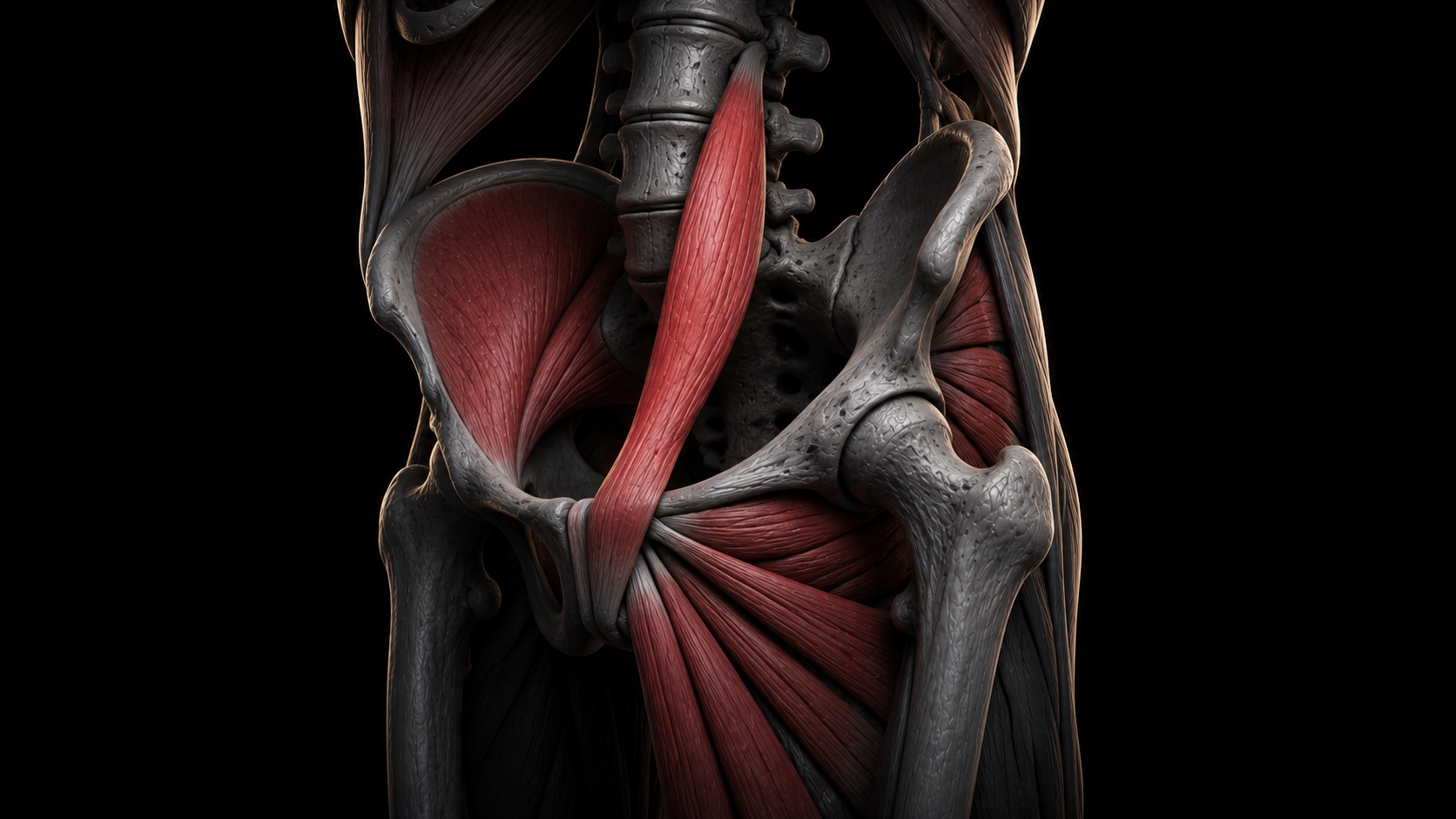
More muscles cross the hip than any other joint in the body, and most training programmes meaningfully load about six of them. Squats and deadlifts cover the glutes and hamstrings well. Everything else — the deep rotators, the adductor group, the iliopsoas itself — gets whatever incidental work it can scavenge from movements aimed at something else.
That is usually fine until it isn’t. The hip is where most persistent lower-body complaints originate, and it is also the group where the gap between what people train and what is actually there is widest. This post covers what sits around that joint, what each part does, and how to load it deliberately rather than by accident.
One note before starting: this is the one muscle group in this series where the training evidence is genuinely thin. There is good anatomical and biomechanical work, and very little controlled hypertrophy research. Where that is the case, it will be said plainly.
The Muscles and What They Actually Do
Iliopsoas — the primary hip flexor
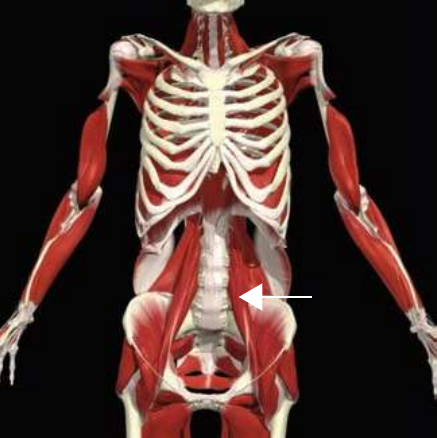
The iliopsoas is not one muscle but a unit of three: psoas major, iliacus, and psoas minor, the last of which is absent in a substantial minority of people. Together they form the strongest flexor of the hip.
| Component | Origin | Insertion | Distinct role |
|---|---|---|---|
| Psoas major | Transverse processes and bodies of T12–L5 | Lesser trochanter | Also acts on the lumbar spine |
| Iliacus | Iliac fossa | Lesser trochanter, via the shared tendon | Stabilises the pelvis in gait |
| Psoas minor | T12–L1 vertebral bodies | Iliac fascia | Minor; often absent |
The psoas major is the one worth understanding, because it originates on the spine rather than the pelvis. That gives it a job no other hip flexor has: with the femur fixed, it acts on the lumbar spine directly. A short, stiff psoas pulls the lumbar spine toward extension, which is the mechanism behind the association between hip flexor tightness and an anterior pelvic tilt.
It also explains why most “hip flexor stretches” miss. A standard lunge stretch with the torso upright lengthens rectus femoris well, but leaves the psoas relatively slack because the lumbar spine is still free to extend and take up the slack. Adding a posterior pelvic tilt and resisting the urge to arch is what actually loads it.
The flexors change roles through the range
The rectus femoris and the iliopsoas do not simply share the work. Their relative contribution shifts with hip angle: rectus femoris has the mechanical advantage early in the range, from standing toward roughly mid-flexion, while the iliopsoas becomes progressively more effective as the hip flexes further. The practical consequence is that hip flexion trained only through the first 45 degrees is largely rectus femoris work, and the iliopsoas gets trained properly only when the knee comes above hip height.
The adductor group — five muscles, one compartment
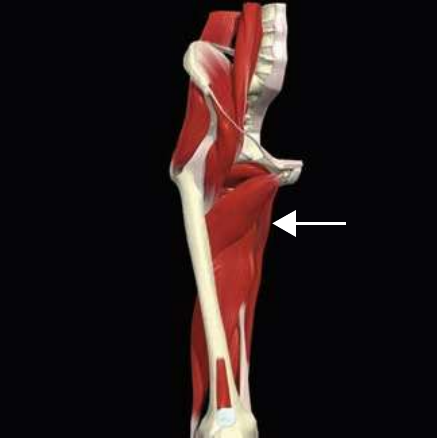
The medial compartment holds five muscles. Four insert on the femur; one — gracilis — crosses the knee to reach the tibia.
| Muscle | Crosses knee? | Primary actions |
|---|---|---|
| Pectineus | No | Adduction, flexion, rotation both directions |
| Adductor longus | No | Adduction, flexion, assists rotation |
| Adductor brevis | No | Adduction, flexion |
| Adductor magnus | No | Adduction, plus extension from its hamstring portion |
| Gracilis | Yes | Adduction, knee flexion, internal rotation of the tibia |
Two of these repay attention.
Pectineus has dual innervation — femoral nerve and, commonly, an accessory obturator branch — reflecting its position bridging the anterior and medial compartments. It is most active in the first 30 degrees of hip flexion, which makes it a genuine contributor to standing up from a chair rather than an anatomical footnote.
Adductor magnus is effectively two muscles wearing one name. Its adductor portion runs from the pubic and ischial rami to the linea aspera under obturator nerve supply. Its hamstring portion originates on the ischial tuberosity, inserts on the adductor tubercle, and is supplied by the tibial division of the sciatic nerve — the same origin and the same nerve as the true hamstrings. Functionally and neurologically it is a hamstring, and some anatomists call it exactly that. It is also a serious hip extensor, which is why heavy sumo deadlifts and wide-stance squats load the adductors far harder than most people expect.
The deep six — the rotator cuff of the hip
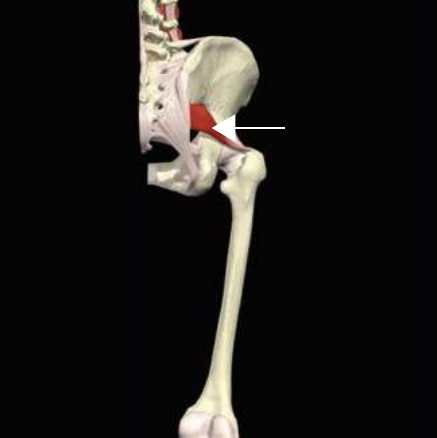
Behind the gluteus maximus sit six short external rotators: piriformis, obturator internus, superior and inferior gemellus, obturator externus, and quadratus femoris. Like the rotator cuff of the shoulder, they are small, deep, and exist to keep the femoral head seated rather than to move heavy loads.
Three details matter:
- Piriformis sits most superiorly, and the sciatic nerve passes beneath it in roughly 85–90% of people, with variant paths through or around the muscle in about 13%. Prevalence varies markedly by population.
- Obturator internus and both gemelli converge into a common tendon, sometimes called the triceps coxae. The obturator internus tendon turns roughly 90° around the lesser sciatic notch, which acts like a pulley and gives it more leverage than its size suggests.
- Quadratus femoris is the only one that performs pure external rotation with no abduction component, and the only one whose function does not change when the hip flexes. The other five switch from external rotation toward abduction as the hip bends.
That last point is the useful one. Below about 60° of hip flexion these muscles externally rotate; above it, most of them become abductors. So training them through a single joint angle trains only part of what they do.
Tensor fasciae latae and the sartorius
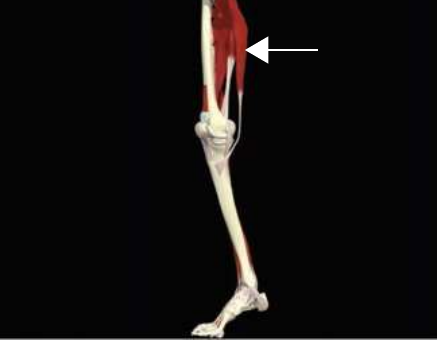
TFL flexes, abducts and internally rotates the hip, and is the only muscle other than the upper glute max fibres to insert directly into the IT band. It is overactive far more often than it is weak, typically compensating for a gluteus medius that is not doing its job. The pattern is self-reinforcing: weak glute medius, TFL takes over, TFL shortens, glute medius is further inhibited.
Sartorius is the longest muscle in the body and the only one that can flex, abduct and externally rotate the hip while flexing the knee, all at once. That combination is the cross-legged tailor’s position from which it takes its name.
Muscle-Specific Exercises (Anatomy and Form Explained)
A caveat worth stating up front: there is very little controlled training research on most of these muscles. The exercise selections below follow from anatomy and from what limited EMG work exists, not from hypertrophy trials. Treat them as well-reasoned rather than proven.
1. Copenhagen plank — the adductor exercise that earns its place
What it targets and why. Side-lying with the top leg supported on a bench, the adductors of the top leg work isometrically against a long lever to hold the pelvis up. It produces some of the highest adductor activation of any commonly used exercise, and the adductor longus and gracilis take the largest share.
Setup and execution. Forearm under the shoulder, top leg on a bench at roughly knee or mid-shin height, bottom leg hanging. Lift the hips until the body is straight. Hold. Lower under control rather than dropping.
The nuance most people miss. The lever length is the load. Bench under the ankle is far harder than bench under the knee, so regress by moving the support closer to the hip rather than by shortening the set. Most people start too hard and compensate by rotating the pelvis backward.
Common error → fix. Letting the hips sag and the pelvis roll open. Both convert it into a rest position. Stop the set when the line breaks; the isometric has no value once the position is lost.
2. Wide-stance or sumo deadlift — the adductors as extensors
What it targets and why. The wide stance places the adductors, particularly the hamstring portion of adductor magnus, in a lengthened position at the bottom, from which they contribute directly to hip extension. This is the heaviest adductor loading available.
Setup and execution. Stance wide enough that the shins are near vertical at the bottom, toes turned out to match the hips. Push the floor apart rather than pulling the bar up.
The nuance most people miss. The adductor contribution comes from the stretch at the bottom, not from the lockout. Cutting depth by pulling from blocks removes most of what makes this an adductor movement.
Common error → fix. Stance so wide that the hips cannot reach the bar without the lower back rounding. Width should be set by hip anatomy, not by copying someone else’s stance.
3. Hanging or supported straight-leg raise — the iliopsoas
What it targets and why. Hip flexion above 90° with the knee extended. The straight knee puts rectus femoris at a mechanical disadvantage — it is already shortened at the knee — so the iliopsoas has to do the work.
Setup and execution. Hang or brace, posteriorly tilt the pelvis first, then raise the legs. The pelvic tilt is the exercise; the legs rising is a consequence.
The nuance most people miss. Height matters more than reps. If the legs stop at parallel, the set has trained the range where rectus femoris dominates. The iliopsoas earns its keep above hip height.
Common error → fix. Swinging, and bending the knees as fatigue arrives — both hand the work straight back to the rectus femoris. Reduce range and keep the knees locked instead.
4. 90/90 hip switch — the deep six through their full range
What it targets and why. Seated with one hip externally rotated in front and one internally rotated behind, switching sides under control loads the deep rotators actively at both ends of their range, including the position above 60° of flexion where they act as abductors.
Setup and execution. Sit tall, both knees at 90°, hands off the floor if you can. Rotate the knees to the opposite side without letting the torso collapse. Slow.
The nuance most people miss. This is not a stretch. Lifting the knees off the floor during the transition, rather than sliding them, is what makes it active work for the rotators rather than passive range.
Common error → fix. Using the hands to drive the rotation. Fold the arms if that is the only way to stop it.
5. Banded clamshell and side-lying abduction — glute medius, minimus and the deep six
What it targets and why. Hip abduction with slight external rotation from a flexed position. With the hip flexed to roughly 45°, the obturator internus and gemelli work alongside the glute medius and minimus.
Setup and execution. Side-lying, band above the knees, hips stacked and stationary. Open the top knee without letting the pelvis roll backward.
The nuance most people miss. Keeping the pelvis square is the whole exercise. The moment it rolls back, the movement becomes hip extension driven by glute max and the target muscles disengage.
Common error → fix. Band too heavy, which guarantees pelvic rotation. This is low-load, high-repetition work.
6. Cossack squat — the adductors and the sartorius through range
What it targets and why. A deep lateral squat loads the adductors of the extended leg in a long position while the working hip flexes, abducts and externally rotates — the sartorius pattern.
Setup and execution. Wide stance, shift into one hip, keep the extended leg’s heel down and toes up. Descend as far as control allows.
The nuance most people miss. Depth without load beats load without depth here. The value is in reaching positions the hip rarely visits, not in the weight.
Common error → fix. Letting the trailing foot roll. Keep the sole flat, and reduce depth until that is possible.
What to be careful with
Aggressive piriformis stretching for suspected “piriformis syndrome” is worth a caveat. The term is largely superseded by deep gluteal syndrome, which covers several sources of sciatic irritation in that region — the gemelli-obturator complex among them. Persistent buttock pain with radiating symptoms is a referral, not a stretching problem.
Warm-Up for Hips
Eight to ten minutes on the RAMP structure — Raise, Activate, Mobilise, Potentiate. Systematic review evidence supports 5–10 minutes at moderate intensity, with no added benefit from going longer.
| Phase | Time | What to do | Why |
|---|---|---|---|
| Raise | 2–3 min | Easy bike or brisk walk | Raises tissue temperature and blood flow |
| Activate | 3–4 min | Banded clamshell 2×15 · side-lying abduction 2×15 · glute bridge 2×12 | Wakes glute medius and the deep rotators before heavy hip work |
| Mobilise | 2–3 min | 90/90 hip switches ×8 each side · deep lunge with rotation ×5 each side · leg swings front-to-back and side-to-side | Takes the joint through the ranges the session will demand |
| Potentiate | 2 min | Ramping sets of the day’s first movement — bodyweight, then ~50%, then ~70% | Bridges warm-up to working load |
The Activate phase is the part that matters here, for the same reason it matters at the shoulder. The TFL-versus-gluteus-medius pattern described above is a compensation problem: if the glute medius does not fire early, something else covers for it, and heavy hip work reinforces the substitution. Two minutes of low-load abduction work in advance is cheap insurance.
Keep it genuinely light. If clamshells feel like a hard set, the band is too heavy for a warm-up.
Cool-Down for Hips
Three to five minutes. Shorter than the warm-up, deliberately.
What it does not do. Post-exercise static stretching does not meaningfully reduce delayed onset muscle soreness, does not restore range of motion faster, and does not speed strength recovery compared with simply resting. An expert consensus review reached full agreement on this point. The hip flexor stretch after leg day feels productive; it is not doing what it is usually credited with.
What it does do. It brings heart rate and breathing down gradually, and it provides a warm window in which mobility work is more comfortable — which is worth having if you are actually chasing range of motion, as opposed to recovery. For the hip specifically, that second point has more value than at most joints, because hip range is genuinely trainable and genuinely useful.
A reasonable version:
- 1–2 min easy walking
- Half-kneeling psoas stretch with a posterior pelvic tilt, 30 seconds each side — the pelvic tilt is what makes it a psoas stretch rather than a quad stretch
- Figure-4 stretch, 30 seconds each side
- Butterfly or frog position, 60 seconds
If you want more hip mobility work than that, do it — just file it under training range of motion rather than recovery.
Putting It Together
| Order | Exercise | Sets × reps | Purpose |
|---|---|---|---|
| 1 | RAMP warm-up | 8–10 min | Glute medius and deep rotators online |
| 2 | Sumo or wide-stance deadlift | 3 × 5–6 | Heavy adductor and extensor loading |
| 3 | Copenhagen plank | 3 × 20–30s each side | Adductors, isometric, long lever |
| 4 | Hanging straight-leg raise | 3 × 8–12 | Iliopsoas above hip height |
| 5 | Banded clamshell | 2 × 15–20 each side | Glute medius, minimus, deep six |
| 6 | 90/90 hip switch | 2 × 8 each side | Rotators through full range |
| 7 | Cool-down | 3–5 min | Downshift, mobility window |
This works as a standalone hip session or, more practically, distributed: the heavy work with your lower-body days, the Copenhagen planks and clamshells appended to any session.
Key Takeaways
- The psoas originates on the spine, not the pelvis, which is why a tight one affects lumbar posture and why most hip flexor stretches miss it. Add a posterior pelvic tilt.
- Rectus femoris dominates early hip flexion; the iliopsoas dominates deep flexion. Leg raises that stop at parallel barely train the iliopsoas.
- Adductor magnus is functionally a hamstring — same origin, same nerve, and a real hip extensor. Wide-stance pulling loads it hard.
- The deep six change function with hip angle: external rotators below roughly 60° of flexion, abductors above it. Train both positions.
- TFL overactivity usually reflects glute medius weakness, not a TFL problem. Address the cause.
- Warm up 8–10 minutes with RAMP, cool down 3–5. Post-session stretching is for range of motion, not recovery.
- Be honest about the evidence: the anatomy here is well established, the training research is not. Most hip recommendations, these included, are reasoned from structure rather than tested.