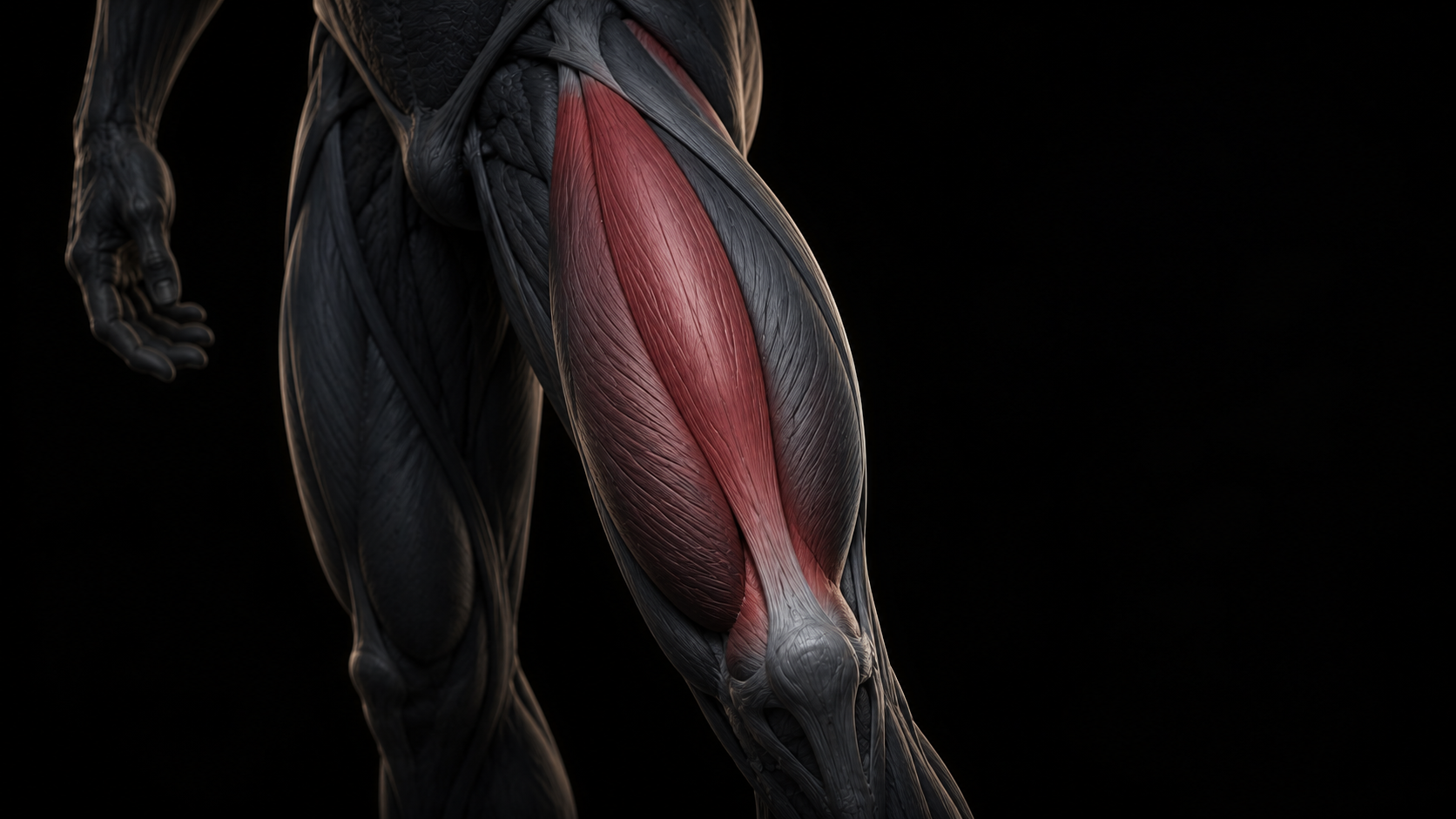
Almost everyone who trains legs squats, and a great many of them end up with quads that are strong but flat. The reason is rarely effort. It is that three of the four quadriceps heads do exactly one thing, the fourth does something quite different, and a programme built entirely from squat variations systematically under-serves that fourth head.
The quadriceps femoris is the largest muscle mass in the body and the only group that extends the knee. It is also, unusually, one where the anatomy hands you a clear prescription rather than a vague one: understand where each head crosses a joint and the exercise selection stops being a matter of taste.
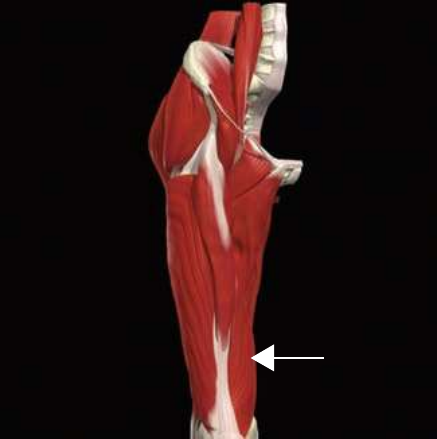
The Muscles and What They Actually Do
All four heads converge into a common quadriceps tendon, which envelops the patella and continues below it as the patellar ligament to attach at the tibial tuberosity. The patella is a sesamoid bone sitting inside that tendon, and its job is leverage: it holds the tendon away from the knee’s axis of rotation, lengthening the moment arm so the quads can produce far more extension torque. Patellar tracking problems therefore sit directly in the force path.
| Head | Origin | Crosses hip? | Function | What makes it distinct |
|---|---|---|---|---|
| Rectus femoris | Anterior inferior iliac spine (straight head); superior acetabular ridge (reflected head) | Yes | Hip flexion + knee extension | The only biarticular head. Its length depends on hip angle as well as knee angle. |
| Vastus lateralis | Greater trochanter, lateral lip of the linea aspera | No | Knee extension | Largest of the four. Produces the outer “sweep” and pulls the patella laterally. |
| Vastus medialis | Intertrochanteric line, medial lip of the linea aspera | No | Knee extension + patellar tracking | The teardrop above the inner knee. Its lowest, most oblique fibres oppose the lateral pull on the patella. |
| Vastus intermedius | Anterior and lateral shaft of the femur | No | Knee extension | The deepest head, sandwiched between rectus femoris and the femur. Pure extensor, no secondary action. |
Rectus femoris — the head that changes the rules
This is the whole story in one paragraph. Because the rectus femoris crosses the hip as well as the knee, its length is set by two joints at once, and that creates a problem no other quad head has: active insufficiency. When the hip is already flexed — sitting upright on a leg extension machine with the hips at 90 degrees, for example — the rectus femoris is pre-shortened at its upper end and cannot contribute much force at the knee. The three vasti pick up the slack.
The squat has the mirror-image problem. On the way up, the knee is extending (which shortens the rectus femoris) while the hip is also extending (which lengthens it). The two changes largely cancel out, so the muscle barely changes length across the whole rep and never reaches a deep stretch or a full contraction. It works, but it works in the narrowest slice of its range.
| Joint configuration | Rectus femoris state | Practical example |
|---|---|---|
| Hip flexed, knee flexed | Neutral-ish — shortened above, lengthened below | Bottom of a seated leg press |
| Hip extended, knee flexed | Lengthened at both ends | Reverse Nordic, sissy squat, bottom of a split squat rear leg |
| Hip flexed, knee extended | Shortened at both ends — weakest position | Seated with legs straight out |
| Hip extending as knee extends | Near-constant length | Ascent of a back squat |
This is not a reason to stop squatting — studies still show respectable rectus femoris growth from squats. It is a reason to add one exercise that fixes the hip angle, forcing a genuine excursion at the knee. One is enough.
The three vasti
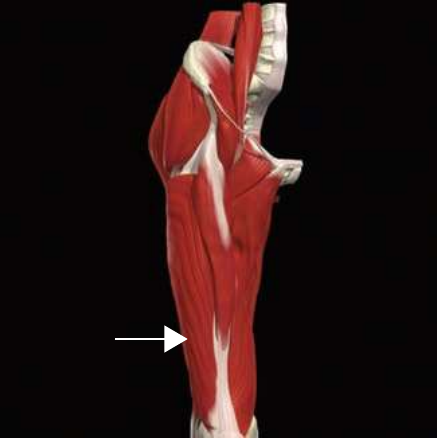
Vastus lateralis is the biggest head by a comfortable margin and gives the thigh its outward flare. Its line of pull is angled outward — useful for force production, less useful for keeping the kneecap centred.
Vastus medialis is the counterweight. Its most distal fibres run at a sharp oblique angle, sometimes labelled the VMO, and they pull the patella medially against the lateral drag of the vastus lateralis. This is where a lot of gym folklore lives, so it is worth being blunt: the idea that you can selectively train the VMO with a particular exercise, foot position or terminal-range squeeze is not well supported, and attempts to demonstrate isolated activation have produced inconsistent results. The workable version is simpler — train the quads through a full range, include single-leg work that demands frontal-plane control, and the medialis develops with everything else.
Vastus intermedius sits underneath the rectus femoris and cannot be biased at all. It is a pure knee extensor, working on every quad exercise you will ever do. Nothing to programme for it specifically.
The fifth head, and the muscle that is not a quad
Two footnotes worth having.
The first is that “quadriceps” may be an undercount. A 2016 cadaveric study described a distinct muscle belly between vastus lateralis and vastus intermedius — the tensor vastus intermedius — with its own nerve and blood supply, present in all 26 limbs the authors dissected. Later cadaveric work has found it far less consistently, in roughly 40 per cent of limbs in one series. Interesting anatomy; no training implication whatsoever, since it extends the knee alongside everything else.
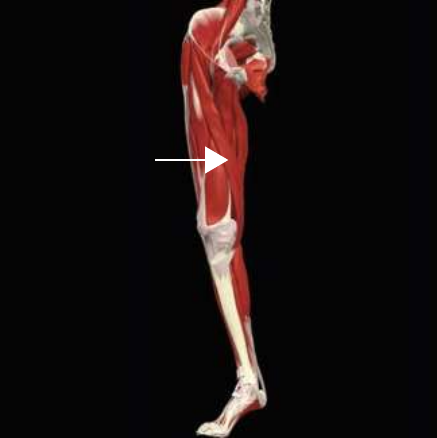
The second correction matters more, because it is common. Sartorius is not a quadriceps muscle and it does not extend the knee. It is the longest muscle in the body, running as a narrow strap from the anterior superior iliac spine diagonally across the thigh to the pes anserinus on the medial tibia. That path means it flexes, abducts and externally rotates the hip while flexing the knee — the cross-legged tailor’s position its name comes from. It crosses the front of the thigh, which is why it gets miscategorised, but functionally it belongs with the hip flexors.
Muscle-Specific Exercises (Anatomy and Form Explained)
The organising principle: hip angle determines whether the rectus femoris is in the game, and depth determines everything else. Build a session from one loaded compound, one unilateral movement, and one fixed-hip isolation, and all four heads are covered.
Hack squat — the most complete single quad exercise
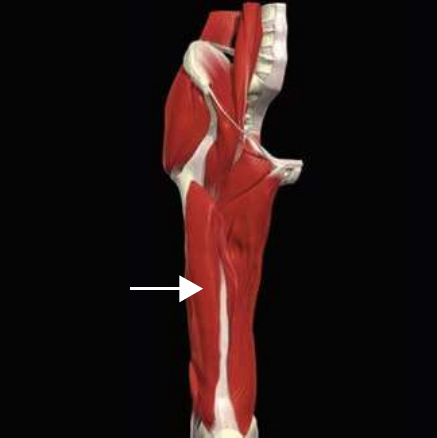
What it targets and why: All four heads, with a bias toward the vasti. The back pad removes the balance and spinal-stabilisation tax of a free-weight squat, so more of your effort reaches the knee extensors, and the fixed path lets you take a set close to failure without technique unravelling.
Setup and execution: Feet flat and low and relatively narrow on the platform. A low foot position increases the knee flexion required at depth and shifts work off the hips onto the quads; a narrow stance biases the vastus lateralis. Descend until the hamstrings meet the calves, or as deep as the machine and your hips allow.
The nuance most people miss: Depth is the variable that matters most and the one most often quietly abandoned. If the machine’s shoulder pads bottom out before your knees do, put a pair of yoga blocks or a folded mat on the pads to raise you and reclaim the range.
Common error → fix: Heels lifting at the bottom. This is nearly always restricted ankle dorsiflexion, not weakness. Elevate the heels slightly or move the feet a touch higher on the platform rather than fighting it — the exercise is not a mobility test.
High-bar back squat or front squat — the loadable base
What it targets and why: Every head, and it remains the best vehicle for straightforward progressive overload — you can add weight or a rep almost indefinitely. Front and high-bar variants keep the torso upright, which lengthens the moment arm at the knee and moves tension toward the quads; a low-bar position shifts load to the hips and glutes.
Setup and execution: Bar high on the traps or racked on the front delts. Break at the knees and hips together, let the knees track forward over the toes, and descend until the hip crease clears the knee.
The nuance most people miss: Knees travelling past the toes is not dangerous — it is required to load the quads properly. Advice to keep the shins vertical produces a squat that trains the hips.
Common error → fix: Cutting depth as the weight climbs. Treat depth as fixed and load as the variable, not the other way round.
Bulgarian split squat — unilateral load and frontal-plane control
What it targets and why: A very large stretch on the front leg’s quads under load, and — because you are balanced on one foot — a genuine demand on the muscles controlling the knee in the frontal plane. This is the practical route to a well-developed vastus medialis, not because you have isolated it, but because single-leg stance forces the whole extensor mechanism to stabilise as well as extend.
Setup and execution: Rear foot on a bench roughly knee height, front foot far enough forward that the shin can travel without the heel lifting. A more upright torso emphasises the quads; leaning forward shifts work to the glutes.
The nuance most people miss: Two sets is usually the right dose. These are unusually fatiguing and sore-making, and four or five sets tends to cost you the rest of the session for no extra stimulus.
Common error → fix: Front foot too close, so the heel peels off the floor. Step it forward a few inches.
Seat-back leg extension — the rectus femoris fix
What it targets and why: This is the only common exercise where the hip is fixed while the knee moves through its full range, which means the rectus femoris finally goes from stretched to fully shortened. It is the direct answer to the squat’s blind spot.
Setup and execution: Set the backrest reclined, so the hip sits at roughly 40 to 60 degrees of flexion rather than a rigid 90. Pull your hips down into the seat so you are locked in and nothing leaks. Full range, controlled negative — a three-second lowering phase is a good default, because it forces a lighter load without costing you stimulus.
The nuance most people miss: The reclined seat is not a comfort preference. A 2024 trial had participants train one leg at 90 degrees of hip flexion and the other at 40 for ten weeks, and found substantially greater rectus femoris growth at 40 degrees — around 16 per cent versus 11 per cent at the distal site — with no difference at all in vastus lateralis, exactly as the anatomy predicts, since hip angle cannot change the length of a monoarticular muscle. Worth flagging: that was 22 untrained men over ten weeks. It is one study, the effect direction is mechanistically sound, and the intervention costs you nothing, which is a good combination even when the evidence base is thin.
Common error → fix: Half reps with a heavy stack, or pins set so you only train the top of the range. Both are the same error. Drop the weight, use the whole range, and take the set to within one or two reps of failure — the burn arrives long before actual fatigue does on this movement, and most people stop far too early.
On safety: leg extensions have a long-standing reputation for damaging knees via shear force. There is no convincing evidence they cause problems in healthy joints any more than other quad exercises do. If they hurt, restrict the range or skip them.
Reverse Nordic curl or sissy squat — the stretched-position specialist
What it targets and why: Here the hip stays extended while the knee flexes, which lengthens the rectus femoris at both ends simultaneously. That is the most stretched position the muscle can occupy under load, and stretched-position work appears to be a particularly potent growth stimulus.
Setup and execution: Kneel tall on a pad with the hips fully extended, then lower backwards under control by bending the knees, keeping a straight line from knee to shoulder. The sissy squat is the standing equivalent: heels elevated, knees travelling forward, torso leaning back to keep the hips open.
The nuance most people miss: Overload here comes from range and reps, not load. Get lower before you consider holding a plate.
Common error → fix: Breaking at the hips on the way down, which turns it back into a squat and lets the rectus femoris off the hook. Squeeze the glutes throughout — if the hips stay locked out, the exercise cannot cheat.
Leg press — volume without the tax
What it targets and why: High quad tension with almost no spinal or systemic cost, which makes it the cheapest way to add volume late in a session. Feet low and narrow maximises knee flexion and quad involvement.
The nuance most people miss: Most leg presses limit depth before your hips do, and depth is where the value is. If you cannot bring the knees toward the chest without the pelvis tucking, you are getting less from the machine than from a deep squat.
Common error → fix: Rounding the lower back to chase depth. Stop where the pelvis starts to tuck — that is your actual range on that machine.
What to skip, and why
| Exercise | Verdict for quad growth | Reason |
|---|---|---|
| Walking lunges | Fine, but a glute exercise | Less quad stretch and tension than a split squat; you should feel the glutes more |
| Step-ups | Poor | Minimal quad stretch, unstable, hard to load |
| Deadlifts | Poor | From the quads’ point of view, a deadlift is a quarter squat |
| Jump squats | Poor for hypertrophy | Low tension, no meaningful overload path |
| Unstable-surface squats | Avoid entirely | The ankle does the stabilising and the quads receive very little tension |
| Squat + press combinations | Avoid entirely | Your shoulders fatigue long before your quads do |
Programming
| Exercise type | Rep range | How to progress |
|---|---|---|
| Loaded compound (hack squat, back squat, leg press) | 5–10 | Add load or a rep week to week |
| Unilateral (Bulgarian split squat) | 8–12 per leg | Add reps first, then load; cap at two sets |
| Fixed-hip isolation (leg extension) | 12–20 | Add reps, improve control and range; load increases run out quickly |
| Bodyweight stretch work (reverse Nordic, sissy squat) | 8–15 | Add depth first, then reps, then load |
Isolation movements run out of loadable progression long before compounds do. When the weight stops moving on a leg extension, the remaining levers are range, tempo and proximity to failure — not more plates.
Warm-Up for Quads
Eight to ten minutes, structured as RAMP — Raise, Activate, Mobilise, Potentiate. The evidence here is unusually tidy: five to ten minutes at moderate intensity is sufficient, and longer warm-ups do not perform better. Extra time spent warming up is time taken from the session, not added to it.
| Phase | Time | What to do | Why |
|---|---|---|---|
| Raise | 2–3 min | Cycling, brisk incline walking or stair machine | Raises muscle temperature and blood flow; lowers synovial fluid viscosity so the knee and hip move more freely |
| Activate | 2–3 min | Glute bridge 2×12 · banded lateral walk 2×10 each way · bodyweight split squat 2×8 each leg | Wakes the hip abductors and extensors that control knee position under load |
| Mobilise | 2 min | Deep bodyweight squat holds, ankle dorsiflexion rocks against a wall, controlled leg swings | Prepares the exact ranges the session demands — ankle and hip, which are what usually limit squat depth |
| Potentiate | 2–3 min | Ramping sets on the first movement: empty bar or light sled × 8, ~50% × 5, ~70% × 3 | Bridges the warm-up to the working load and rehearses the pattern |
Two points specific to quads. First, the ankle deserves attention the quads themselves do not: restricted dorsiflexion is the most common reason people cannot reach depth, and it shows up as lifting heels or a collapsing lower back — both of which look like quad problems and are not. Second, the Activate phase targets the hips. The quads get loaded plenty in the potentiation sets; what benefits from low-load rehearsal is the abduction and external rotation that stops the knee drifting inward once the weight gets heavy.
The Potentiate phase does double duty on a quad day. Ramping sets are not just neural preparation; they are the last chance to check that depth and knee path hold before the load is heavy enough to hide problems. If the pattern degrades at 50 per cent, it will not repair itself at 85.
Skip long-duration static stretching before quad work. Holding a stretch for a minute or more can transiently reduce force production, and there is no benefit to offset it. Dynamic movement through range does everything you actually need.
Cool-Down for Quads
Three to five minutes. Deliberately much shorter than the warm-up, and the asymmetry is not laziness.
What it does not do. Post-exercise static stretching does not meaningfully reduce delayed onset muscle soreness, does not restore range of motion faster, and does not accelerate strength recovery compared with simply resting. This is one of the more consistent negative findings in the field, and a recent expert consensus reached full agreement on it. Given that Bulgarian split squats reliably produce some of the worst quad soreness in training, this is worth internalising: nothing you do in the ten minutes after the session will change how you feel on Tuesday.
What it does do. It brings heart rate and breathing down after what is usually the most systemically demanding session of the week. It gives you a warm window in which mobility work is more comfortable — useful if you are trying to gain range, which is a training goal rather than a recovery one. And it closes the session, which matters for adherence more than most people admit.
A workable quad cool-down:
- 1–2 min easy cycling or walking
- Standing quad stretch, 30 seconds each side — this one lengthens the rectus femoris across both joints if you keep the hip extended
- Half-kneeling hip flexor stretch, 30 seconds each side
- 60 seconds of slow nasal breathing
If you want to do more, do more. Just be clear that you are training flexibility, not buying back recovery.
Putting It Together
One quad-focused session built from everything above:
| Order | Exercise | Sets × reps | Purpose |
|---|---|---|---|
| 1 | RAMP warm-up | 8–10 min | Hips and ankles ready, pattern rehearsed |
| 2 | Hack squat | 3 × 6–8 | Loaded compound, all four heads, deep |
| 3 | Bulgarian split squat | 2 × 8–10 each leg | Unilateral load and frontal-plane control |
| 4 | Seat-back leg extension | 3 × 12–20, 3s eccentric | Rectus femoris through full excursion |
| 5 | Reverse Nordic curl | 2 × 8–12 | Stretched-position rectus femoris |
| 6 | Cool-down | 3–5 min | Downshift |
Ten working sets. If you want more quad volume, add a second, lighter exposure later in the week rather than extending this session — frequency handles the extra work better than a longer single day does.
Key Takeaways
- Three quad heads only extend the knee. Rectus femoris also crosses the hip, and that single fact drives every sensible exercise choice.
- The squat barely changes rectus femoris length across a rep. Add one fixed-hip exercise — a reclined leg extension — and the gap closes.
- Recline the leg extension seat to roughly 40–60 degrees of hip flexion. One 2024 trial in untrained men found markedly more rectus femoris growth that way, and none at all in vastus lateralis.
- You cannot selectively train the VMO. Train the quads through a full range and include single-leg work; the medialis follows.
- Sartorius is not a quadriceps muscle and it flexes the knee. Depth, not the exercise name, is the variable that determines results.
- Warm up 8–10 minutes with RAMP; cool down 3–5. Warm-ups have measurable performance effects, post-session stretching does not reduce soreness.