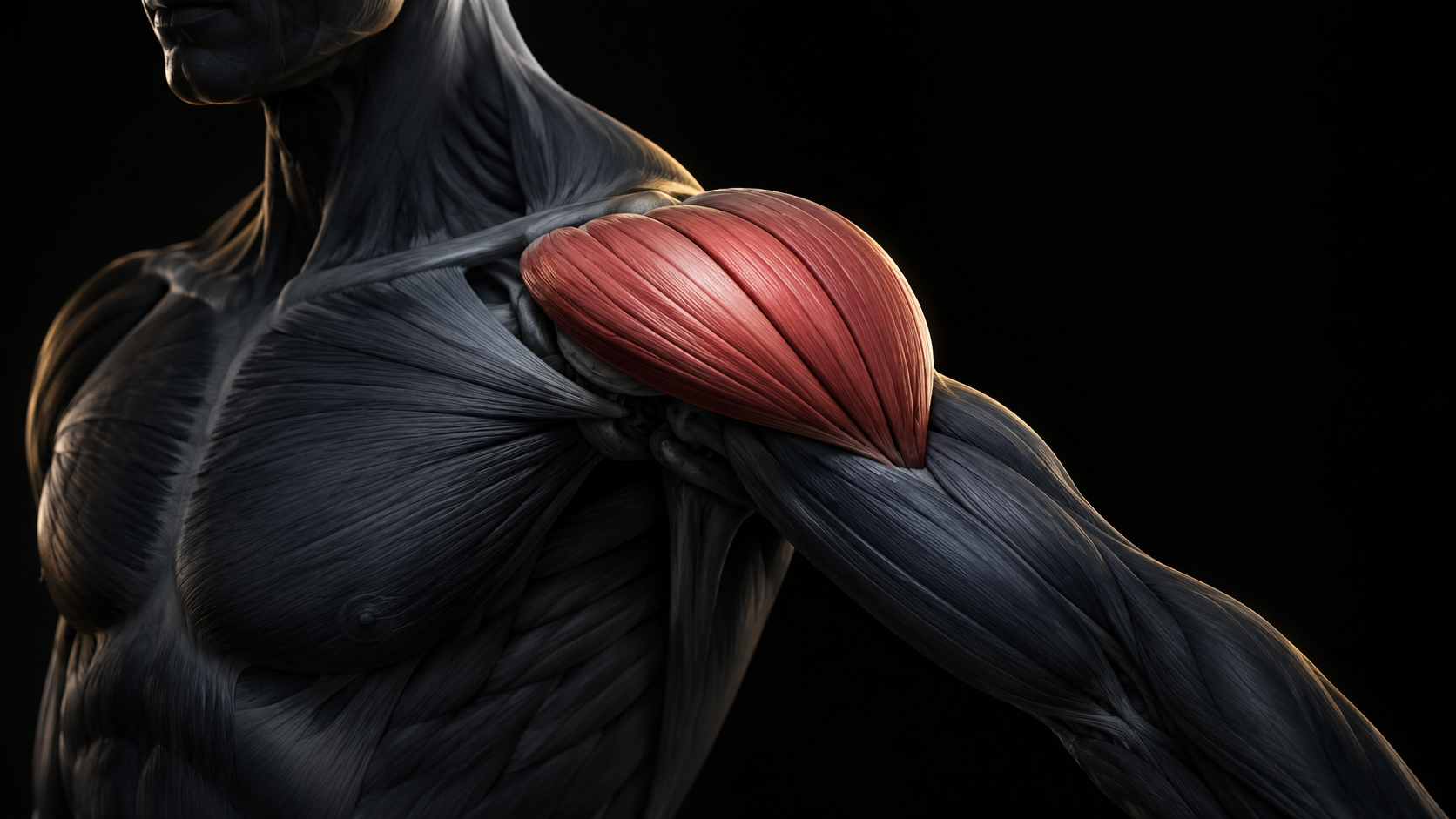
Most shoulder advice starts with a list of exercises. This one starts with the joint, because almost every mistake people make with shoulder training — the impingement, the stalled lateral raises, the front delts that grow while the side and rear heads stay flat — comes from not understanding what the shoulder is actually doing when you load it.
The shoulder is the most mobile joint in the body. That mobility is bought at the cost of stability, and the muscles that pay for it are not the ones you can see in the mirror. Get that relationship right and the exercise selection becomes obvious.
The Muscles and What They Actually Do
The deltoid — three heads, three jobs
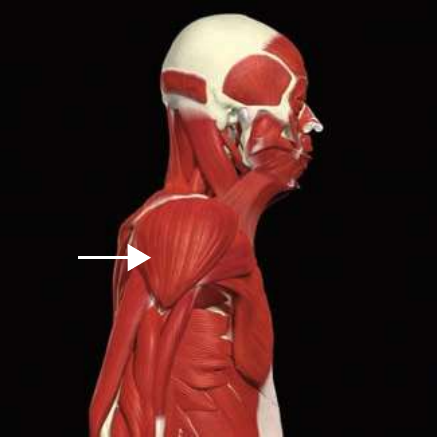
The deltoid caps the shoulder like a shoulder pad. It has three heads, and their origins spell out a useful memory aid — Spine of scapula, Acromion, Clavicle, all Sharing an insertion on the deltoid tuberosity of the humerus.
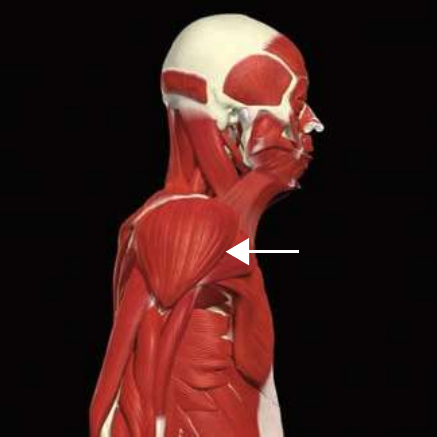
Anterior (front) head — originates on the lateral third of the clavicle. Flexes the shoulder, internally rotates, and horizontally adducts. This is the head that gets trained whether you intend to or not: every bench press, every push-up, every overhead press hits it hard.
Lateral (side) head — originates on the acromion, fibres running vertically. This is the pure abductor, and the head responsible for shoulder width. It’s most active when the arm is internally rotated during abduction, and progressively less so as the arm externally rotates.
Posterior (rear) head — originates on the spine of the scapula. Extends the shoulder, externally rotates, and horizontally abducts. That last action — the reverse fly motion — is unique to the rear delt among the three heads, which is exactly why it needs its own exercises rather than hoping rows will cover it.
There’s a wrinkle worth knowing. A cadaveric study of 60 specimens found the deltoid isn’t really three muscles but seven intramuscular segments, each with its own tendon — three in the front head, one in the middle, three in the rear. Each segment sits at a slightly different angle. The practical consequence is that training only in the three cardinal planes leaves fibres in between under-stimulated, and the fix is simply to include diagonal movements alongside the standard front, side and rear work.
The abduction handoff
Here is the single most useful thing to understand about the shoulder.
| Range | Prime mover | What’s happening |
|---|---|---|
| 0–15° | Supraspinatus | Initiates abduction, seats the humeral head |
| 15–90° | Lateral deltoid | Takes over as prime abductor |
| 90–180° | Lateral deltoid + upper trap + serratus anterior | Continues, with scapular upward rotation |
The lateral deltoid cannot start abduction. It only continues a movement the supraspinatus has already begun. This is why a supraspinatus tear is so disabling — the deltoid is still strong, but the arm can’t leave the side. It also explains why cuff work belongs before delt work in a session rather than tacked on at the end.
The rotator cuff — SITS
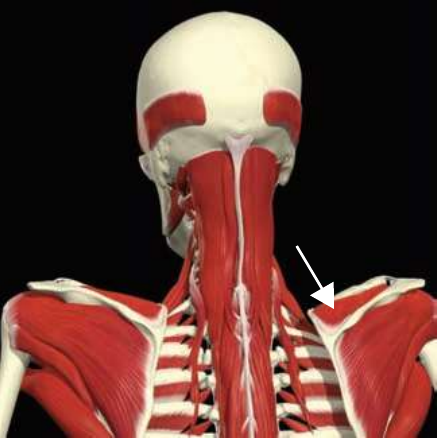
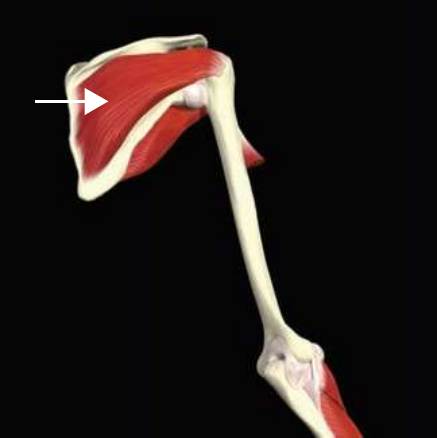
Four muscles wrap the joint and keep the humeral head centred in the glenoid while the deltoid moves the arm.
| Muscle | Primary function | Notes |
|---|---|---|
| Supraspinatus | Initiates abduction (0–15°) | Most commonly torn — isolated tears account for roughly half of cases presenting clinically |
| Infraspinatus | External rotation | Largest, strongest external rotator; most active with the arm at the side |
| Teres minor | External rotation | Most active with the arm abducted to 90° |
| Subscapularis | Internal rotation | Largest cuff muscle; the only one on the front of the scapula |
The cuff is not a prime mover. Think of the deltoid as the engine and the cuff as the suspension: without it, force still gets produced, it just doesn’t go where you want it.
The rotator cuff paradox. The deltoid’s line of pull is upward. Unopposed, that drives the humeral head up into the acromion. The lower cuff — infraspinatus, teres minor, subscapularis — pulls down and in, creating a force couple that keeps the head centred. So a strong deltoid with a weak cuff doesn’t just fail to protect the shoulder; it actively destabilises it. That’s the mechanism behind most impingement, and it’s why a fatigued cuff at the end of a session is worse than no cuff work at all.
One anatomical detail with real clinical value: the teres minor is innervated by the axillary nerve, the same nerve that supplies the deltoid, while the other three cuff muscles run off the suprascapular and subscapular nerves. If someone has axillary nerve damage — after a dislocation, say — they’ll have deltoid weakness and weak external rotation at 90° of abduction, but normal external rotation with the arm at the side. That specific pattern points straight at the nerve rather than the tendon.
Serratus anterior — the one nobody trains
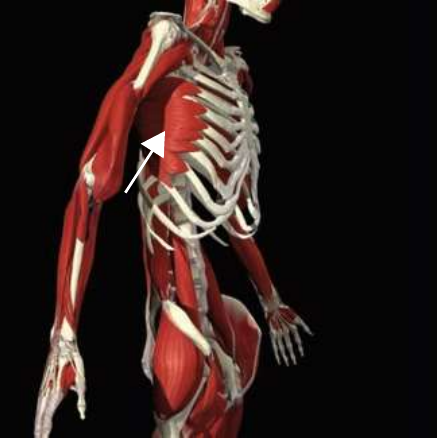
The serratus is the only muscle that can protract and upwardly rotate the scapula at the same time. Upper and lower traps upwardly rotate but can’t protract; rhomboids retract but downwardly rotate. Nothing else does both.
Without it, the scapula doesn’t rotate out of the way as the arm goes overhead, and the acromion stays where the humeral head wants to be. Weakness shows up as medial scapular winging — the inner border of the shoulder blade lifting off the ribcage — and it’s the reason overhead pressing hurts some people no matter how much cuff work they do.
Muscle-Specific Exercises (Anatomy and Form Explained)
The organising principle: arm position determines which head does the work, and where in the range you feel tension determines how much the exercise is worth.
Cable lateral raise — the best side delt exercise there is
Set the pulley at roughly hand height. Because tension peaks when the cable and your arm form a 90° angle, this places maximum load on the side delt while it is lengthened — the opposite of what a dumbbell gives you.
Why it beats dumbbells: a standing dumbbell lateral raise has zero tension at the bottom, where the delt is most stretched, and peak tension at the top, where it’s shortest. The cable inverts that curve.
The nuance most people miss: start the movement with the arm swept slightly across the body rather than hanging at your side. That adds adduction range you can’t access with dumbbells, and it’s the part most people skip. Honest caveat — the one eight-week trial comparing cables to dumbbells for lateral raises found no difference in growth, and the authors noted participants stopped at the side rather than crossing over. So treat the cable’s advantage as mechanically sensible rather than proven.
Common error → fix: traps taking over. The cue that works better than “keep your shoulders down” is to imagine holding a long shovel and scooping sand out to the side. It forces the delt to initiate before the scapula elevates.
Machine shoulder press — the front delt builder
A vertical press loads the anterior delt through a long range with heavy, progressible load. A machine adds two things a barbell doesn’t: a deeper stretch at the bottom, and enough stability to take the set genuinely to failure without technique collapsing.
The nuance: the common claim that vertical pressing is “front delts only” is overstated — the side delts work harder on a vertical press than most people assume, particularly on a machine where you aren’t fighting for balance.
Common error → fix: stopping when the upper arms reach parallel. Sink as deep as the shoulder comfortably allows. Depth is where the tension is.
Standing barbell overhead press — good, not optimal
Genuinely high tension in the stretched position and easy to progress. Two costs: it is heavily anterior-dominant, and standing means your core and legs are stabilising, which bleeds tension away from the target. Excellent as a strength lift; middling as a pure hypertrophy tool.
Reverse cable crossover — the best rear delt exercise
Cross the arms at the top for maximum stretch, hold the cables themselves rather than the handles, and sweep outward rather than yanking back. Alternate which arm crosses on top between sets. Enormous range, even tension, no dead spot.
Reverse pec deck — brace and isolate
The chest pad directs all the load into the rear delts. Performed sitting sideways, one arm at a time, the stretch is deeper still. Superset arms to keep it time-efficient.
Rope face pull — the finisher
Set the rope slightly low, take an underhand grip, and externally rotate as you pull — finishing like a rear double-biceps pose. This trains rear delt horizontal abduction and infraspinatus external rotation in one movement, which is why it belongs at the end of every shoulder session.
Honest limitation: the mid-traps will always contribute, so the rear delts may not be the limiting factor. That’s not a reason to skip it — mid-back work is useful — just don’t count it as your only rear delt exercise.
What to skip
Front raises. Not harmful, just redundant. If your programme contains any pressing at all, the anterior delt is already well served. The exception is genuine anterior deltoid weakness, which is rare.
Banded lateral raises. Same flawed tension curve as dumbbells with less loadability. Fine when they’re all you have.
Programming the two heads that need it
| Exercise type | Progression | Why |
|---|---|---|
| Shoulder press | Linear — add 5 lb weekly at 5–6 reps | Compound, tolerates load increases |
| Lateral / rear raises | Double progression — fix a rep range, add reps first, then weight | Isolation lifts max out on load quickly |
Double progression in practice: pick 10–12 reps. Week one, ten reps to near-failure. Week two, eleven. Week three, twelve. Then add the smallest available increment and restart at ten. When you can no longer add a rep without form breaking, rotate to a different variation and start again.
Frequency matters more than volume per session. Effective volume within a single workout caps out somewhere around six to eight sets per muscle — beyond that, returns diminish sharply. So the way to add shoulder work is not more sets on the same day but more days: three or four exposures per week rather than one or two. Shoulders tolerate this well; they rarely get sore, and they recover fast between sessions when the work is mostly isolation.
Warm-Up for Shoulders
Eight to ten minutes, structured as RAMP — Raise, Activate, Mobilise, Potentiate. Systematic review evidence suggests 5–10 minutes at moderate intensity is sufficient; longer warm-ups don’t perform better.
| Phase | Time | What to do | Why |
|---|---|---|---|
| Raise | 2–3 min | Rowing machine, arm swings, easy skipping | Raises muscle temperature and blood flow |
| Activate | 3–4 min | Band external rotation 2×15 · band internal rotation 2×15 · scapular push-up or wall slide 2×12 | Wakes the cuff and serratus before the delts are loaded |
| Mobilise | 2 min | Controlled arm circles, thoracic rotations, overhead reach against a wall | Prepares the ranges the session will demand |
| Potentiate | 2–3 min | Ramping sets: empty bar or light dumbbells × 10, then ~50% × 5, ~70% × 3 | Bridges warm-up to working weight |
The Activate phase is the part that matters and the part people skip. The reasoning is the rotator cuff paradox: a cuff that hasn’t fired yet cannot counter the deltoid’s upward pull, and the humeral head migrates toward the acromion under load. Keep it genuinely light — bands or 2–5 lb — because this is motor control work, not strength work. If your external rotations feel hard, they’re too heavy.
Cool-Down for Shoulders
Three to five minutes. Deliberately shorter than the warm-up, because the evidence says so.
What it doesn’t do. Post-exercise static stretching does not meaningfully reduce delayed onset muscle soreness, doesn’t restore range of motion faster, and doesn’t speed strength recovery compared with simply resting. A recent expert consensus reached complete agreement on this point. Anyone selling stretching as a soreness cure is selling something the research doesn’t support.
What it does do. It brings heart rate down gradually. It gives you a warm window in which mobility work is more comfortable — useful if you’re actually trying to gain range, as opposed to recover. And it marks the end of the session, which matters more for adherence than most people admit.
A reasonable shoulder cool-down:
- 1–2 min easy walking or light rowing
- Doorway pec stretch, 30 seconds each side — the pec minor pulls the scapula into the position that causes impingement, so this one has a mechanical rationale
- Cross-body posterior shoulder stretch, 30 seconds each side
- 60 seconds of slow nasal breathing
That’s it. If you want more mobility work, do it — just be clear that you’re training range of motion, not accelerating recovery.
Putting It Together
A single shoulder session built on everything above:
| Order | Exercise | Sets × reps | Purpose |
|---|---|---|---|
| 1 | RAMP warm-up | 8–10 min | Cuff and serratus online first |
| 2 | Machine shoulder press | 3 × 5–6 | Heavy, linear progression |
| 3 | Cable lateral raise | 3 × 10–12 | Side delt, lengthened tension, double progression |
| 4 | Reverse cable crossover | 3 × 12–15 | Rear delt, full range |
| 5 | Rope face pull | 2 × 15–20 | Rear delt + external rotation finisher |
| 6 | Cool-down | 3–5 min | Downshift |
Six working sets on the delts on this day, then repeat a lighter version two or three days later rather than adding sets here.
Key Takeaways
- The lateral deltoid cannot initiate abduction — the supraspinatus does the first 15°. Train the cuff before the delts, never after.
- A strong deltoid with a weak cuff destabilises the shoulder. That’s the impingement mechanism, and it’s why the Activate phase of the warm-up is non-negotiable.
- Anterior delts are almost never the limiting factor if you press at all. Spend your isolation work on the side and rear heads.
- Cables beat dumbbells for lateral raises on tension curve — mechanically clear, though the single direct trial found no growth difference. Sweep across the body, don’t stop at your side.
- Use linear progression on presses and double progression on raises. They fail in different ways.
- Warm-up 8–10 minutes, cool-down 3–5. The asymmetry is deliberate: warm-ups have measurable performance effects, post-session stretching does not reduce soreness.