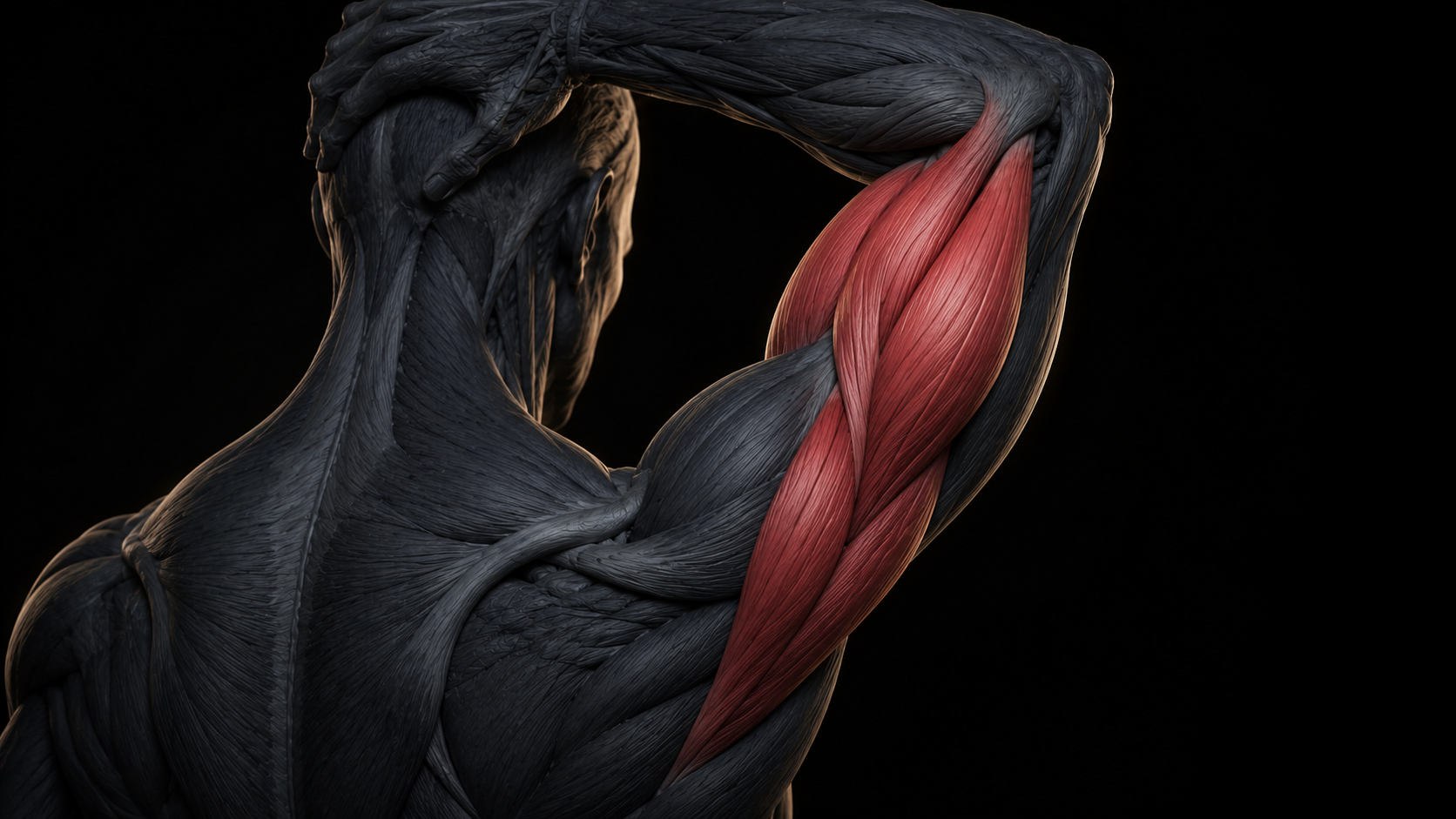
The triceps is the bulk of your upper arm, and it is the muscle most people train with the least thought. Pushdowns at the end of a chest session, three sets, elbows pinned, done. That approach trains two of the three heads reasonably well and leaves the third — the largest one, the one that gives the back of the arm its depth — barely stimulated.
The reason is anatomical and it is not subtle. Two of the three heads cross only the elbow. One crosses the shoulder as well, which means its length depends on where your upper arm is, not just where your forearm is. Every meaningful decision about triceps training follows from that single fact — including the one about where the evidence is genuinely strong, where it rests on a single study, and where the popular claim has no support at all.
The Muscles and What They Actually Do
Three heads, one tendon
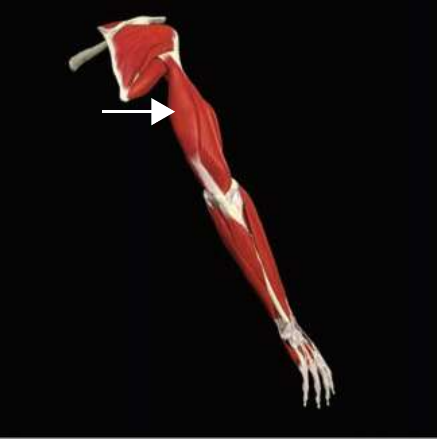
The triceps brachii sits on the back of the humerus and converges into a common tendon on the olecranon process of the ulna. All three heads extend the elbow. Only one of them does anything else.
| Head | Origin | Insertion | Crosses shoulder? |
|---|---|---|---|
| Long head | Infraglenoid tubercle of the scapula | Olecranon process of the ulna | Yes |
| Lateral head | Posterior humerus, above the radial groove | Olecranon process | No |
| Medial head | Posterior humerus, below the radial groove | Olecranon process | No |
The long head is the biarticular one. Because it originates on the scapula rather than the humerus, it also produces shoulder extension and adduction — pulling the upper arm down and in toward the body. That is why you feel your triceps working on a dumbbell pullover or a straight-arm pulldown, movements that involve no elbow motion at all.
The medial head is the deepest and, in EMG work, the most consistently active — it contributes at low forces where the other two heads are still relatively quiet, then all three ramp up as load increases. It is sometimes called the workhorse of the group for exactly that reason.
The lateral head is the one you can see. It runs along the outside of the arm and produces the outline people call the horseshoe.
The single most important idea: long-head length
Because the long head spans the shoulder, its length is set by shoulder position before the elbow does anything.
| Upper-arm position | Long head is | Tension in the stretched range | Typical exercise |
|---|---|---|---|
| Overhead (shoulder flexed) | Maximally lengthened | High | Overhead extension, incline skull crusher |
| At the side (neutral) | Mid-length | Moderate | Pushdown, close-grip bench |
| Behind the torso (shoulder extended) | Shortest | Low | Kickback, dip |
Try it without any weight. Reach an arm straight overhead and you will feel a clear pull along the back of the upper arm. Now put the same arm behind your torso and squeeze — the long head goes hard and short. Same muscle, opposite ends of its range, and the only variable you changed was the shoulder.
This also explains a problem with pressing. During a close-grip bench press the long head is lengthening at the shoulder while shortening at the elbow, so its overall length barely changes. It is contracting, but it never gets meaningfully stretched or meaningfully shortened. That is a poor recipe for growth in a muscle that appears to respond well to long-length loading, and it is the mechanical reason pressing alone builds a triceps that looks flat from the side.
What the direct evidence says
A 2023 trial gives the clearest test of this. Twenty-one participants trained one arm overhead and the other arm at their side, cable elbow extensions, matched at 70% of 1RM, twice a week for twelve weeks. Because it is a within-subject design, each person acted as their own control.
| Region measured | Overhead arm | Neutral arm |
|---|---|---|
| Long head volume | +28.5% | +19.6% |
| Lateral and medial heads | roughly 1.4× the neutral arm’s gain | — |
| Whole triceps | roughly 1.4× the neutral arm’s gain | — |
Two things are worth pulling out. First, the advantage was not confined to the long head — the monoarticular heads grew more in the overhead condition too, which the shoulder-position argument alone does not fully explain. Second, participants had to use roughly 34–39% less weight in the overhead position, and still grew more. Load on the bar is not the variable that matters here.
The honest caveat: this is one study with twenty-one people and one exercise. It is well designed and the effect is large, but it is a single result, and unilateral training designs have their own quirks. Treat it as strong support for including overhead work, not as proof that pushdowns are wasted.
Anconeus — the head that isn’t one
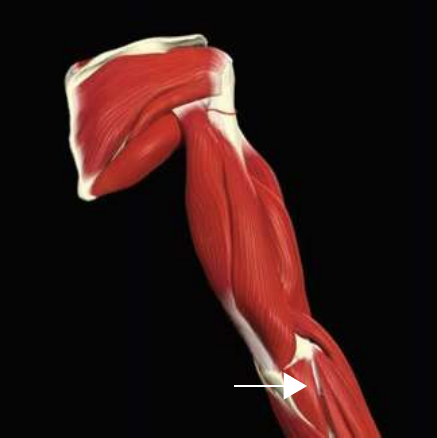
The anconeus is a small triangular muscle running from the lateral epicondyle of the humerus to the posterior surface of the proximal ulna. It assists elbow extension, stabilises the joint, and helps position the ulna during pronation. It shares the triceps’ innervation from the radial nerve, and some anatomists treat it as a fourth head.
For training purposes: you cannot isolate it, no exercise selectively targets it, and it grows or does not grow alongside everything else at the back of the elbow. It is worth knowing about because it explains some of the soreness people feel just below the elbow after heavy extension work, and because it is a landmark in elbow assessment — not because you need to program for it.
One clinical detail worth carrying
The radial nerve supplies all three heads, and it runs in the radial (spiral) groove of the humerus — which is precisely why the lateral head originates above that groove and the medial head below it. A mid-shaft humeral fracture can damage the nerve there, producing the classic wrist drop, while elbow extension is often partly preserved because the branches to the upper heads leave above the groove.
Fibre type, and why it changes less than you think
Cadaveric fibre-type mapping has put the lateral head at roughly two-thirds type II fibres, a higher fast-twitch proportion than many limb muscles, and this gets used to justify heavy, low-rep triceps training.
Be careful with that inference. Proportions vary widely between individuals, and the evidence that they should dictate your rep range is weak — training near failure across a broad range of loads produces similar hypertrophy. Use the reps that let you load and progress the exercise, not the ones a fibre-type table suggests.
Muscle-Specific Exercises (Anatomy and Form Explained)
The organising principle is simple: train the triceps from more than one shoulder angle, and make sure at least one of those angles is overhead.
| Exercise | Shoulder position | Emphasis |
|---|---|---|
| Overhead cable extension | Flexed (overhead) | Long head, stretched |
| EZ-bar skull crusher | Slightly flexed | Long head + all three |
| Straight-bar pushdown | Neutral | Lateral and medial |
| Close-grip bench press | Neutral | Lateral and medial, heavy |
| Cable kickback | Extended | Long head, shortened |
| Dip | Extended | All three, heavy |
Overhead cable extension — the one to build the session around
What it targets and why: with the upper arm alongside the head, the shoulder is flexed and the long head is at its longest. A cable holds tension in that stretched position rather than losing it, which a dumbbell cannot do.
Setup and execution: set the pulley low, face away from the stack, take a bar or rope, and step forward until there is tension before you begin. Upper arms stay roughly vertical and close to the ears. Lower until you feel a firm stretch behind the arm, then extend without letting the elbows drift forward.
The nuance most people miss: the elbows are the whole exercise. As the set gets hard, the upper arms creep forward and down, which quietly shortens the long head and turns the movement into a pushdown at an awkward angle. Keeping the elbows fixed is worth far more than adding weight.
Common error → fix: stopping short at the bottom because the stretch feels vulnerable. Drop the load by a third and go deeper. The stretched portion is the part the 2023 trial suggests is doing the work.
EZ-bar skull crusher — the best free-weight option
What it targets and why: lying with the upper arms angled slightly back puts the shoulder into mild flexion, so the long head starts partly lengthened, and the free weight allows straightforward loading.
Setup and execution: lie flat, take an EZ bar with a comfortable grip, and start with the elbows tilted slightly back toward your head rather than stacked vertically — that alone puts tension in the muscle before the first rep. Lower in an arc past the top of your head, not down to your forehead, then extend back along the same arc.
The nuance most people miss: the arc is the point. Stopping the bar at your skull ends the range exactly where the long head would start to lengthen. Taking it behind the head is what converts a mediocre exercise into a good one.
Common error → fix: elbow pain on the way down. Switch from a straight bar to an EZ bar, reduce the load, and slow the eccentric. The distal triceps tendon and elbow tolerate this movement well when load is built gradually and badly when it is rushed.
Straight-bar cable pushdown — the loadable staple
What it targets and why: with the upper arm at the side, the long head is at mid-length and the lateral and medial heads do most of the work. Even tension throughout the range and the simplest progression of any triceps exercise.
Setup and execution: stand close to the stack, upper arms pinned to your ribs, torso upright. Extend fully, pause briefly at lockout, and control the return until the forearms are past parallel.
The nuance most people miss: the bar out-loads the rope. In practical testing, the same weight allows meaningfully more reps with a rigid bar than with a rope, because a rope has to be stabilised by the forearms and wrists. Spreading the rope ends at the bottom feels satisfying, but that motion happens mostly at the wrist, not the elbow. Use the rope if you prefer it; just do not expect it to be the better overload tool.
Common error → fix: leaning over the bar and pressing with the shoulders and lats. Step back half a pace so the cable pulls you slightly forward, and keep the elbows from travelling.
Close-grip bench press — heavy, useful, oversold for the long head
What it targets and why: a compound press with the elbows tucked shifts load from the pectorals toward the triceps, and it progresses in a way isolation work cannot.
Setup and execution: hands roughly shoulder-width — narrower than that mainly punishes the wrists without adding triceps involvement. Lower to the lower chest with the elbows at about 45 degrees to the torso, then press by driving the elbows straight.
The nuance most people miss: it is a lateral and medial head exercise, not a long head exercise, for the reason described earlier — the long head lengthens at the shoulder and shortens at the elbow simultaneously and ends up near-isometric. Program it for load and strength carryover, not as your long-head work.
Common error → fix: the bar drifting up toward the throat as the elbows flare. Cue the forearms to stay vertical at the bottom; if they cannot, the grip is too narrow.
Cable kickback — the shortened-position option
What it targets and why: with the upper arm held behind the torso, the shoulder is extended and the long head reaches full contraction — an end of the range no other common triceps exercise visits.
Setup and execution: low pulley, single handle, upper arm fixed alongside or slightly behind the torso. Extend the elbow fully, hold the contraction for a beat, and return under control. Higher reps suit this one — 12 to 20.
The nuance most people miss: whether you bend forward or stand upright makes no biomechanical difference, since what matters is the angle between the upper arm and torso. Choose whichever position lets you keep the upper arm still.
Common error → fix: swinging the whole arm. If the upper arm moves, the weight is too heavy — this movement is worth doing lightly or not at all.
Dip — the heavy compound, with a caveat
What it targets and why: a loadable bodyweight press that trains all three heads with the arms behind the torso. Excellent for progression: add reps, then add a belt.
Setup and execution: stay upright rather than leaning forward — leaning shifts work to the pectorals. Lower until the upper arms are roughly parallel to the floor, or slightly below if the shoulders are comfortable, then press up by extending the elbows.
The nuance most people miss: the shoulder is extended, so the long head is in its short position throughout. Dips are a good triceps exercise and a poor long-head stretch exercise. They complement overhead work; they do not replace it.
Common error → fix: shoulder discomfort at the bottom. Reduce depth, keep the torso vertical, and if it still aches, use a machine dip or a close-grip press instead. There is no depth requirement worth an irritated shoulder.
What’s overrated
| Claim | Verdict |
|---|---|
| Underhand pushdowns target the medial head | Not supported. Rotating the forearm happens at the radioulnar joint and does not change the triceps’ line of pull. It mostly reduces the load you can handle. |
| The medial head needs its own exercises | No. It is active in every elbow extension you do. There is no reliable way to bias it. |
| Dumbbell kickbacks | Tension is lowest where the muscle is longest — the opposite of what you want. Not useless, but a cable does the same job better, and an overhead dumbbell extension does a more useful job with the same dumbbell. |
| Rope beats bar on pushdowns | Feels better, loads worse. Fine as a preference, not an upgrade. |
Progressing it
| Exercise type | Progression | Why |
|---|---|---|
| Close-grip bench, dip | Linear — add a small increment weekly at 6–8 reps | Compound, tolerates load jumps |
| Overhead extension, skull crusher | Double progression at 8–12 reps | Load increments are large relative to the weight used |
| Pushdown, kickback | Double progression at 12–20 reps | Small muscle, small jumps, high rep tolerance |
On weekly volume: meta-analytic evidence supports more than about ten hard sets per muscle per week outperforming less, with returns that flatten as volume climbs. The upper end of the commonly quoted range is not a proven optimum. Two exposures a week beats one, mostly because it spreads the sets out — not because the frequency itself is doing something.
Warm-Up for Triceps
Eight to ten minutes, structured as RAMP — Raise, Activate, Mobilise, Potentiate. Systematic review evidence indicates 5–10 minutes at moderate intensity is sufficient to get the performance benefit; longer warm-ups do not perform better, and can cost you output on the first working set.
| Phase | Time | What to do | Why |
|---|---|---|---|
| Raise | 2–3 min | Easy rowing or bike, arm swings, band pull-aparts | Raises muscle and connective-tissue temperature; a warmer tendon is more compliant under load |
| Activate | 2–3 min | Light band pushdowns 2×20 · scapular wall slides 2×10 | Gets the triceps firing and the scapula upwardly rotating, which is what makes an overhead position available |
| Mobilise | 2 min | Overhead reach against a wall · full elbow flexion–extension, slowly, ×15 · wrist flexion and extension circles | Prepares the exact ranges the session demands, including the wrist, which takes real load on skull crushers and pushdowns |
| Potentiate | 2–3 min | Ramping sets on your first exercise: very light ×12, then ~50% ×6, ~75% ×3 | Bridges the gap between warm-up and working weight |
The phase people skip here is Mobilise, and specifically the overhead check. If your shoulder cannot comfortably reach overhead, you cannot do an overhead extension properly — you will compensate by letting the elbows drift forward, which removes the only reason you chose the exercise. Thirty seconds against a wall tells you what range you actually have today.
Two honest notes. First, the elbow needs more ramping than it gets. Skull crushers and heavy overhead work put substantial tension through the distal triceps tendon, and tendons respond to gradual loading rather than to stretching. Build the load over three or four ramping sets rather than two.
Second, the evidence that warming up prevents elbow injuries specifically is thin. The well-supported effect of a warm-up is on performance — force output, range of motion, and how the first working set feels. That is a good enough reason on its own; you do not need to oversell it as injury prevention.
Cool-Down for Triceps
Three to five minutes. Deliberately shorter than the warm-up, because that is what the evidence supports.
What it does not do. Post-exercise static stretching does not meaningfully reduce delayed onset muscle soreness, does not restore range of motion faster, and does not speed strength recovery compared with simply resting. A 2021 systematic review and meta-analysis found no effect on soreness at 24, 48 or 72 hours against passive recovery. If you have been stretching your triceps after arm day to avoid being sore two days later, that is not what is happening.
What it is actually for. It brings heart rate and breathing down gradually. It gives you a warm window in which mobility work is more comfortable — genuinely useful if you are trying to gain overhead range, which is a training goal in its own right, not a recovery method. And it ends the session cleanly, which matters more for consistency than most people admit.
A reasonable triceps cool-down:
- 1–2 min easy walking or light rowing
- Overhead triceps stretch, 30 seconds each side — elbow bent, hand behind the head, gentle pressure. Do this because you want overhead range, not because you want to be less sore.
- Wrist extensor and flexor stretch, 20 seconds each — the forearms have just done more work than you think
- 60 seconds of slow nasal breathing
That is the whole thing. Anything longer is mobility training, which is fine — just call it what it is.
Putting It Together
A single triceps session built on everything above:
| Order | Exercise | Sets × reps | Purpose |
|---|---|---|---|
| 1 | RAMP warm-up | 8–10 min | Overhead range checked, elbow ramped |
| 2 | Overhead cable extension | 3 × 8–12 | Long head, stretched — the priority |
| 3 | Close-grip bench press or dip | 3 × 6–8 | Heavy compound, linear progression |
| 4 | Straight-bar pushdown | 3 × 12–15 | Lateral and medial, easy to overload |
| 5 | Cable kickback | 2 × 15–20 | Shortened long head, third shoulder angle |
| 6 | Cool-down | 3–5 min | Downshift |
Eleven working sets. If you want more triceps volume, add a second lighter exposure later in the week rather than stacking more sets onto this day.
Key Takeaways
- The long head is the only head that crosses the shoulder. Its length is set by upper-arm position before the elbow moves.
- Overhead work is not optional. The one direct trial found roughly 1.5× the long-head growth from overhead versus neutral training — on 34–39% less weight.
- Close-grip pressing and dips leave the long head near-isometric. They build triceps; they do not build that.
- You cannot bias the medial head with an underhand grip. That claim has no mechanical basis.
- Warm up 8–10 minutes with RAMP, check overhead range, ramp the elbow gradually. Cool down 3–5 minutes — and stop expecting stretching to prevent soreness.