Home Education Exam Prep Adventure Apply
← Back to Study Hub

Allergies vs Sensitivities vs Intolerances

Three completely different problems. Most people call them all "allergies." Here's why that matters — and what to actually do about each one.

🚨
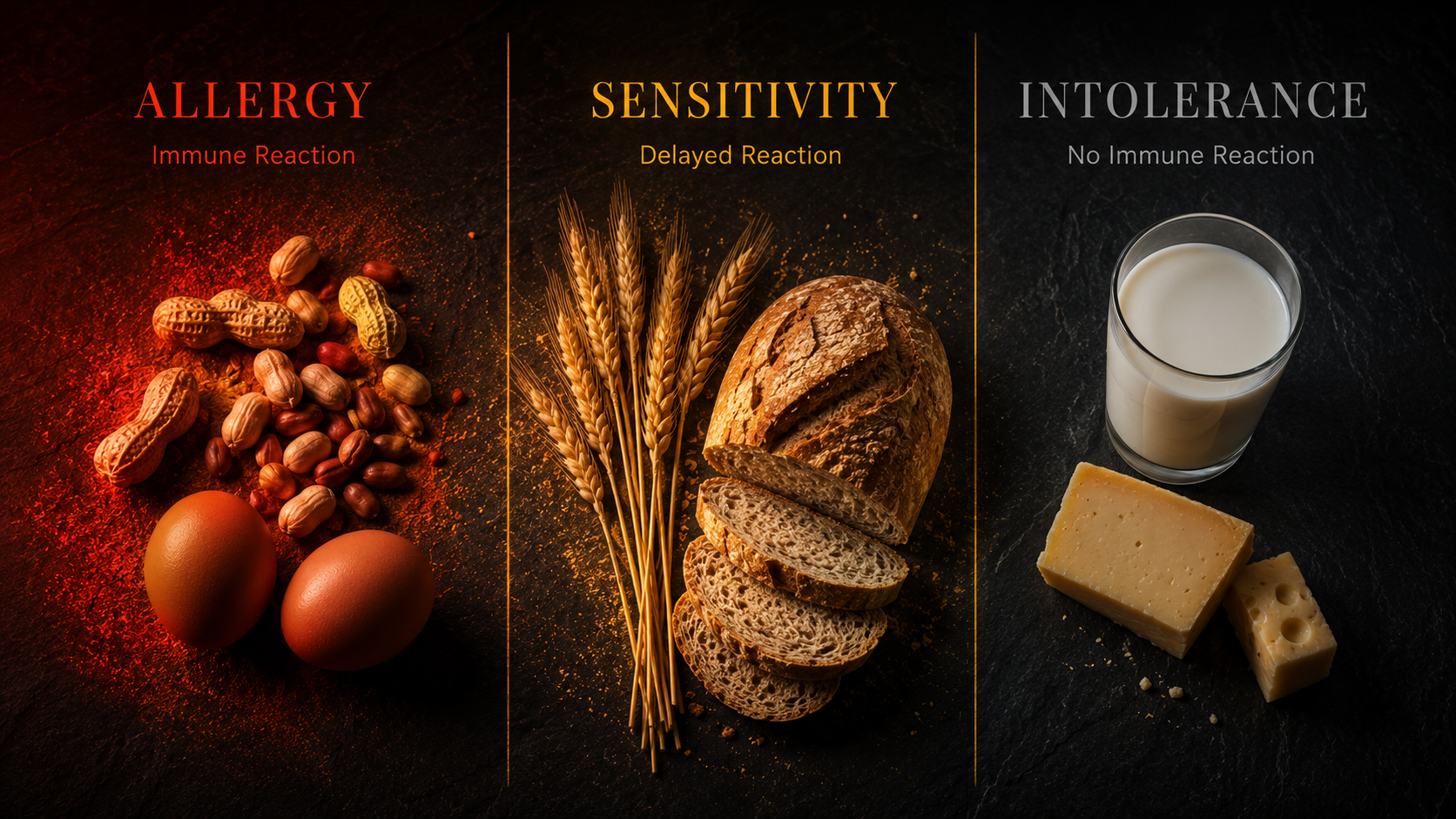
Food Allergy
IgE · Immune · Immediate
Fire alarm. Body calls the fire department. Even a tiny spark can trigger it. Life-threatening.
"Your immune system thinks peanuts are a biological weapon."
Food Sensitivity
IgG · Immune · Delayed
Slow leak in the roof. Takes days to notice. Not immediately dangerous but causes cumulative damage.
"Your gut let something through that shouldn't be there. Your body got grumpy."
🔧
Food Intolerance
Enzyme · Non-immune · Variable
Missing the right tool for the job. You can't process this food efficiently. Usually just uncomfortable.
"You don't have the key to unlock this molecule. It sits there and ferments."
📊 Side-by-Side Comparison
🚨 Allergy (IgE) ⚡ Sensitivity (IgG) 🔧 Intolerance (Enzyme)
Immune system? Yes — emergency (IgE) Yes — slow burn (IgG) No immune involvement
How fast? Minutes (2–30 min) Hours to 72 hours later 30 min – a few hours
Severity Life-threatening possible Chronic low-grade damage Uncomfortable, not dangerous
Symptoms Hives, swelling, breathing difficulty, anaphylaxis Fatigue, brain fog, bloating, joint pain, skin issues, headaches Gas, bloating, cramping, diarrhoea
Minimum dose? Trace amounts can trigger Often dose-dependent Small amounts usually fine
Permanent? Usually (managed, not cured) No — fixable via gut repair Often — but manageable
Common examples Peanuts, shellfish, tree nuts, milk (children), eggs Gluten, dairy, eggs, soy, corn, nightshades Lactose, fructose, histamine, FODMAPs
How to test Skin prick test, IgE blood panel IgG panel, elimination diet Hydrogen breath test, elimination + reintroduction
The key insight for coaches: Most clients who say "I'm allergic to dairy" have an intolerance or sensitivity — not a true allergy. The distinction matters because the fix is completely different. A sensitivity may be reversible in 4–8 weeks. A true allergy is permanent and requires strict avoidance.
🚨 Food Allergy — The Emergency Response (IgE)

A true food allergy is an IgE-mediated immune response. The immune system misidentifies a harmless food protein as a deadly pathogen — and responds accordingly. The result is rapid, systemic, and potentially fatal.

The Mechanism (How It Actually Works)

First Exposure
Body produces IgE antibodies to food protein (sensitisation — no symptoms yet)
IgE Binds
IgE antibodies attach to mast cells throughout the body (waiting)
Second Exposure
Food protein enters, crosslinks IgE on mast cells — tripwire pulled
Mast Cell Explosion
Massive histamine release + tryptase + leukotrienes + prostaglandins
Symptoms
Hives, swelling, airway constriction, anaphylaxis — within minutes
🥜
The Big 8 Allergens
Peanuts · Tree nuts · Shellfish · Fish · Milk · Eggs · Wheat · Soy. These account for ~90% of all food allergies. Sesame was added as #9 in 2023 (US).
Anaphylaxis Warning Signs
Throat tightening, voice change, difficulty swallowing, drop in blood pressure, loss of consciousness. Epinephrine (EpiPen) is the only effective first-line treatment. Antihistamines alone are NOT sufficient.
Scope of practice note: As a fitness coach you may have allergic clients. Know the signs of anaphylaxis. Never tell a client with a confirmed allergy to "just try a small amount." Even 1mg of peanut protein can trigger fatal anaphylaxis in highly sensitised individuals.

What to Do

Strict avoidance — no exceptions. Client carries epinephrine auto-injector. Medic-alert bracelet. Immunotherapy (OIT) exists for some allergens but is done under medical supervision only. This is NOT a dietary coaching issue.

Food Sensitivity — The Slow Burn (IgG)

Food sensitivity is a delayed immune reaction — usually IgG antibody-mediated — that develops hours to days after eating a trigger food. Because the gap between eating and symptoms is so wide, most people never connect the food to the reaction. This is the most underdiagnosed and most reversible of the three types.

The Mechanism

Leaky Gut
Gut barrier is compromised — large food particles cross into bloodstream
Immune Recognition
Immune system encounters food protein it shouldn't see — treats it as foreign
IgG Production
Body produces IgG antibodies to that food (sensitisation builds over weeks)
Immune Complexes
IgG + food antigen form immune complexes — trigger inflammation in tissues
Delayed Symptoms
Fatigue, brain fog, joint pain, bloating, skin — hours to 72 hrs later
Why the delay makes it so hard to catch: You eat gluten on Monday. You feel terrible on Wednesday. You blame stress, sleep, the weather — not Monday's toast. This is why elimination diets are the only reliable diagnostic tool. You need to remove the food for 3–4 weeks before symptoms reliably clear.
🧠
Brain & Nervous System
Brain fog, difficulty concentrating, headaches, anxiety, depression-like symptoms. LPS from leaky gut crosses blood-brain barrier.
💪
Joints & Muscles
Unexplained joint pain, stiffness, slow recovery from training. Immune complexes deposit in joints.
🔋
Energy & Metabolism
Persistent fatigue unrelated to sleep. Chronic low-grade inflammation impairs mitochondrial function.
🫁
Gut & Digestion
Bloating, alternating bowel habits, IBS-like symptoms. Damaged villi impair nutrient absorption.
🧴
Skin
Eczema, acne, rashes, psoriasis flares. Skin is often where systemic inflammation surfaces visibly.
😴
Sleep & Recovery
Waking at night, non-restorative sleep. Inflammatory cytokines disrupt sleep architecture.

What to Do — The Sensitivity Protocol

Remove: Eliminate the suspected food completely for 4–6 weeks (gluten is often the main trigger — remove 100%, not 90%). Repair: L-glutamine, zinc, omega-3s — heal the gut barrier. Reintroduce: One food at a time, monitor for 72 hours. Timeline: Most sensitivities resolve if the barrier is properly repaired. This is NOT a permanent condition.

🔧 Food Intolerance — The Missing Tool (Enzyme)

Food intolerance has nothing to do with the immune system. It happens when the body lacks the enzyme or transporter needed to break down a specific molecule. The undigested molecule reaches the colon, gets fermented by bacteria, and produces gas and irritation.

🥛
Lactose Intolerance
Missing enzyme: Lactase.
Lactose (milk sugar) can't be broken into glucose + galactose. Passes to colon intact. Bacteria ferment it → hydrogen gas → bloating, cramping, diarrhoea. Affects ~68% of adults globally. Fix: lactase enzyme supplements, hard cheeses (low lactose), aged yogurt.
🍎
Fructose Malabsorption
Missing transporter: GLUT5 capacity exceeded.
Small intestine can only absorb a limited amount of fructose. Excess passes to colon → fermentation. Symptoms: bloating, gas, diarrhoea after fruit, honey, HFCS. Fix: Low-fructose diet, glucose co-ingestion improves absorption.
🍷
Histamine Intolerance
Missing enzyme: DAO (diamine oxidase).
DAO breaks down dietary histamine in the gut. Low DAO = histamine accumulates. Found in: wine, aged cheese, fermented foods, processed meats. Symptoms: headache, flushing, hives, congestion. Fix: Low-histamine diet, DAO supplements.
🧅
FODMAP Intolerance
Missing enzyme / fermentability. FODMAPs (fermentable carbs — onions, garlic, beans, certain fruits) are osmotic and fermentable. Common in IBS. Symptoms: gas, bloating, altered bowel habits. Fix: Low-FODMAP diet (elimination phase + reintroduction to find specific triggers).
The dose-dependence rule: Unlike allergies (where trace amounts matter), intolerance is almost always dose-dependent. Most lactose-intolerant people can handle hard cheese, butter, or a small amount of milk without symptoms — they just can't handle a large glass of milk. Help clients find their threshold, not eliminate the food category entirely.
🔗 How Sensitivities Develop — The Leaky Gut Link

Most food sensitivities are not innate — they are acquired. The mechanism is almost always a compromised gut barrier. This is why a client can eat a food for 30 years without issue and then suddenly "react" to it.

Healthy Gut
Tight junctions sealed. Only small digested molecules cross into blood.
Trigger Event
Stress, antibiotics, NSAIDs, illness, dietary change opens tight junctions
Large Particles Cross
Partially digested food proteins now enter bloodstream through gaps
IgG Antibodies Made
Immune system flags these proteins as foreign → builds IgG memory
Sensitivity Established
Every time you eat that food now, immune reaction follows 4–72 hrs later
The bad news: Once IgG antibodies are established, the sensitivity persists as long as the gut barrier is damaged. Avoiding the food alone doesn't fix it — it just reduces the immune load while the real problem (the leaky gut) continues.
The good news: Repair the gut barrier → food particles stop crossing → immune system stops seeing the antigen → IgG levels drop → sensitivity resolves. Most food sensitivities are gone within 4–8 weeks of proper gut repair. True allergies don't work this way.

The "I used to be fine with this food" story is almost always a leaky gut narrative. The food didn't change. The gut barrier did.

  • Client was fine with gluten until a stressful period at work — now reacts to any bread
  • Client took a long course of antibiotics — now reacts to dairy, eggs, soy
  • Client had a GI illness — now has multiple food sensitivities that won't go away
  • All three: same mechanism — barrier broken → IgG antibodies formed → sensitivity acquired
🔬 How to Actually Identify Which One You Have
🚨
Testing for Allergy
Skin prick test — gold standard. Allergen placed on forearm, pricked through. Wheal/flare response = positive.

Serum IgE panel — blood test for specific food IgE antibodies (RAST / ImmunoCAP).

Oral food challenge — done in clinical setting. Confirms or rules out allergy under supervision.

Needs: allergist/immunologist.
Testing for Sensitivity
IgG food panel — blood test measuring IgG antibodies to 90–200+ foods. Clinically useful but controversial (not covered by most insurance).

Elimination diet — the gold standard. Remove suspect foods completely for 4–6 weeks. Systematic reintroduction one at a time. Most reliable and cheapest method.

No: skin prick test will be negative. IgE will be negative. Standard allergy testing misses this.
🔧
Testing for Intolerance
Hydrogen breath test — for lactose and fructose. Patient drinks a sugar solution, exhaled hydrogen measured. High hydrogen = fermentation = malabsorption.

Elimination + reintroduction — practical and effective. Remove lactose for 2 weeks, reintroduce, monitor symptoms.

DAO level — blood test for histamine intolerance (diamine oxidase enzyme level).
The practical coaching approach: You cannot diagnose. But you can guide. The elimination diet — removing the top 6 suspects (gluten, dairy, eggs, soy, corn, processed foods) for 4 weeks — will resolve most food sensitivity symptoms if that's the cause. If symptoms don't improve, they likely have intolerance, allergy, or a non-food cause. Refer accordingly.
💡 Coaching Summary — What to Do With Each Client

🚨 Client with Confirmed Food Allergy

Strict avoidance — no "just a little bit." Confirm they carry epinephrine auto-injector. Know the signs of anaphylaxis. Do not attempt dietary modification. Outside scope of practice — this is medical management.

⚡ Client Who "Reacts to" Foods — Fatigue, Brain Fog, Bloating

Likely sensitivity. Guide them through a 4-week elimination of gluten, dairy, and processed foods. Simultaneously support gut barrier: L-glutamine, zinc, bone broth, fermented foods. Systematic reintroduction after 4 weeks. Most will be eating those foods again within 3 months with no reaction.

🔧 Client with GI Symptoms Only (Gas, Bloating, Diarrhoea)

Likely intolerance. First question: dairy? Start with a 2-week lactose removal. If GI clears, lactose intolerance. If not, trial low-FODMAP. Refer for breath test if needed. Enzyme supplements (lactase) are available OTC and often allow full reintroduction.

The One Thing to Teach Every Client:

"You are probably not permanently allergic to these foods. Your gut barrier may be damaged and letting food particles through that trigger an immune response. Repair the barrier, and in most cases, the 'allergies' disappear. True allergies are rare — sensitivities are not."

2–3%
Adults with true IgE food allergy
~45%
People who report food sensitivities
68%
Global adults with lactose intolerance
4–6 wks
Elimination diet to identify sensitivities
4–8 wks
Gut repair timeline for sensitivity reversal
72 hrs
Maximum delay for IgG sensitivity reaction