The biggest myth about muscle growth is that it’s complicated. It isn’t. There are about six principles that govern all of it, and they’ve been understood since the 1970s.
The reason most people don’t grow muscle isn’t lack of knowledge — it’s that they’re missing one or two of those principles. Usually: not enough load, not enough rest, or training the wrong fibres for their goal.
This post walks through the actual science: what a muscle is, how it contracts, why some fibres get bigger faster than others, the two kinds of hypertrophy, and the small set of programming variables that determine whether you’ll gain size and strength or just spin your wheels.
"Every single rep you've ever done was thousands of microscopic sarcomeres shortening simultaneously. Understanding what happens at that level is the difference between training and just moving weight around."
The Sarcomere — Where It All Actually Happens
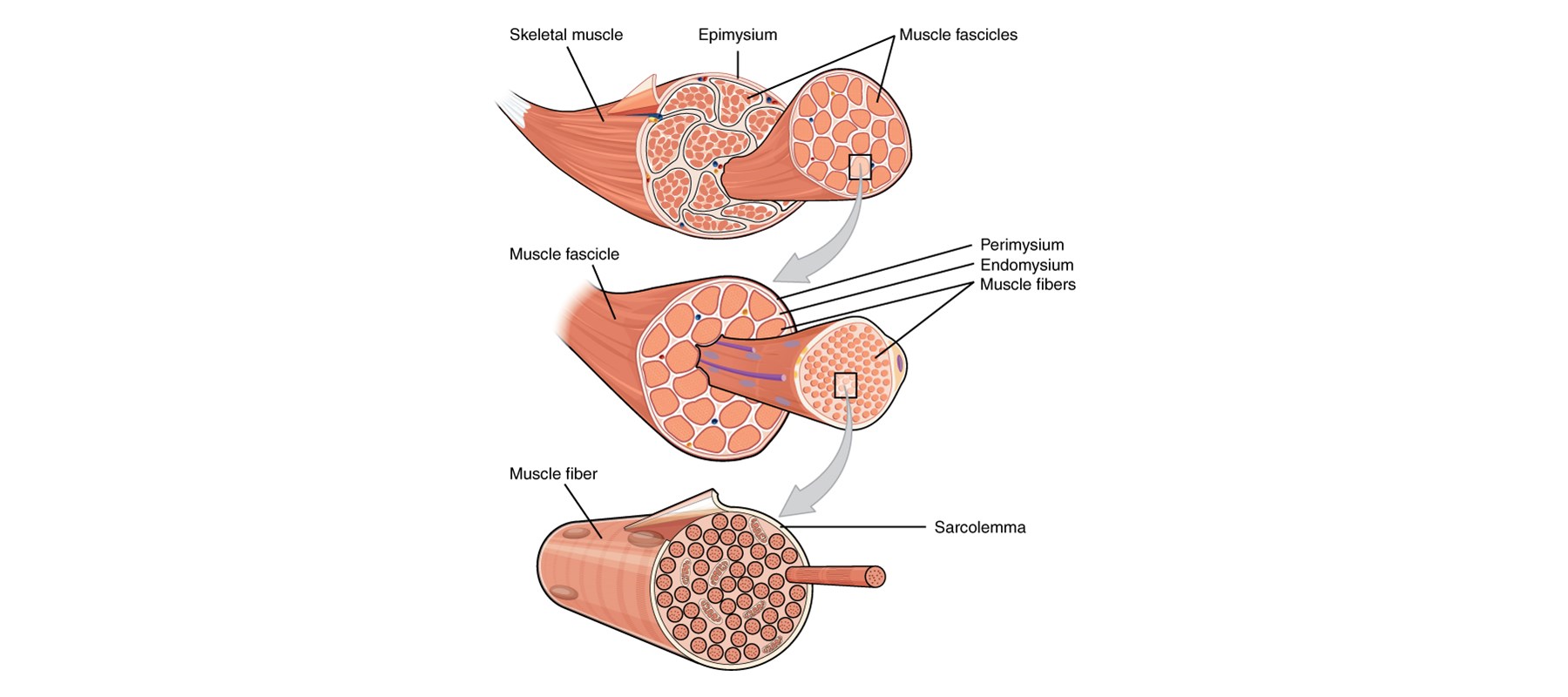
A muscle is built like a Russian doll. Whole muscle → bundles of fibres → bundles of myofibrils inside each fibre → and inside each myofibril, the smallest contracting unit: the sarcomere.
Every movement you make traces back to thousands of sarcomeres shortening at the same time. Here’s what happens inside one of them when you decide to flex a bicep:
- A nerve signal arrives from your spinal cord
- Calcium is released inside the muscle cell
- Myosin heads (thick filaments) bind to actin (thin filaments)
- Actin gets pulled inward
- Z-lines move closer together — the sarcomere shortens
- Multiply this by thousands of sarcomeres in parallel and you have a contraction
This is called the sliding filament model. It’s the universal mechanism for every voluntary muscle contraction in your body.
A few landmarks worth knowing:
- Z-lines mark the borders of each sarcomere
- Actin filaments are thin, attached to the Z-lines
- Myosin filaments are thick, sit in the middle
- H zone = the middle region that contains only myosin (no actin overlapping)
- M line = the dead centre of the sarcomere
Why does any of this matter for training? Because it tells you what’s physically happening when you load a muscle: actin slides over myosin, the sarcomere shortens, force is produced. To make that machinery stronger or bigger, you have to challenge it in specific ways — which is what fibre types and programming variables come in for.
The Three Muscle Fibre Types
Not all muscle fibres are the same. You have three basic types, in different proportions depending on genetics and what you train:
| Fibre | Also called | Mitochondria | Fatigue resistance | Force output | Best for |
|---|---|---|---|---|---|
| Type I | Slow-oxidative | High | High | Low | Endurance, posture |
| Type IIa | Intermediate / FOG | Moderate | Moderate | Moderate-high | Strength + power, up to 3 min |
| Type IIx | Fast-glycolytic | Few | Very low (sec) | Highest | Max power, sprints |
A few important things:
- Genetics sets your baseline ratio. Sprinters tend to be born with more Type II, endurance athletes more Type I.
- Training can shift IIx → IIa, but not Type I ↔ Type II. You can’t turn slow fibres into fast ones, no matter what your gym bro says.
- Type II fibres are bigger and have more growth potential — they’re the ones that drive most visible muscle size.
- All fibre types respond to training, just differently. Type I gets denser mitochondria; Type II gets bigger overall.
"You can't out-train your genetics, but you can absolutely train smarter for the genetics you have. Knowing your fibre dominance — through how you respond to different rep ranges — is more useful than any DNA test."
Three Types of Muscle Action
Every exercise involves some combination of these three actions:
- Concentric — muscle shortens while overcoming resistance. The “up” phase of a bicep curl. This is what most people think of as “lifting.”
- Eccentric — muscle lengthens under load. The “down” phase of a bicep curl, controlled. This is where most muscle damage (and growth signal) happens.
- Isometric — muscle generates force with no visible movement. Holding a plank. The pause at the top of a squat.
Why eccentrics matter more than people think
Eccentric contractions produce greater microtrauma than concentrics — meaning they create a bigger growth signal and more soreness. Delayed Onset Muscle Soreness (DOMS) — that 24-to-72-hour ache after a new workout — is primarily caused by eccentric work, not by lactic acid.
The good news: DOMS diminishes rapidly with repeated exposure. The first session of a new exercise wrecks you. By the third or fourth session, the same load barely registers. This is the repeated bout effect — your nervous system and connective tissue adapt fast.
Two Types of Hypertrophy (and Why You Probably Want Both)
When a muscle “grows,” it can grow in two distinct ways:
Myofibrillar Hypertrophy
Growth of the actual contractile proteins (more actin and myosin). Increases both size and force production. This is what strength training in the 4–8 rep range targets. Less visible day-to-day; more durable.
Sarcoplasmic Hypertrophy
Increase in non-contractile elements — fluid, glycogen, organelles. Increases size without much added force. This is the “pump” feeling, and it’s what high-volume bodybuilding work (10–15+ reps) generates. More visible immediately; partly transient.
The “muscle pump” you feel after a high-rep set is transient hypertrophy — fluid accumulation that diminishes within hours. Not bullshit, just temporary.
Neural adaptations come first
Here’s something most lifters get wrong: in the first 4–6 weeks of a new training program, almost all of your strength gains are neural, not muscular. Your nervous system gets better at recruiting motor units, firing them in sync, and inhibiting antagonist muscles. You get noticeably stronger before you’ve added any meaningful tissue.
This is also why beginners gain strength on programs that wouldn’t budge an advanced lifter — they have huge neural headroom to claim.
What Actually Drives Hypertrophy
Beyond fibre type, several factors determine how much you can grow:
- Hormones — testosterone is the big one. Differences in baseline testosterone partially explain why men generally gain muscle faster than women and why young trainees gain faster than older ones.
- Sex and age — both modify the hormonal environment.
- Muscle length and tendon insertion points — these are biomechanical. Where your tendons attach affects leverage. You can’t change this.
- Limb length — affects strength (longer limbs = worse leverage), but not hypertrophy potential.
- Training history — beginners gain fast, intermediates moderately, advanced lifters glacially. Diminishing returns is the universal rule.
What you can control: load, volume, rest, frequency, and consistency. Which brings us to programming.
The Programming Variables That Matter
Here’s the small set of dials that determine whether you’ll build muscle:
Frequency
- Beginner: 2–3 days per week is enough
- Advanced: 72-hour minimum recovery for the same muscle group
- More isn’t always more — if you can’t recover, you can’t grow
Volume
- Total volume = sets × reps × load
- Higher volume biases toward hypertrophy
- Most people undershoot volume, not overshoot it
Intensity (load)
- Strength: heavy load, low reps (1–6)
- Hypertrophy: moderate load, moderate reps (6–15)
- Endurance: light load, high reps (15+)
- All three rep ranges grow muscle to some extent — pick based on goal
Rest intervals
| Goal | Rest between sets | Rep range | Load |
|---|---|---|---|
| Endurance | ≤30–60 sec | 15–25+ | Low |
| Hypertrophy | 60–90 sec | 6–15 | Moderate |
| Strength | 2–5 min | 1–6 | High |
| Power | 2–5 min | 1–5 | Very high |
The mistake most people make: resting too little for strength work (1 min between heavy sets is not enough) or too much for hypertrophy work (5 min between hypertrophy sets kills the volume).
Order of exercises
Large, compound movements first. Squat before leg extension. Bench before fly. The nervous system fatigues quickly, and you want it fresh for the lifts that matter most.
Tempo
There’s no single “best” tempo. What matters: control the eccentric (it’s where growth happens), don’t bounce out of the bottom of a squat, don’t half-rep your way to fake progress.
The Double-Progression Protocol
If you only take one programming idea from this post, take this one. It’s the simplest possible framework for getting stronger forever:
Step 1 — Add reps. Pick a rep range (e.g., 8–12 reps). Add one rep per session until you can complete the top of the range (12) with good form across all your sets.
Step 2 — Add weight. Once you hit the top of the rep range, increase resistance by about 5%. Reset to the bottom of the rep range (8). Repeat.
There’s no time limit. Whether it takes a week or a month to add a rep, it doesn’t matter. Weight increases only when earned, not on a schedule. No ego lifting, no jumping ahead, no “I’ll just add 10 pounds and grind through it.” Just earned, slow, durable progress.
This is how Milo of Croton allegedly built his strength — carrying the same calf every day until it grew into a bull. The principle hasn’t changed.
Key Takeaways
- Every contraction is sarcomeres shortening. Understand the machinery and you understand the training.
- Fibre types matter, genetics sets the baseline. Train for the fibres you have, not the ones you wish you had.
- Eccentrics drive growth and DOMS. Lower the weight slowly — that’s where the work happens.
- Two kinds of hypertrophy. Myofibrillar (size + strength) and sarcoplasmic (size only). Both real; both useful.
- Early gains are neural, not muscular. Newbie gains are real, but they end. Plan for what comes after.
- The big programming dials: frequency, volume, intensity, rest, order. Get these right and everything else is detail.
- Double progression beats periodisation for most people. Add reps until you hit the top of the range, then add weight. Repeat for life.
Want the technical, exam-prep version of this?
Read the ACE Chapter 9 Deep Dive →Poster image: skeletal muscle diagram from OpenStax Anatomy & Physiology via Wikimedia Commons, CC BY 4.0.