Everyone understands retirement savings. Start early, invest steadily, let compounding do the work — and never, ever try to scramble together a lifetime of savings at 55.
Almost nobody applies the same logic to their body.
But the math is identical. How well you move at 70, 80, and 90 — whether you carry your own groceries, get off the floor without help, travel, play with grandkids — is being decided right now, by the physical “deposits” you make in your 30s, 40s, and 50s. Muscle and bone are a reserve account. You can build it cheaply today, or try to scrape it together late in life, when every deposit costs triple and the account barely grows.
This idea sits at the heart of Outlive, the longevity book by physician Peter Attia — he calls it training for the “Centenarian Decathlon”: deciding what physical tasks you want to be capable of in your final decades, and training for them now. Let’s break down why it matters, and exactly where to start.
The decline is real — and faster than you think
Muscle mass starts slipping as early as your thirties. By 80, the average man has roughly 40% less muscle tissue than he had at 25.
That number is alarming enough. But it hides the part that actually matters.
According to Dr. Andy Galpin, professor of kinesiology at California State University, Fullerton, we lose strength about two to three times faster than we lose muscle mass. And we lose power — strength expressed quickly — two to three times faster than strength.
What You Lose Fastest As You Age
Relative speed of age-related decline. Power — the ability to produce force quickly — goes first.
Why does power vanish first? Because the biggest change in aging muscle is the withering of fast-twitch (type 2) fibers — the fibers responsible for producing force quickly. Walking and daily life can maintain your slow-twitch fibers. But type 2 fibers respond to one thing only: meaningful resistance. If you never load them, they quietly disappear — and they’re exactly the fibers that catch you when you trip.
And inactivity erases your reserve shockingly fast. In one study, twelve healthy volunteers around age 67 spent just ten days on bed rest — roughly what a major illness or injury demands — and lost an average of 1.5 kg of lean muscle mass. Ten days. That’s the entire downward spiral in miniature: an injury forces rest, rest dissolves muscle, lost muscle invites the next fall.
Being sedentary while overeating makes it worse still. Excess calories with no training don’t just add fat around the muscle — fat “spills over” and infiltrates the muscle tissue itself, degrading its quality from the inside. The account isn’t just shrinking; the currency is being debased.
The endpoint of that spiral has a name: sarcopenia — severe age-related muscle loss — which slides into frailty, clinically defined as having three or more of: unintended weight loss, exhaustion, low activity, slow walking speed, and weak grip.
"Here's the cruel part: a study of frail seniors (average age 78) put them through six months of dedicated strength training — and half of them gained no muscle at all. The window for building the reserve is earlier than you think. The time to deposit is now."
Bone density: the same decline, and nobody checks
Your skeleton is on the same downward escalator. Bone mineral density (BMD) peaks in your late twenties and declines from there — faster for women after menopause, because estrogen is essential for bone strength in both sexes.
Standard guidelines only screen women at 65 and men at 70. By then, you’re reading the account statement decades after the balance collapsed.
Why it matters so much: after age 65, a hip or femur fracture carries a one-year mortality of roughly 15–36%. Up to one in three people die within a year of breaking a hip. And even survivors often face a setback that’s functionally equivalent to the end of independent life — not because the bone doesn’t heal, but because of the months of muscle lost during recovery. The fracture starts the spiral; the bed rest finishes it.
The test that tells you where you stand is a DEXA scan — a quick, low-radiation scan of the hips and lumbar spine that reports your bone mineral density along with your body-fat and lean-mass numbers. It’s widely available in Indian diagnostic labs, inexpensive, and takes about ten minutes. There is no good reason to wait until 65 to find out your skeleton has been quietly thinning for three decades.
Four strategies protect your bone account:
- Load your skeleton. Bone responds to mechanical stress the same way muscle does. Heavy resistance training — especially hip-loading movements like squats, deadlift variations, and step-ups — is the most powerful signal you can send it.
- Eat enough protein and get your vitamin D checked. Bone is living tissue being rebuilt constantly; it needs raw material. Vitamin D deficiency is extremely common in India despite the sunshine — test, don’t guess.
- Don’t rely on non-weight-bearing sport. If cycling or swimming is your main exercise, your heart is thriving but your skeleton is barely being asked to adapt. Add loaded, standing work.
- Women: take menopause seriously as a bone event. Discuss bone protection (including whether HRT is appropriate for you) with your doctor before density collapses, not after the first fracture.
Especially if you’re a woman: this is your highest-leverage decade
Everything above applies doubly to women — and the fitness industry has spent decades telling women the exact opposite of what their physiology needs.
Women start adulthood with less muscle and lower peak bone density than men, then face a steep, hormone-driven drop in both at menopause. That means the reserve built between 25 and 45 matters even more, because the withdrawal later is bigger. The single best protection against osteoporosis at 70 is the bone you banked at 35 — and bone is banked under a barbell, not on a treadmill.
And no — lifting will not make you “bulky.” Building visible muscle mass takes years of deliberate, heavy, high-volume work backed by aggressive eating; it does not happen by accident to anyone, least of all to women, whose testosterone levels are a fraction of men’s. What lifting will do is keep your bones dense, your joints supported, your metabolism higher, and your future self out of the fracture statistics above. Cardio-only routines — the default prescription handed to women for decades — protect the heart but leave the skeleton and fast-twitch fibers to decay on schedule.
The reframe: strength is carrying, not bench-pressing
Forget the gym-mirror definition of strength for a moment. The most human expression of strength — the thing our thumbs, long arms, and upright posture evolved for — is carrying heavy things over distance. No other animal does it like we do.
That’s also the most honest test of useful strength: groceries up the stairs, a child on your hip, a suitcase overhead, your own body weight caught by one hand on a railing.
A brilliantly simple way to train it: rucking — walking briskly with a loaded backpack. Writer Michael Easter (author of The Comfort Crisis) argues that modern life has systematically engineered carrying and discomfort out of our days — we roll our luggage, park at the door, order delivery — and rucking is the most practical way to put that lost human work back in.
What makes it nearly perfect for longevity training:
- It’s strength and cardio at once — loaded walking taxes muscles and heart together.
- It happens outdoors, which means you’ll actually keep doing it.
- It scales infinitely — start with 5 kg of books in any backpack on your evening walk; work up over months toward a quarter to a third of your body weight.
- Uphill segments push your VO₂ max; downhill segments build the eccentric braking strength that protects your knees and prevents falls. One hill, both systems.
The four foundations of strength
You don’t need a complicated program. You need these four capacities, trained consistently:
| Foundation | What it means | The real-life payoff |
|---|---|---|
| Grip strength | Force from your hands up through your lats | Opening jars, catching a railing mid-fall |
| Concentric + eccentric loading | Lifting weight up and lowering it with control | Going down stairs safely at 80 |
| Pulling | Rows, pull-ups — drawing the world toward you | Lifting, carrying, climbing |
| Hip-hinging | Bending at the hips, not the spine | Getting out of a chair, picking things up, forever |
Each one earns its place.
Grip is the most underrated number in fitness. Large studies link stronger midlife grip to lower all-cause mortality — evidence reportedly as robust as VO₂ max. And we’re collectively losing it: in 1985, men aged 20–24 averaged a 55 kg (121 lb) right-hand grip; by 2015, same-aged men averaged 46 kg (101 lb). One generation, nearly 20% weaker hands.
Eccentric strength — controlling weight as it lowers — is where aging bodies fail first. It’s the strength that lets you walk down a hill slowly instead of being pulled into a stumble. Think of creeping carefully down a steep slope versus running down it out of control: the difference in force slamming through your knees is enormous. Eccentric control is fall prevention. It’s also where most gym-goers cheat — dropping the weight on the way down and training only half the movement. The lowering half is the half that saves you on a staircase at 80.
Pulling — rows, pull-up progressions, resistance-band pulls — is how we physically act on the world: lifting a bag onto a shelf, hauling yourself up, carrying what you love. It also directly counteracts the rounded, desk-collapsed posture that decades of sitting carve into a spine. If your training has lots of pressing and no pulling, you’re building the wrong half of the account.
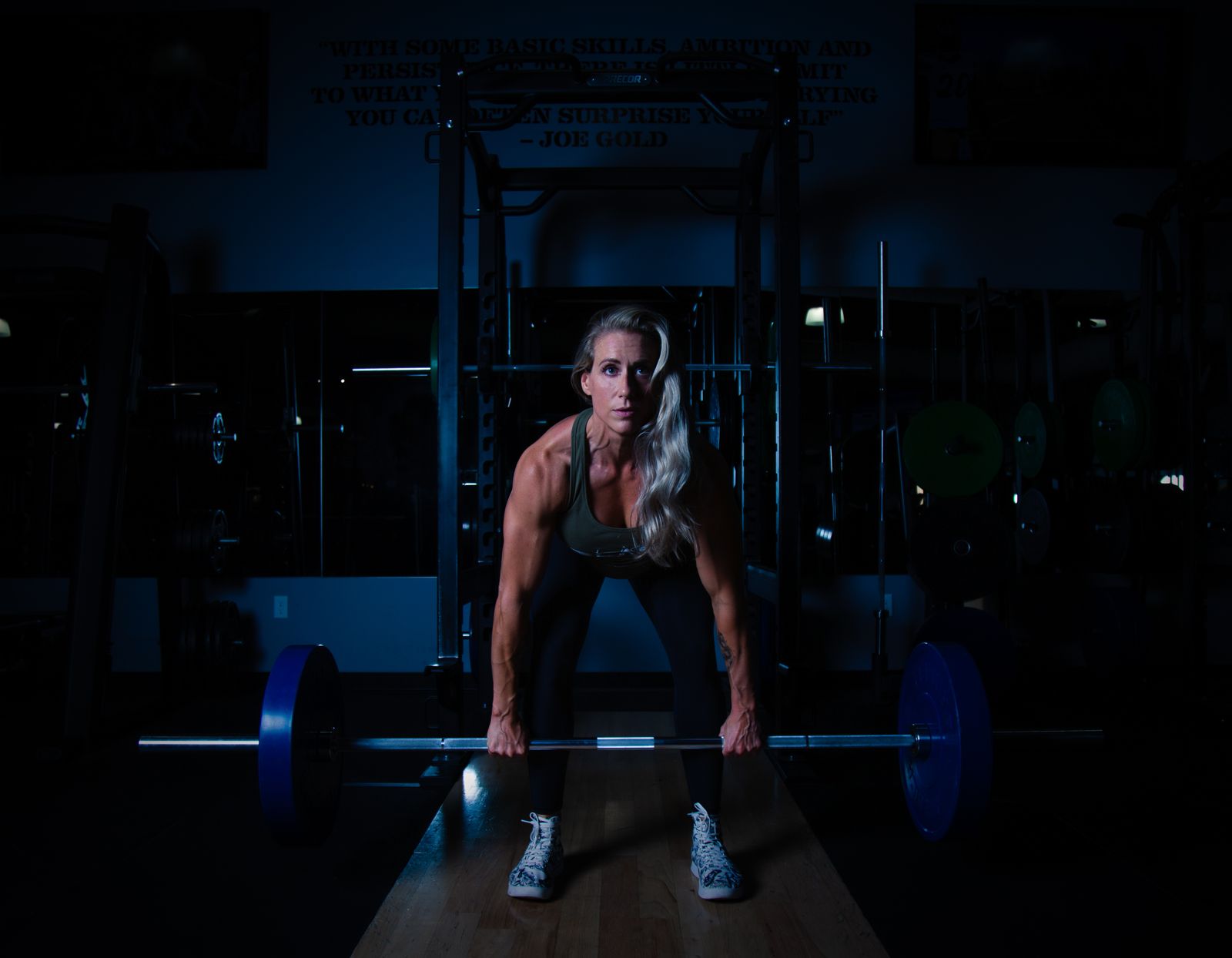
Hip-hinging — bending at the hips, not the spine, so the glutes and hamstrings do the work — is arguably the most important movement pattern of old age, because it is the movement of getting out of a chair, off a toilet, up from the floor. The day you can no longer hinge under your own body weight is the day you need assistance to live. One safety note: heavily loaded hinging (big deadlifts) carries real spinal-injury risk if you rush it. Earn it slowly — start with step-ups and light single-leg Romanian deadlifts, master the pattern, then add load over months and years. You have decades; that’s the entire point.
Your first deposits: where to start this week
-
Start lighter than your ego wants. Movement quality beats load — even 5–7 kg dumbbells are a real starting deposit.
-
Farmer’s carry: a weight in each hand, shoulder blades back and down, walk for a minute. The long-term benchmark in Outlive is carrying half your body weight per hand (men) — a destination, not day one.
-
Dead hang: simply hang from a pull-up bar. Benchmark at 40: about 2 minutes for men, 90 seconds for women.
-
The step-down drill: from a low box or stair, lower yourself on one leg taking a slow 3 full seconds to reach the floor. This is pure eccentric gold.
-
Hinge, don’t bend. Learn to fold at the hips with a flat spine — start with step-ups and light single-leg Romanian deadlifts before loading heavy.
-
Cue the “down” phase of every lift: 2–3 seconds lowering, every rep.
-
Frequency target: two to three strength sessions a week. That’s enough to keep type 2 fibers responding and bones adapting — consistency over decades beats intensity over weeks.
If you want the deeper science of how muscle actually responds to this training, read our guide on how your muscles actually grow.
Common questions
Am I too old to start? No — but you’re too old to wait. Strength training produces measurable gains at every age, including in people in their 80s. What changes with age is the rate: the frail-seniors study above showed half couldn’t add muscle at 78 despite six months of training. Translation: whatever your age today, it’s the youngest you’ll ever be. Start.
I’m in my 30s and feel fine. Why should I care now? Because your 30s are when the decline quietly begins — and when deposits are cheapest. Muscle and bone you build now compound for forty years. The person who trains from 35 and the person who scrambles at 60 arrive at 75 in different bodies entirely.
Do I need a gym? Not to start. A backpack with weight in it, a pair of dumbbells, a pull-up bar for dead hangs, and a staircase for step-downs cover all four foundations. A gym helps later, when progressive loading needs heavier tools.
How is this different from just walking daily? Walking is wonderful and preserves your slow-twitch fibers and your heart. But it does almost nothing for fast-twitch fibers, grip, or bone density — the three things that decline fastest. Walking is the savings account; lifting is the investment portfolio. You want both.
Muscle, strength, power, and bone are a retirement account for your body — and the decline starts in your thirties, with strength and power falling 2–3× faster than size. You cannot cram these gains at 70; half of frail seniors who train late gain nothing at all. Start depositing now: grip work, controlled lowering, pulling, and hip-hinging, twice or more a week, plus loaded walking. You're not training for today's mirror — you're training for who carries your bags at 85. Make sure it's you.
Want a strength plan built for your body, your age, and the next 40 years?
Lifelong Athletics is an online coaching practice that teaches you how to train for life — not a 30-day crash plan. We'll assess where you are, build your program around the four foundations, and design the habits that keep you investing for decades. Apply For Online Coaching